← On a small screen, scroll the diagram horizontally. →
01 /
The game at a glance
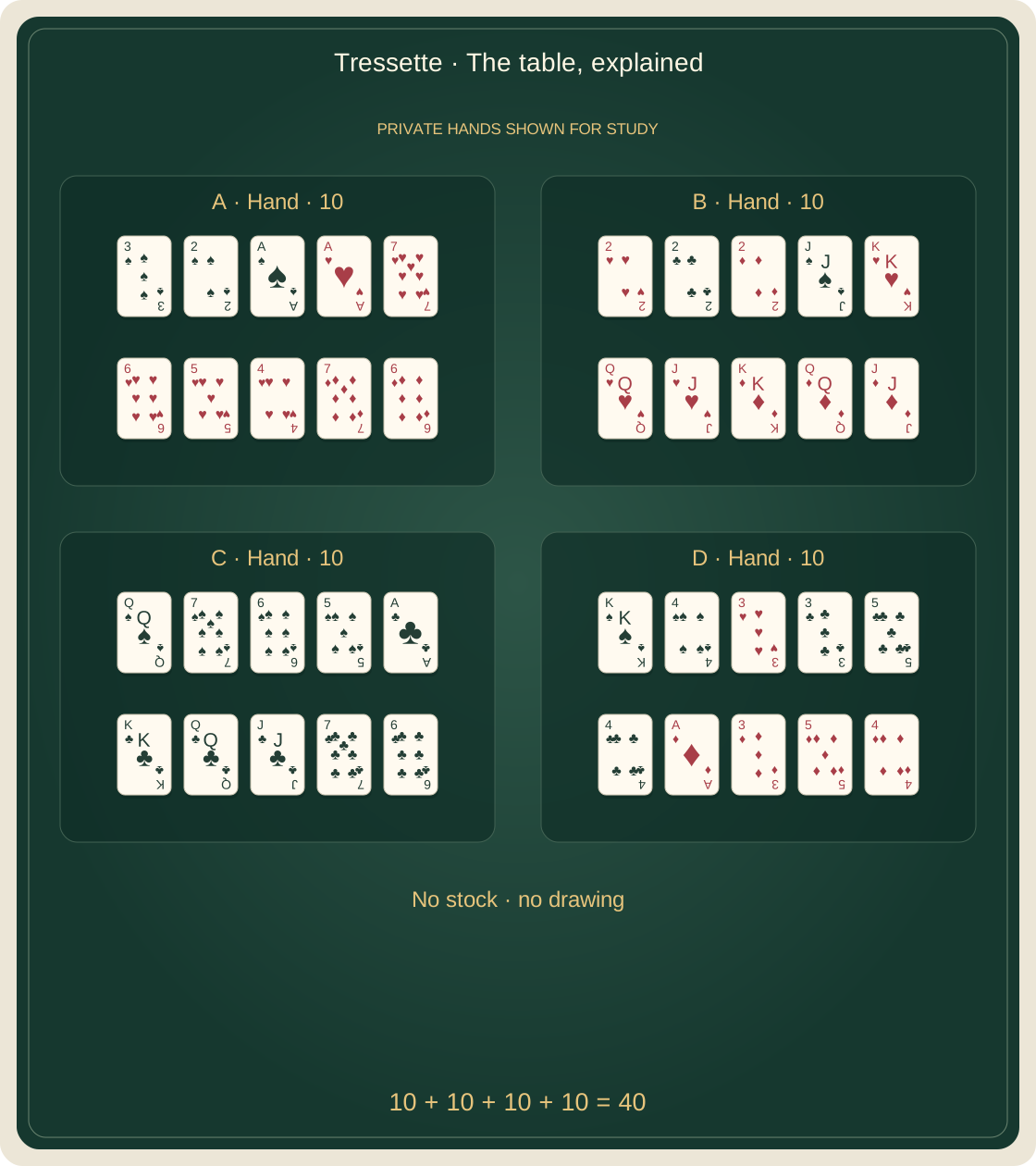
Partners sit opposite: A/C against B/D. Win valuable cards, combine captures by team and add valid declarations. There are 10 tricks per deal. Strength is not value: the 3 beats the ace, but the ace contributes more points. The ordinary deal distributes 11 whole card points between the teams, before declarations.
02 /
Prepare and deal
Take a 40-card pack without 8, 9, 10 or jokers. Use the French-suit order 3, 2, A, K, Q, J, 7, 6, 5, 4 from high to low. Deal counterclockwise in packets of 5 until each has 10. The dealer’s right-hand neighbour leads; the deal then rotates right. Players keep hands private.
03 /
How play proceeds
Lead freely; each follower must play the led suit if held, but need not overtake. Without that suit, any discard is legal. There are no trumps, so only the led suit can win. The winner leads next. At the end of the first trick, announce combinations from your original hand, including cards already played in that trick.
04 /
Rules that change your decision
A napoletana, 3–2–A in one suit, scores 3. Three aces, twos or threes score 3; four score 4. Name the suit for a napoletana and the missing suit for a set of three. Overlap is allowed: a napoletana plus four twos gives 3 + 4 = 7. Only the leader may signal: Busso asks the partner to play high and return the suit; Volo says this is the last card of that suit; Striscio indicates other low cards, K or below, in that suit. Other private information is forbidden.
05 /
Finish and scoring
Aces count 1; 3, 2, K, Q, J each count 1/3; others 0. Combine a team’s captured thirds, add 1 for the last trick, then round down once. Add declarations. A player may claim 21 using points already secured by the team: a correct claim wins immediately, an incorrect one loses. Special awards end the game: team all tricks, cappotto, wins 2 games; team all points but not all tricks, stramazzo, wins 3. A single player achieving these wins 6 for cappottone or 8 for stramazzone. For all-points tests the others’ card points must be below 1, ignoring the last-trick bonus; the single-player award takes precedence. These are game credits, not multiplied card scores.
06 /
A worked example
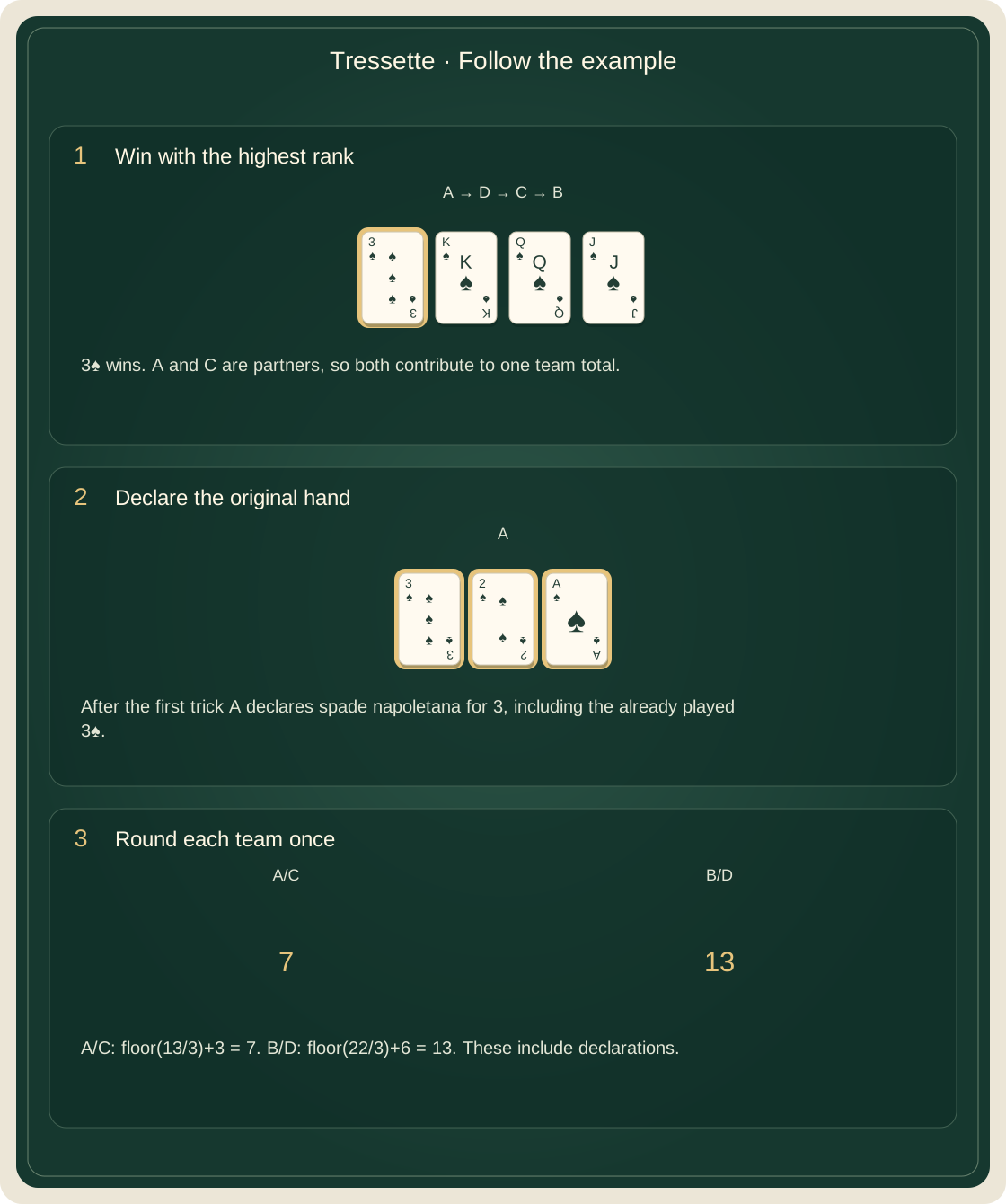
A leads 3♠; D plays K♠, C Q♠, B J♠. A wins. After this trick A declares the original spade napoletana for 3; B declares three twos for 3, D three threes for 3, both missing spades. The full replay gives A/C 10 thirds plus 3 last-trick thirds: floor(13/3) = 4. B/D have 22 thirds: floor(22/3) = 7. Adding declarations gives A/C 7 and B/D 13. Neither team has reached the target yet.
| Trick | Play order | Cards in that order | Winner | Thirds |
|---|---|---|---|---|
| 1 | A → D → C → B | 3♠ · K♠ · Q♠ · J♠ | A | 4 |
| 2 | A → D → C → B | 2♠ · 4♠ · 7♠ · 2♣ | A | 2 |
| 3 | A → D → C → B | A♥ · 3♥ · A♣ · 2♥ | D | 8 |
| 4 | D → C → B → A | 3♣ · K♣ · 2♦ · A♠ | D | 6 |
| 5 | D → C → B → A | 3♦ · Q♣ · K♦ · 7♦ | D | 3 |
| 6 | D → C → B → A | A♦ · J♣ · Q♦ · 6♦ | D | 5 |
| 7 | D → C → B → A | 5♣ · 7♣ · K♥ · 7♥ | C | 1 |
| 8 | C → B → A → D | 6♣ · Q♥ · 6♥ · 4♣ | C | 1 |
| 9 | C → B → A → D | 6♠ · J♦ · 5♥ · 5♦ | C | 1 |
| 10 | C → B → A → D | 5♠ · J♥ · 4♥ · 4♦ | C | 1 |
| A/C | B/D | |
|---|---|---|
| Base | 4 | 7 |
| Declarations | 3 | 6 |
| Total | 7 | 13 |
← On a small screen, scroll the diagram horizontally. →
07 /
What to watch at the table
Count the three highest ranks separately from the valuable aces. Feed points to a partner who is certain to win, rather than spending a control card unnecessarily. A Busso is a request, not permission to break the follow-suit rule. Before claiming the match, check captured thirds and declarations rather than estimating unplayed cards.
08 /
Choose the rules before starting
Some tables omit declarations or Striscio, reverse the relative positions of J and Q with local packs, or use another target. Agree these before play. Our profile keeps the rank order and declarations printed above. Special game-credit awards require a session score sheet; in a single-game session they simply decide the winner, with the award recorded.
09 /
History and related games
Tressette is rooted in Italian card-playing culture and has spread around the Adriatic, where names such as Treseta occur. A regional name does not guarantee identical announcements or signals. Its rank structure also survives in negative games such as Traversone. The practical lesson of this history is to ask which local profile is being played, rather than treating all family names as one universal rulebook.
10 /
Check your understanding
Can a played card be declared?
Show the answer
Yes, at the end of the first trick, because the declaration concerns the initial hand.
Do you round each trick?
Show the answer
No. Combine the team’s card thirds and last-trick bonus, then round down once before declarations.
Common questions
Are there trumps?+
No. Follow suit if possible; otherwise discard freely.
Which card is highest?+
The 3, then 2, then A, in each suit.
Is Treseta another game page?+
It is included here as a family name; local differences must still be agreed.