← On a small screen, scroll the diagram horizontally. →
01 /
The game at a glance
One banker deals; the other participants choose their wagers before any card appears. For study, counters need no cash value. A player can use more than one area, settling each independently. There is no personal hand, no decision to hit or stand and no trick-taking. Learn to separate a row’s name from the actual colours of its cards.
02 /
Prepare and deal
Mix 6 standard packs of 52: 312 cards without jokers. Mark separate Noir and Rouge rows, plus betting areas Noir, Rouge, Couleur and Inverse. Aces count 1, courts 10, other cards their number. In our home exercise reshuffle the complete shoe before each round, an explicit practice convention. Choose stake units divisible into halves. No bets may be added or changed after dealing begins.
03 /
How play proceeds
Deal face up to Noir first, adding cards until the total first exceeds 30, then stop that row immediately. Deal Rouge the same way. Each total must be between 31 and 40: before the last card it was at most 30, and a card adds at most 10. Compare the finished totals; the smaller one wins. The row names never depend on the number of black or red cards inside them.
04 /
Rules that change your decision
Noir and Rouge wagers predict the winning row. Couleur wins when the actual colour of the very first card in Noir matches the winning row’s name: a black first card needs Noir; a red first card needs Rouge. Inverse wins on the opposite relationship. Use only that first card, not the final card, the majority colour or the first card in Rouge. On unequal totals exactly one row wager and one relationship wager win.
05 /
Finish and scoring
Every winning area pays 1:1 profit plus returns its stake; losing areas lose their stake. Equal totals from 32 to 40 return all stakes unchanged. A 31–31 tie, trente et un après, loses half of every uninsured stake under our chosen immediate settlement. For a stake of 10, a win returns 20 gross, ordinary tie 10, this special tie 5, ordinary loss 0. Collect all cards after settlement and begin the next round with new wagers.
06 /
A worked example
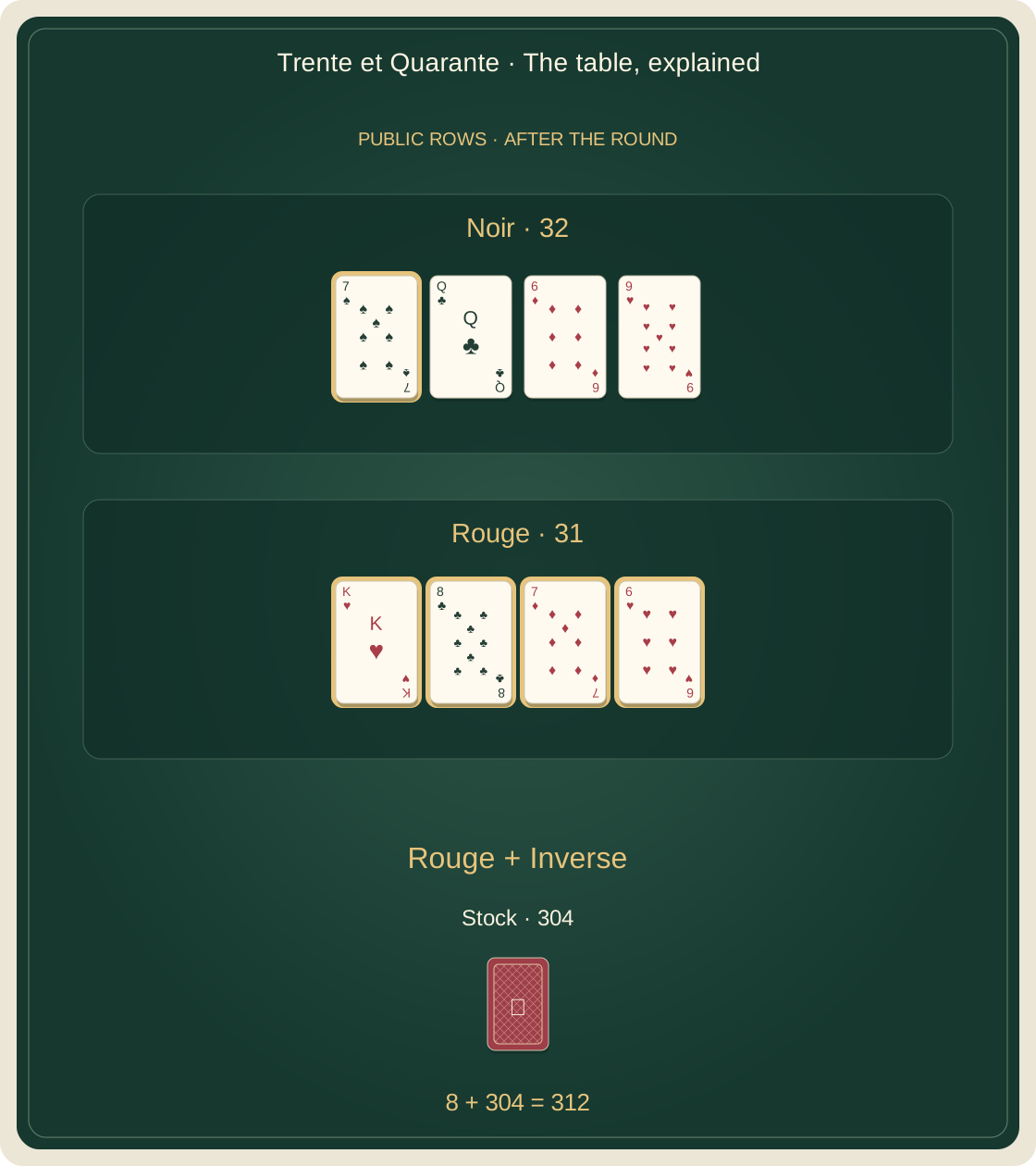
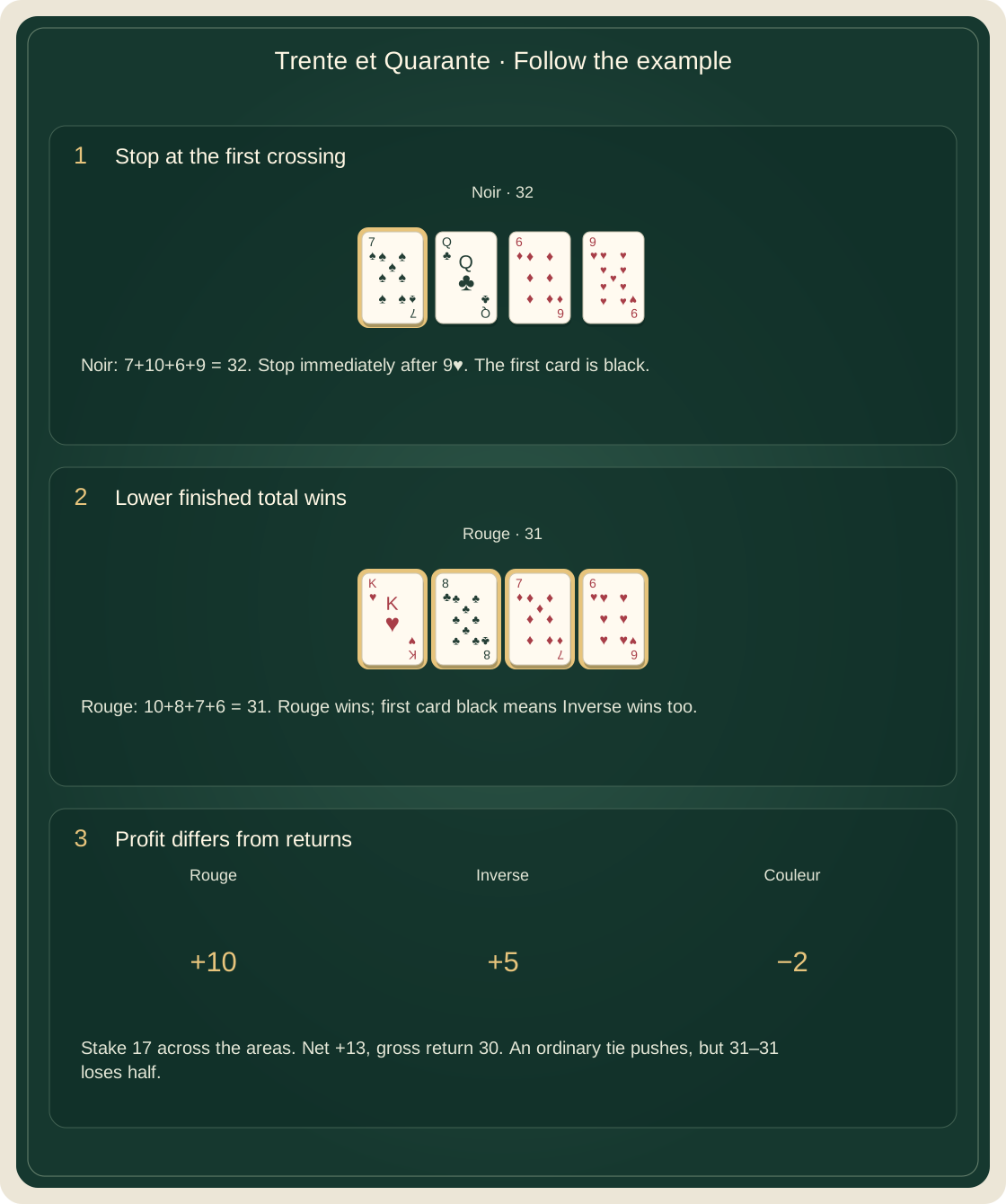
Noir receives 7♠, Q♣, 6♦, 9♥: 7 + 10 + 6 + 9 = 32. Rouge receives K♥, 8♣, 7♦, 6♥: 10 + 8 + 7 + 6 = 31. Rouge wins despite containing black cards. First card 7♠ is black, so Inverse also wins. Put 10 on Rouge, 5 on Inverse, 2 on Couleur: profits are +10, +5, −2, net +13. The 17 staked returns 30 gross. The drawing shows the finished rows, with 304 cards left, not a possible private deal.
| Bet | Stake | Profit / loss |
|---|---|---|
| rouge | 10 | 10 |
| inverse | 5 | 5 |
| couleur | 2 | -2 |
← On a small screen, scroll the diagram horizontally. →
07 /
What to watch at the table
Keep a running sum aloud and stop exactly at the first crossing. Record the first card’s colour separately before comparing the row totals. Distinguish gross returns from profit: returned stakes are not additional winnings. Earlier colours or previous round results do not change the settlement rule; no pattern of wagers guarantees a favourable next row.
08 /
Choose the rules before starting
An alternative to half-loss is prison: the wager stays blocked until a later non-tied round, then is returned without profit if it wins or lost if it loses. Insurance is another operator option, with its own fee and eligibility; it is not included here. Do not import casino-specific thresholds into this counter exercise. A continuing shoe rather than our round-by-round reshuffle is also a distinct dealing convention.
09 /
History and related games
The French name means thirty and forty, describing the narrow range of finished totals. The game belongs to the European casino tradition and remains documented in Monte-Carlo’s operator rules. It is also associated with the name Rouge et Noir. Rather than assert a precise inventor, this account distinguishes the enduring two-row mechanism from local table procedures and optional insurance.
10 /
Check your understanding
Can the dealer stop at 30?
Show the answer
No. Draw until the first total above 30, then stop immediately.
Noir 32, Rouge 31, first card black: which relationship wins?
Show the answer
Inverse, because Rouge wins and its red label differs from the black first card.
Common questions
Do players receive cards?+
No. Both rows are public and shared by all wagers.
Does a tie always return everything?+
No: 31–31 loses half under our selected profile. Other tied totals push.
Is a proprietary pack needed?+
No. Combine 6 ordinary packs without jokers.