← On a small screen, scroll the diagram horizontally. →
01 /
The game at a glance
The aim is to finish with the fewest penalties. A trick is one card from each player; its winner takes all of them and leads next. Card strength decides the winner, while card value decides the penalty: these are different things. A low-value card can still be dangerous if it wins the last trick.
02 /
Prepare and deal
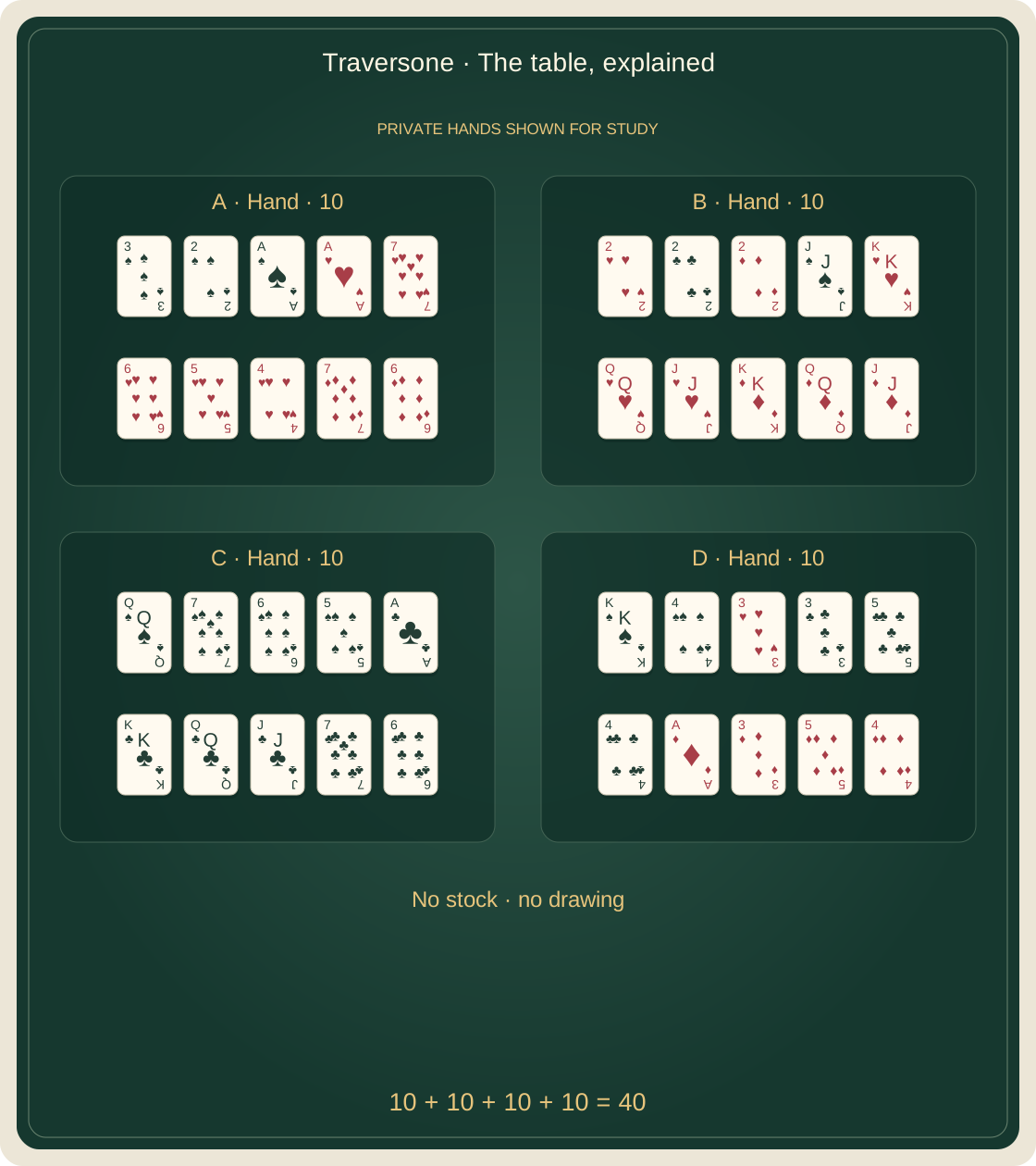
Use 40 cards: remove 8, 9 and 10 from an ordinary pack, with no jokers. Shuffle and deal 10 each, counterclockwise; the next dealer is to the right. The player to the dealer’s right leads. In every suit the descending order is 3, 2, A, K, Q, J, 7, 6, 5, 4. Keep captured cards separately for each individual.
03 /
How play proceeds
Lead any card. Everyone else must follow its suit if able; with none of that suit, discard any card. You do not have to beat the current highest card. Only the highest card of the led suit wins: an off-suit 3 cannot take the trick. Play continues counterclockwise until all hands are empty; there is no drawing from a stock.
04 /
Rules that change your decision
An ace is worth 1 point. Each 3, 2, K, Q or J is worth 1/3; 7, 6, 5 and 4 are worth 0. Count in thirds to avoid rounding every trick. Do not import partnership declarations, bonuses or signals from Tressette. Here an ace may be weak in rank yet expensive to capture.
05 /
Finish and scoring
After 10 tricks, everyone except the last-trick winner rounds their own card points down. The last winner receives the remainder needed to make 11 penalties in all. This is not simply rounding their own cards and adding 1. If someone would receive all 11 while everyone else has less than 1 captured card point, apply cappotto: that player gets 0 and each other player gets 11, even without taking every trick. Add penalties to the running totals. At 31 or more, lowest wins; tied lowest totals share the win in this profile.
06 /
A worked example
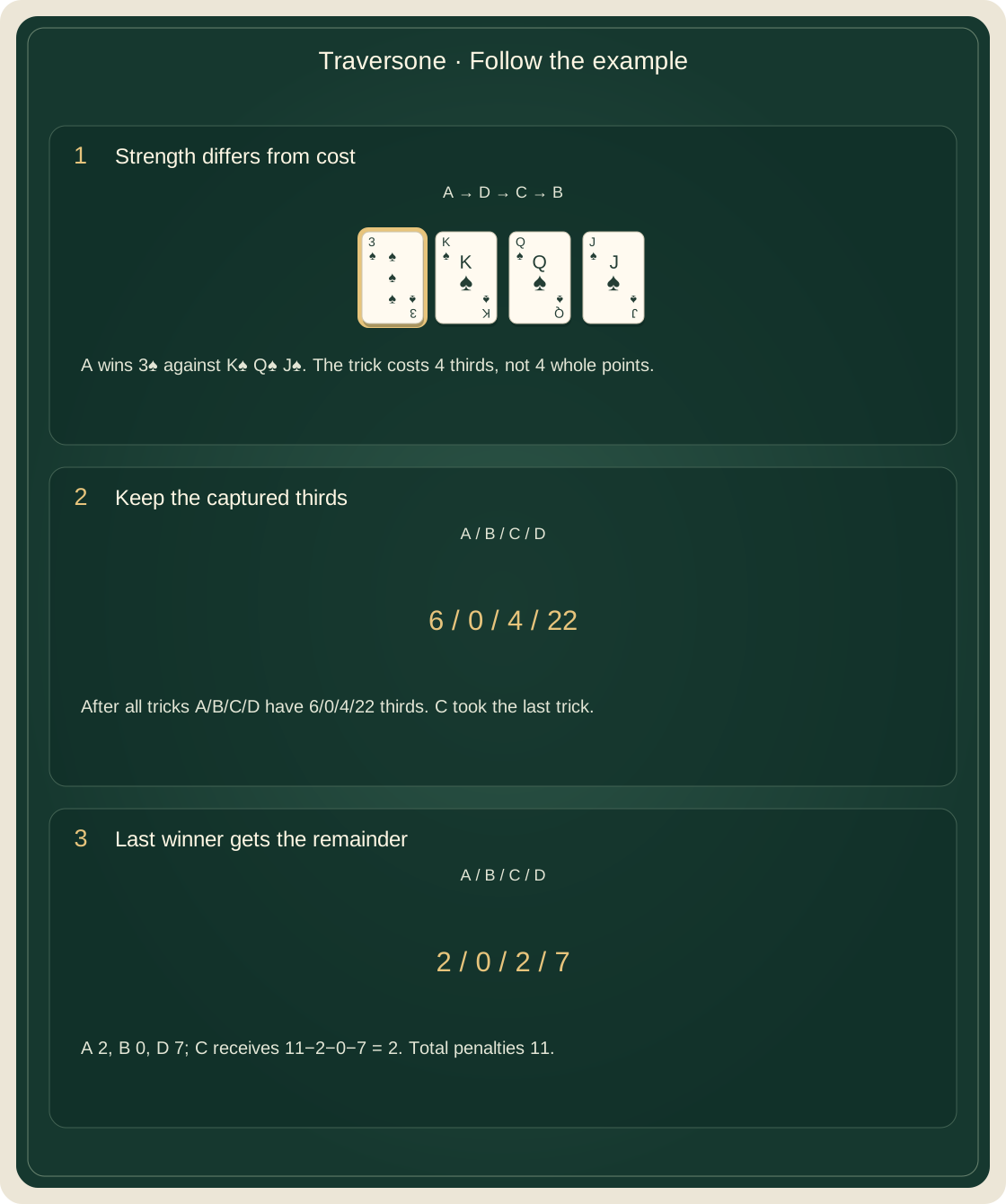
Our full deal starts A → D → C → B with 3♠, K♠, Q♠, J♠. A wins and captures 4 thirds. After all tricks A/B/C/D have 6/0/4/22 thirds; C won last. A gets 2, B gets 0, D gets 7. C therefore gets 11 − 2 − 0 − 7 = 2. The card values alone would give C only 1 after rounding. The table below lets you replay every legal follow and discard.
| Trick | Play order | Cards in that order | Winner | Thirds |
|---|---|---|---|---|
| 1 | A → D → C → B | 3♠ · K♠ · Q♠ · J♠ | A | 4 |
| 2 | A → D → C → B | 2♠ · 4♠ · 7♠ · 2♣ | A | 2 |
| 3 | A → D → C → B | A♥ · 3♥ · A♣ · 2♥ | D | 8 |
| 4 | D → C → B → A | 3♣ · K♣ · 2♦ · A♠ | D | 6 |
| 5 | D → C → B → A | 3♦ · Q♣ · K♦ · 7♦ | D | 3 |
| 6 | D → C → B → A | A♦ · J♣ · Q♦ · 6♦ | D | 5 |
| 7 | D → C → B → A | 5♣ · 7♣ · K♥ · 7♥ | C | 1 |
| 8 | C → B → A → D | 6♣ · Q♥ · 6♥ · 4♣ | C | 1 |
| 9 | C → B → A → D | 6♠ · J♦ · 5♥ · 5♦ | C | 1 |
| 10 | C → B → A → D | 5♠ · J♥ · 4♥ · 4♦ | C | 1 |
| A | B | C | D | |
|---|---|---|---|---|
| Captured thirds | 6 | 0 | 4 | 22 |
| Final penalties | 2 | 0 | 2 | 7 |
← On a small screen, scroll the diagram horizontally. →
07 /
What to watch at the table
Track which higher cards of each suit are gone before trusting a small card. When void, expensive discards can reduce your future exposure, but only if another player certainly wins. Near the end, compare your remaining suits with the likely final leader. Do not chase a cappotto merely because you have already taken several costly tricks: the other players’ fractional totals matter.
08 /
Choose the rules before starting
The elimination form removes players at 31 and requires agreement on how many survivors win. Do not mix it with our fixed-player ending. Games with the club ace worth 11, extra stocks, or a reversed win condition need separate score sheets. Agree the direction, target, ties and cappotto treatment before the first shuffle; none changes halfway through a deal.
09 /
History and related games
Traversone belongs to Italy’s family of negative Tressette games. In Lombardy it is also called Ciapanò, a name associated with the idea of not catching. Regional names and endings differ, so the title alone does not identify a scoring system. Its relationship with Tressette is clearest in the unusual rank order and fractional card values; removing partnerships changes the decisions completely. No single inventor or exact origin date is established here.
10 /
Check your understanding
Can an off-suit ace win?
Show the answer
No. There are no trumps; only the led suit can win. Discarding that ace transfers its value to the actual winner.
Must cappotto include every trick?
Show the answer
No. The deciding test is all 11 penalties after the normal allocation; another player may have captured less than 1 card point.
Common questions
Is Traversone a partnership game?+
Not in this profile: each player has an independent penalty total.
Is a special pack needed?+
No: use an ordinary pack after removing 8, 9, 10 and jokers.
Who wins the match?+
At the first total of 31 or more, the lowest cumulative penalty wins.