← On a small screen, scroll the diagram horizontally. →
01 /
The game at a glance
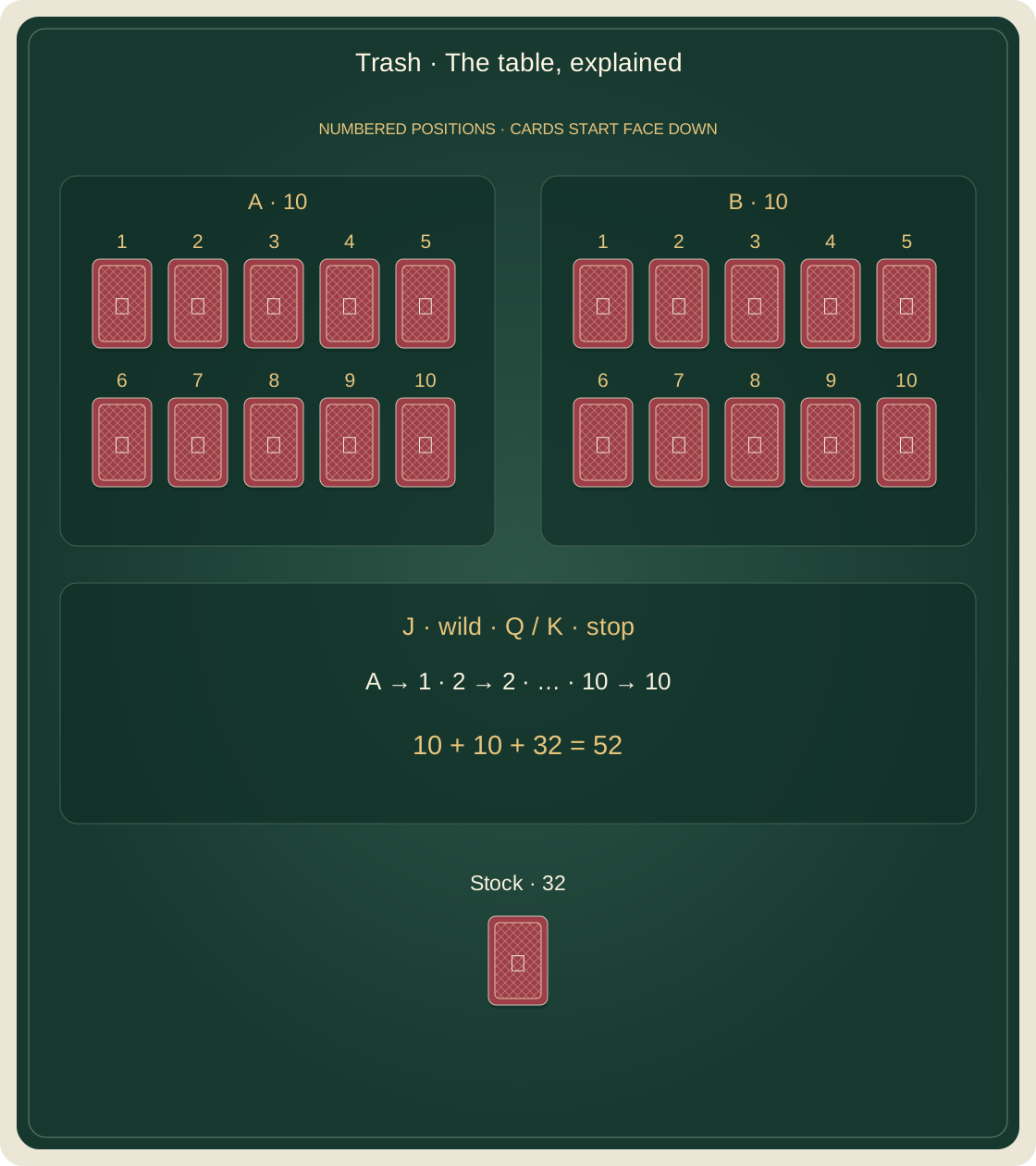
Ace fills position 1; numerals 2–10 fill matching positions regardless of suit. Jack may fill any still-covered position. Queen or king ends the chain. A number whose position already holds its natural number is also unusable. Cards are not played on opponents’ grids and there is no stealing.
02 /
Prepare and deal
Shuffle, cut and deal 10 face down to each person, two rows of five. Label top row 1–5 and bottom 6–10 from left to right. Nobody looks underneath. Remaining 32 form stock; discard starts empty. Choose the first starter randomly as our table agreement; later the last hand’s winner starts. Play clockwise.
03 /
How play proceeds
First turn draws stock top. Later choose stock top or discard top. If usable, place it face up at its position and lift the displaced covered card. Try that card next, repeating without another stock draw. When unusable, put that card on discard top and pass the turn. You cannot replace a naturally filled position with another card of the same number.
04 /
Rules that change your decision
A natural number may replace a jack occupying that number’s position. Lift the jack and move it to a covered position; reveal that displaced card and continue. A jack does not move a correctly placed natural card out. With no covered position remaining the grid is complete, so the hand has ended; do not keep moving the jack in a loop.
05 /
Finish and scoring
Stop as soon as someone fills every position. Gather and shuffle all cards. Winner alone receives one fewer next deal; others keep their current size. At size 9, tens are unusable; at size 8, nines and tens are unusable. Continue down to one position, where completing it with an ace or jack wins the match. If stock empties mid-hand, retain discard top and shuffle covered discards into new stock.
06 /
A worked example
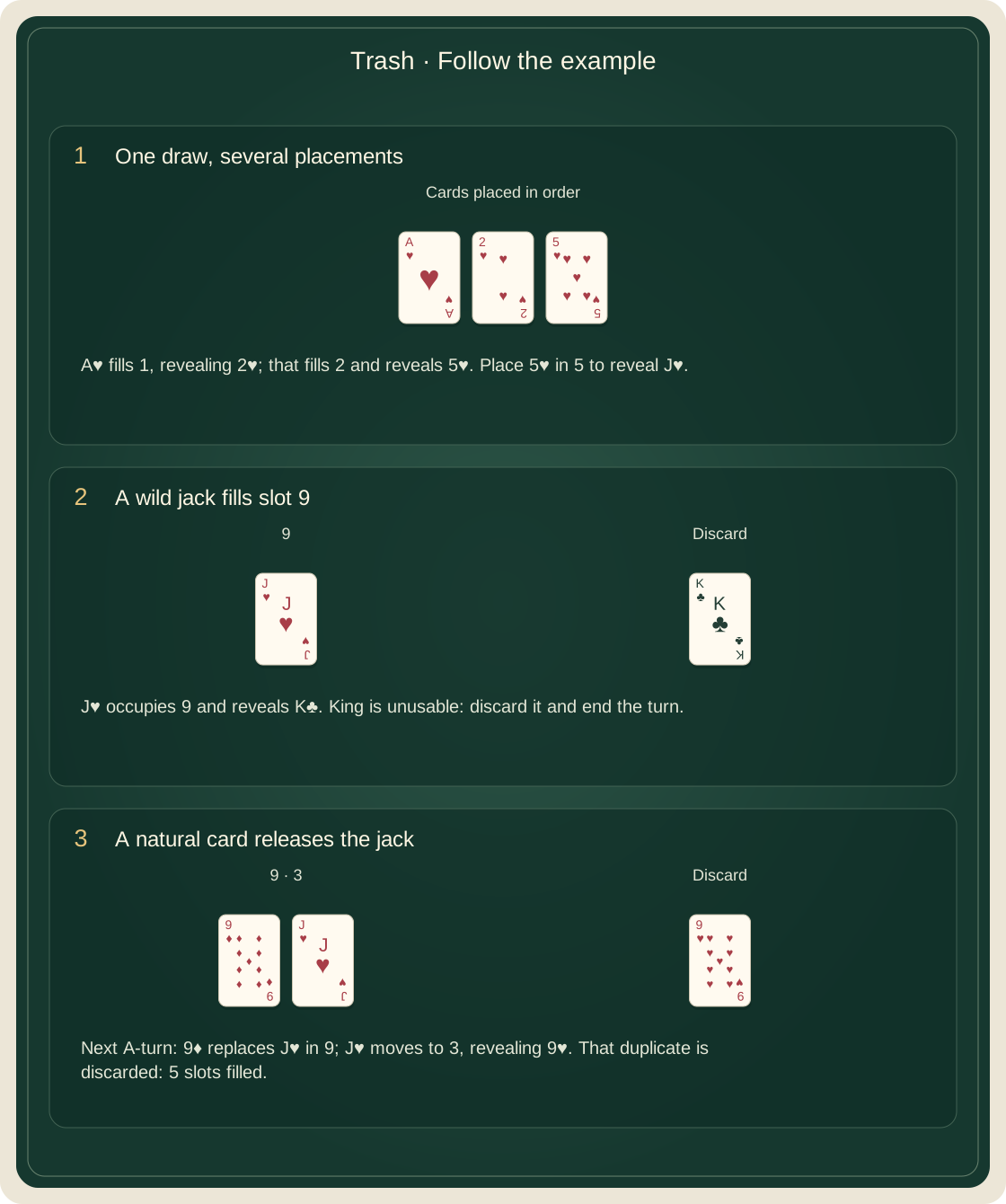
A draws A♥: slot 1 reveals 2♥; slot 2 reveals 5♥; slot 5 reveals J♥. A puts J♥ in slot 9, revealing K♣, which ends the turn. After B’s turn A draws 9♦, replaces the slot-9 jack and moves it to covered slot 3. That reveals 9♥, but slot 9 already holds natural 9♦, so discard 9♥. A has filled 5 positions, not won the hand.
| Player | Draw | Positions filled | Discard |
|---|---|---|---|
| A | A♥ | A♥ → 1; 2♥ → 2; 5♥ → 5; J♥ → 9 | K♣ |
| B | 3♦ | 3♦ → 3 | Q♠ |
| A | 9♦ | 9♦ → 9; J♥ → 3 | 9♥ |
← On a small screen, scroll the diagram horizontally. →
07 /
What to watch at the table
The main decision is where to put a jack. Keep track of its position so a later natural card can release it. Choose a useful top discard instead of an uncertain stock draw when it fits. Do not turn up extra cards or rearrange covered positions. Much of the result is luck; there is no guaranteed winning arrangement.
08 /
Choose the rules before starting
For 3–4 people use two packs; for 5–6 use three, with the same grid mechanism. Our catalog lesson is the one-pack two-player game. Some families make kings wild, add jokers or give losers final chances; none applies here. Agree a shorter target or time limit before starting if a full descent is too long.
09 /
History and related games
Trash is documented as an American children’s layout game, also called Garbage or Ten. Those names can refer to other games, so check the mechanism. Contributor accounts and ordinary-pack publisher rules agree on the core chain and shrinking layout. They do not establish a verified inventor or precise creation date.
10 /
Check your understanding
Can 9 replace a jack in slot 9?
Show the answer
Yes. Move the released jack to a covered slot and continue.
Is 10 useful with only 9 slots?
Show the answer
No. It has no position and ends the chain.
Common questions
Which card is wild?+
Jack in this profile.
Can you look at covered cards?+
No. Reveal only the card displaced by a legal placement.
Who starts the next hand?+
The previous hand’s winner.