← On a small screen, scroll the diagram horizontally. →
01 /
The game at a glance
Each suit ranks 10, 9, 8, 7, A, K, Q, J, highest first. There are no card points and no trumps. Follow suit if able; otherwise play anything, but an off-suit card cannot win. Winning a trick gives the next lead, not a match point. The final trick determines who avoids the hand’s penalty.
02 /
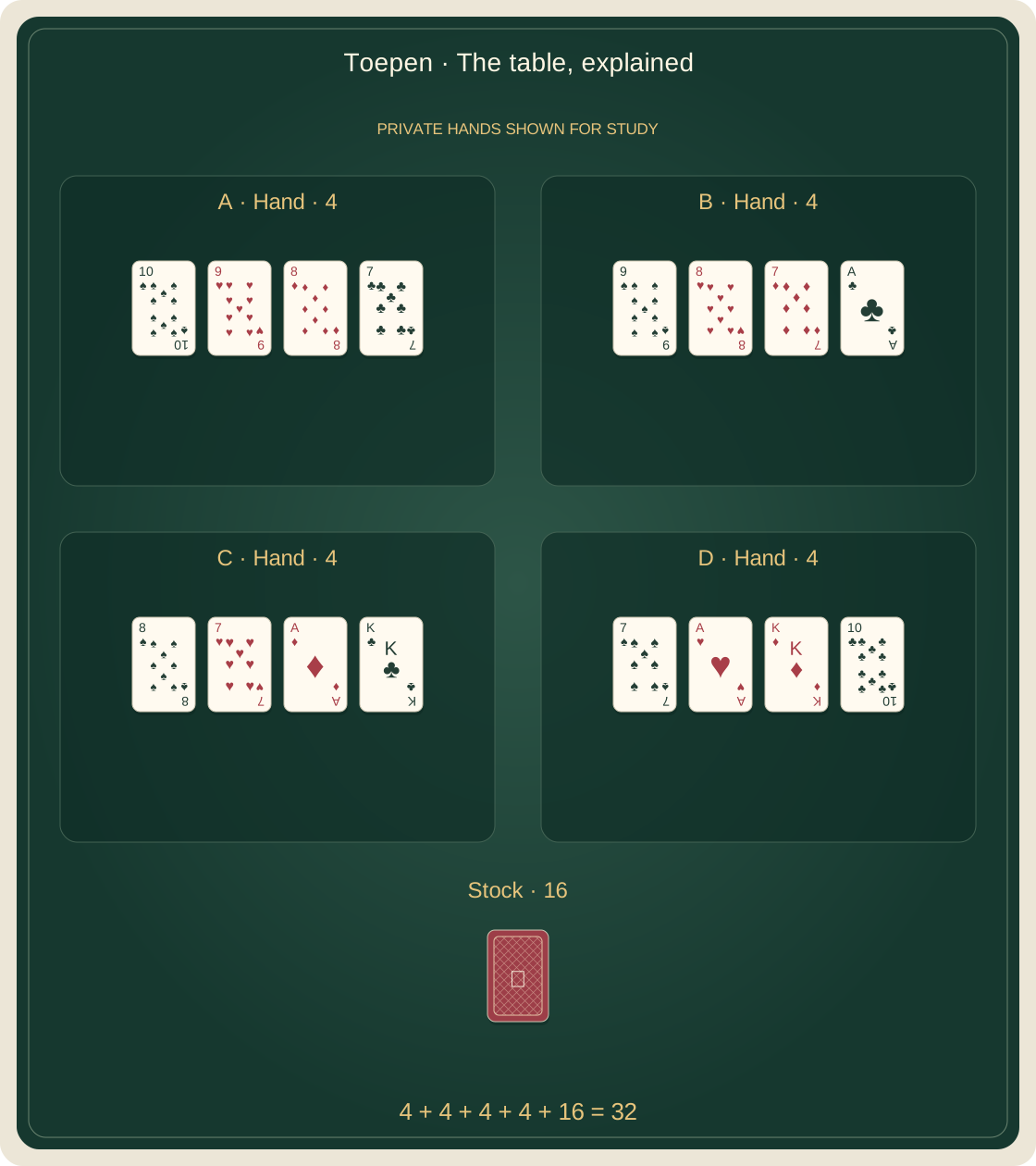
Prepare and deal
Use 32 cards, 7 through A, no jokers. Choose dealer, shuffle and cut; deal 4 each clockwise, leave the rest closed. Dealer’s left leads. The last-trick winner deals next, not an automatic dealer rotation. In the diagram 16 cards are in hands and 16 undealt.
03 /
How play proceeds
Before play, a player may replace their whole hand with 4 undealt cards if enough remain; discard the old hand closed. Any opponent may challenge it. If it contains 10, 9, 8 or 7, replacer loses 1 life but keeps the new hand. If it contains only A/K/Q/J, challenger loses 1. Discarded hands never return to stock.
04 /
Rules that change your decision
Stake begins at 1 life. Once everyone has seen their cards, an active player may knock at any time, even mid-trick. Pause: clockwise from knocker’s left, opponents stay or fold. Folding loses the old stake immediately; staying accepts a stake higher by 1. Knocker cannot fold on their own knock or knock again until someone else has knocked.
05 /
Finish and scoring
Those still in who do not win the fourth trick lose the final stake. Winner loses nothing and deals next; a sole survivor also wins. Folded cards already played retain their rank: if that card wins an earlier trick, next active to its owner’s left leads. If it wins the last, all remaining players lose the final stake while the folder already paid the earlier fold cost.
06 /
A worked example
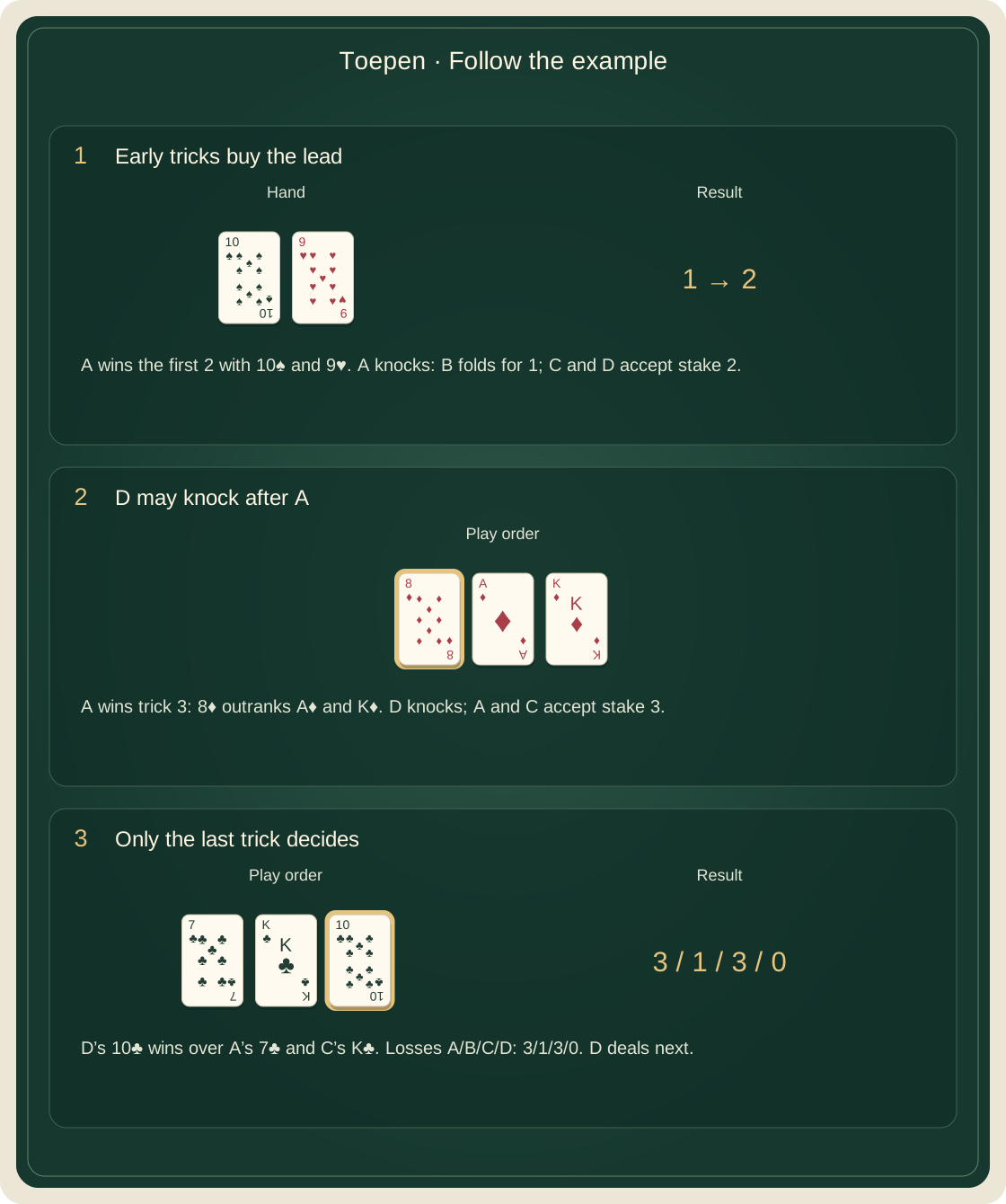
A wins the first 2 tricks with 10♠ and 9♥, then knocks. B folds for 1; C and D stay at 2. A wins trick 3 with 8♦. D now knocks; A and C stay at 3. Final cards A 7♣, C K♣, D 10♣ make D winner. Losses A/B/C/D: 3/1/3/0. B’s unplayed cards are kept apart, never used to follow suit.
| Trick | Play order | Winner |
|---|---|---|
| 1 | A: 10♠ → B: 9♠ → C: 8♠ → D: 7♠ | A |
| 2 | A: 9♥ → B: 8♥ → C: 7♥ → D: A♥ | A |
| 3 | A: 8♦ → C: A♦ → D: K♦ | A |
| 4 | A: 7♣ → C: K♣ → D: 10♣ | D |
← On a small screen, scroll the diagram horizontally. →
07 /
What to watch at the table
Record cumulative lives lost, starting at zero; first to 10 or more loses the match. A player may knock only if the proposed new stake does not exceed remaining lives: with 9 lost, no first knock; with 8 lost, no second. This profile stops at the first loser instead of eliminating players to find a sole winner.
08 /
Choose the rules before starting
Traditional signals: with three tens you must whistle, with four tens stand; if unable to whistle sing. Three jacks allow whistling, four allow standing. Do not give false signals or accidental knocks. Other versions remove these rituals, use immediate simultaneous folds or remove folded cards from trick comparison; agree the profile first. No drinks or money are needed.
09 /
History and related games
Toepen is a Dutch last-trick game with close relatives in northwestern Germany called Tuppen, Schröömen or Eifelpoker. It appears in both social and tournament descriptions. These accounts document a family of local rules, not a verified inventor or a single origin date.
10 /
Check your understanding
Does winning the first three tricks win the hand?
Show the answer
No. The fourth decides unless all others fold.
Can the last knocker knock again immediately?
Show the answer
No. Someone else must knock first.
Common questions
Which card is highest?+
Ten in each suit.
Are there trumps?+
No. Only the led suit can win.
Who deals next?+
The last-trick winner or sole survivor.