← On a small screen, scroll the diagram horizontally. →
01 /
The game at a glance
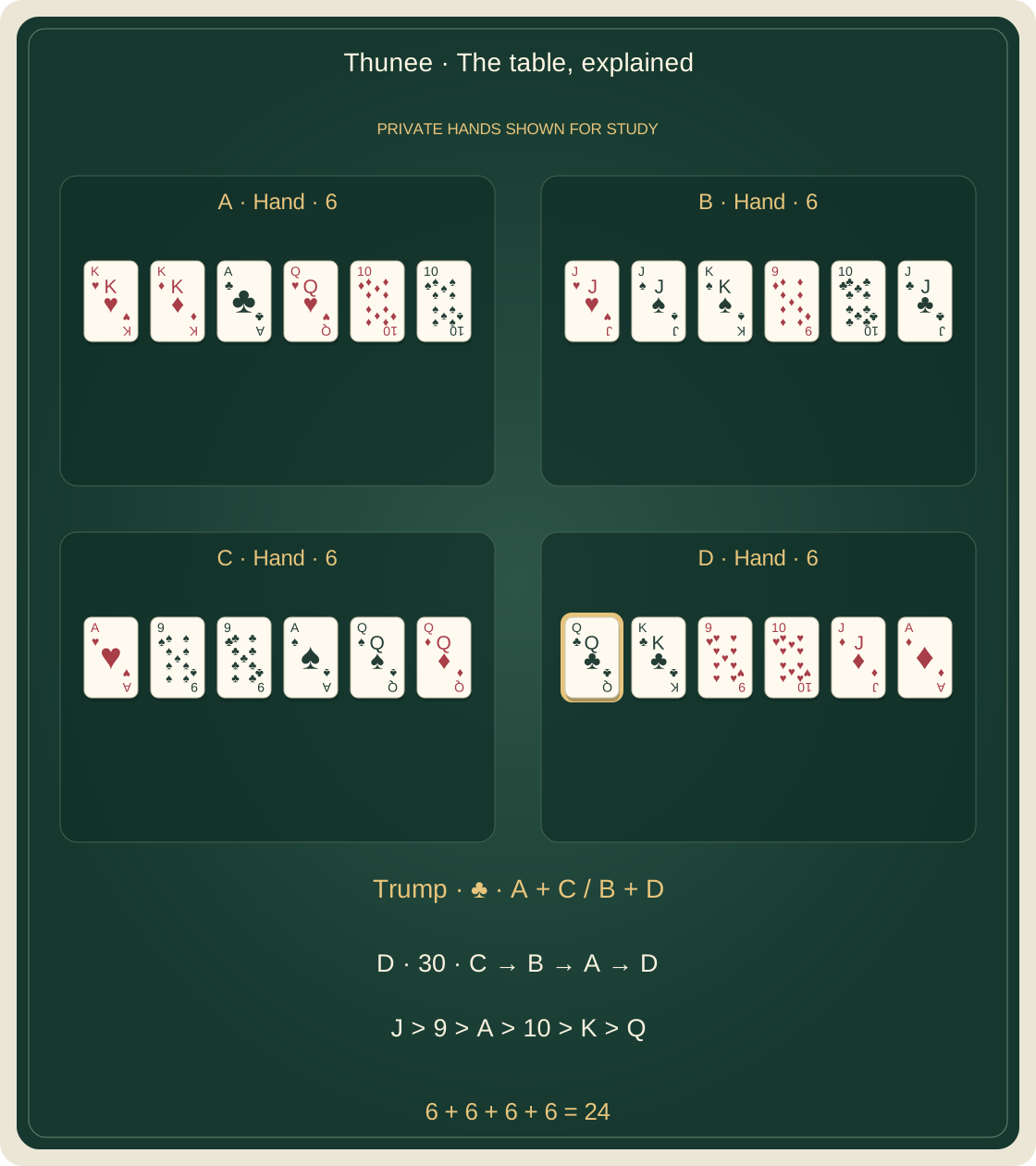
Keep J, 9, A, 10, K and Q in each suit; no jokers. Rank and value are identical in plain suits and trumps: J > 9 > A > 10 > K > Q. Values appear below. Each suit totals 76. The trump-making partnership chooses trumps; its opponents are the counting team. In ordinary play the counting team wins with at least 105 after all transfers; at 104 or below the makers win. Record balls separately on paper. Traditionally the four sixes are score markers outside the active deck, not extra playable cards.
| Rank, high to low | Card points |
|---|---|
| J | 30 |
| 9 | 20 |
| A | 11 |
| 10 | 10 |
| K | 3 |
| Q | 2 |
02 /
Prepare and deal
Choose a dealer. Shuffle; the player to dealer’s left may cut or decline. Deal packets of 4, starting at dealer’s right and continuing counterclockwise. That player places a card of the desired trump suit face down, or asks for “last card”: their last card of the final packet will determine trumps. A first hand of four different suits, only kings/queens, totalling at most 10 permits that player to demand a redeal. The dealer’s side may now call 10. Either opponent of the latest caller may raise by 10 through 100; the final raise is 104. Calls are not in turn and partners cannot raise one another. Highest caller replaces the original indicator with a card from their own first 4 and cannot choose “last card”. Their team transfers the call value to the counting team. Then deal 2 more each, making 6.
If both opponents simultaneously call 20 over 10, it counts as 30; the other team chooses which caller must make trumps. Settle simultaneous-call handling at the 104 ceiling before play.
03 /
How play proceeds
Before the opening lead, any player may call Thunee: personally win every trick, choosing trumps by their own first lead. Holding all 6 trumps is not eligible; at least one card must be outside trumps. Ask the leader to wait while considering it. With competing calls the original makers’ team has priority; partners must resolve theirs by voluntary withdrawal without discussion. Otherwise the player to the trump maker’s right leads, then reveal the indicator and return it to its owner’s hand. Follow the led suit if possible. When void, you may discard or trump: trumping is not compulsory. Highest trump wins, otherwise highest of the led suit. Winner leads next. On a plain-suit lead already trumped, a later void player may not undertrump while holding any non-trump; discard or overtrump instead. With only trumps left, undertrumping is allowed. A trump lead requires following suit but not heading the trick.
A late Thunee call after a lead faces “marials” in that suit. It is allowed only with no potentially losing card in that suit: no cards or an unbroken top sequence. J-9-10 is unsafe when the ace is missing. If accepted, retract the original lead and caller leads; if withdrawn, original lead stands. A leader may first ask opponents whether they want Thunee; after their refusal the leader may lead and call without a later challenge call.
04 /
Rules that change your decision
A Jodie is K-Q or K-Q-J still held together in one suit at the moment of announcement. Announce only immediately after your team’s first or third won trick, not the first or third trick of the deal. Either partner may announce one or two holdings. Say its value; a 20 may name the suit, a 30 must not. At settlement transfer its value from opponents to callers. Double is called just before your own last-trick card: your team must take all 6 and you personally take the last. Khanaak has the same timing, requires a Jodie by your team, at least one trick won by opponents, your personal last-trick win, and opponents’ adjusted total strictly below zero. For Khanaak include Jodies and the last-trick transfer but exclude the numeric trump call. The tables below give values and ball awards.
| Holding | Trump | Plain suit |
|---|---|---|
| K-Q | 40 | 20 |
| K-Q-J | 50 | 30 |
During Thunee, stop as soon as a card led by the caller is beaten; do not finish that trick before deciding the catch. A beating card from an opponent means ordinary failure; one from the partner means partner catch. For Double or Khanaak, a beating card on the caller’s final card also ends the claim, but either kind of catch has the same failure award.
05 /
Finish and scoring
For an ordinary hand, add the counting team’s card points, the trump call and its own Jodies, subtract opponents’ Jodies, then add 10 if it won the last trick or subtract 10 if it lost. At least 105 wins. Without a numeric call either winner gains 1 ball. With a numeric call makers gain 1 for winning, counters gain 2. For special calls use only the special award, not an ordinary award as well. A Thunee partner catch means the partner wins a trick and costs 8 balls to the opponents. Reach at least 12 balls to win. At exactly 11 balls (corner), Double is forbidden; an inadvertent call gives opponents 4. Thunee and Khanaak remain possible. If both opponents of makers have no trumps, cancel and redeal without score, even after Thunee. Dealer continues while their team trails; when tied or ahead, deal passes right.
| Call | Success: callers | Failure: opponents | Partner catch: opponents |
|---|---|---|---|
| Thunee | 4 | 4 | 8 |
| Double | 2 | 4 | 4 |
| Backward Double | 4 | 4 | 4 |
| Khanaak | 3 | 4 | 4 |
| Backward Khanaak | 6 | 4 | 4 |
06 /
A worked example
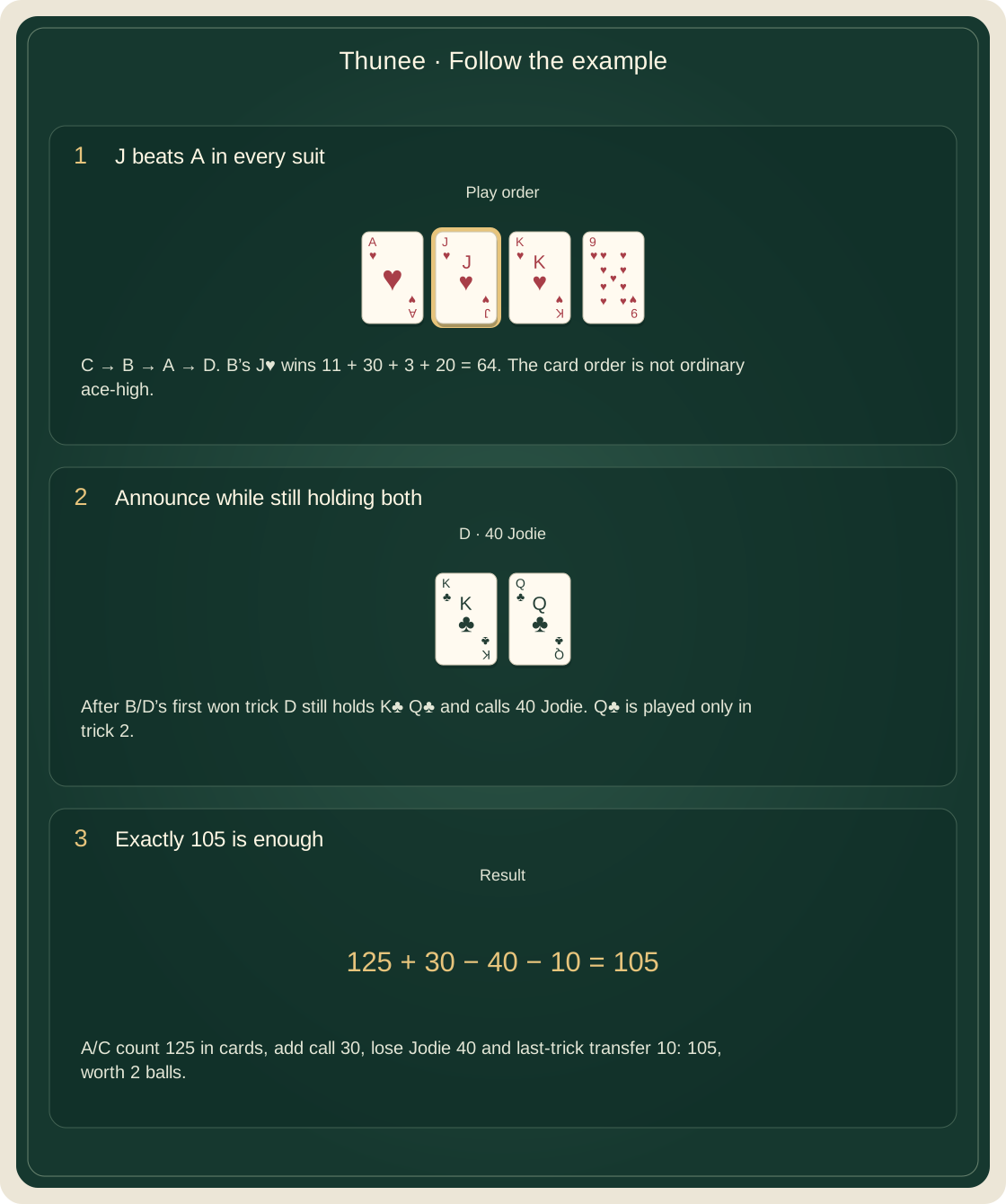
B deals. Calls B 10 → A 20 → D 30 make D the maker, using Q♣ as indicator. C leads A♥; B J♥, A K♥, D 9♥ complete the trick. B wins 64. D still holds K♣-Q♣ and immediately calls 40 Jodie after the partnership’s first win. Across all 6 tricks A/C take 125 card points, B/D take 179. B/D win the last. Counting team A/C calculates 125 + 30 − 40 − 10 = 105 and wins 2 balls. One fewer card point would leave 104 and give makers 1 instead. Jodie does not add another physical card; the indicator was always in D’s hand.
| Trick | Play order | Winner | Card points |
|---|---|---|---|
| 1 | C: A♥ → B: J♥ → A: K♥ → D: 9♥ | B | 64 |
| 2 | B: J♠ → A: 10♠ → D: Q♣ → C: 9♠ | D | 62 |
| 3 | D: K♣ → C: 9♣ → B: 10♣ → A: A♣ | C | 44 |
| 4 | C: A♠ → B: K♠ → A: K♦ → D: 10♥ | C | 27 |
| 5 | C: Q♠ → B: 9♦ → A: Q♥ → D: J♦ | C | 54 |
| 6 | C: Q♦ → B: J♣ → A: 10♦ → D: A♦ | B | 53 |
← On a small screen, scroll the diagram horizontally. →
07 /
What to watch at the table
Track jacks and nines in every suit, not only trumps. Keep a separate ledger of calls and transfers before adding captured cards. A big call buys trump control at the price of the opponents’ target. Do not spend a Jodie card before its legal announcement window. For Khanaak, with your 50 Jodie and opponents’ 20, and your last-trick win, opponents need fewer than 40 card points: exactly 40 makes zero, which fails. Do not add a trump call to that Khanaak test. Partner cooperation in Thunee means avoiding every unwanted trick, not merely winning as a team.
08 /
Choose the rules before starting
This profile uses the special-award table below, no blind calls or extra variations. “Backward” Double or Khanaak means the counting side calls against makers who made a numeric call. Wrong suit-following, out-of-turn play, false Jodie or illegal partner communication normally gives opponents 4 balls, with no other hand score. Wrong-time Jodie is invalid for that deal. Record balls before the next cut or forfeit them; no prohibited partner reminder. Other tables change partner-catch penalties, Khanaak conditions, target or require a two-ball margin. Do not mix Nigerian 32-card Thuni or the 2- and 6-player versions into these rules.
09 /
History and related games
Thunee is strongly associated with the Indian South African community, especially Durban. Its all-suit J-9-A-10-K-Q order and 304-point pack connect it to the Indian branch of the Jass family and Sri Lankan 304. Accounts propose transmission through Indian indentured migration in the nineteenth century, following earlier Dutch influence in India; that route is a historical explanation, not a verified invention date. Klawerjas reached South Africa by a separate Dutch route. The Nigerian game shares the name and top ranks but counts tricks differently.
10 /
Check your understanding
Must you trump when void?
Show the answer
No. You may discard. The undertrumping restriction still applies after a plain lead is trumped.
Does a partner’s trick save a Thunee call?
Show the answer
No. Caller must win every trick personally; partner catch awards opponents 8 balls here.
Common questions
Which cards are active?+
J, 9, A, 10, K, Q of each suit: 24 cards. Sixes may mark the score but never enter tricks.
Is the last trick a bonus added to the pack?+
No. It transfers 10 between teams; total remains 304.
What ordinary score wins for the counting team?+
At least 105 after the call, Jodies and last-trick transfer.