← On a small screen, scroll the diagram horizontally. →
01 /
The game at a glance
Partners sit opposite and share a score. Use 52 cards without jokers, each suit descending A, K, Q, J, 10, 9, 8, 7, 6, 5, 4, 3, 2. Cards have no individual point values: count tricks. All suits are equal until the final bidder selects trump, or chooses the no-trump option allowed by this profile.
02 /
Prepare and deal
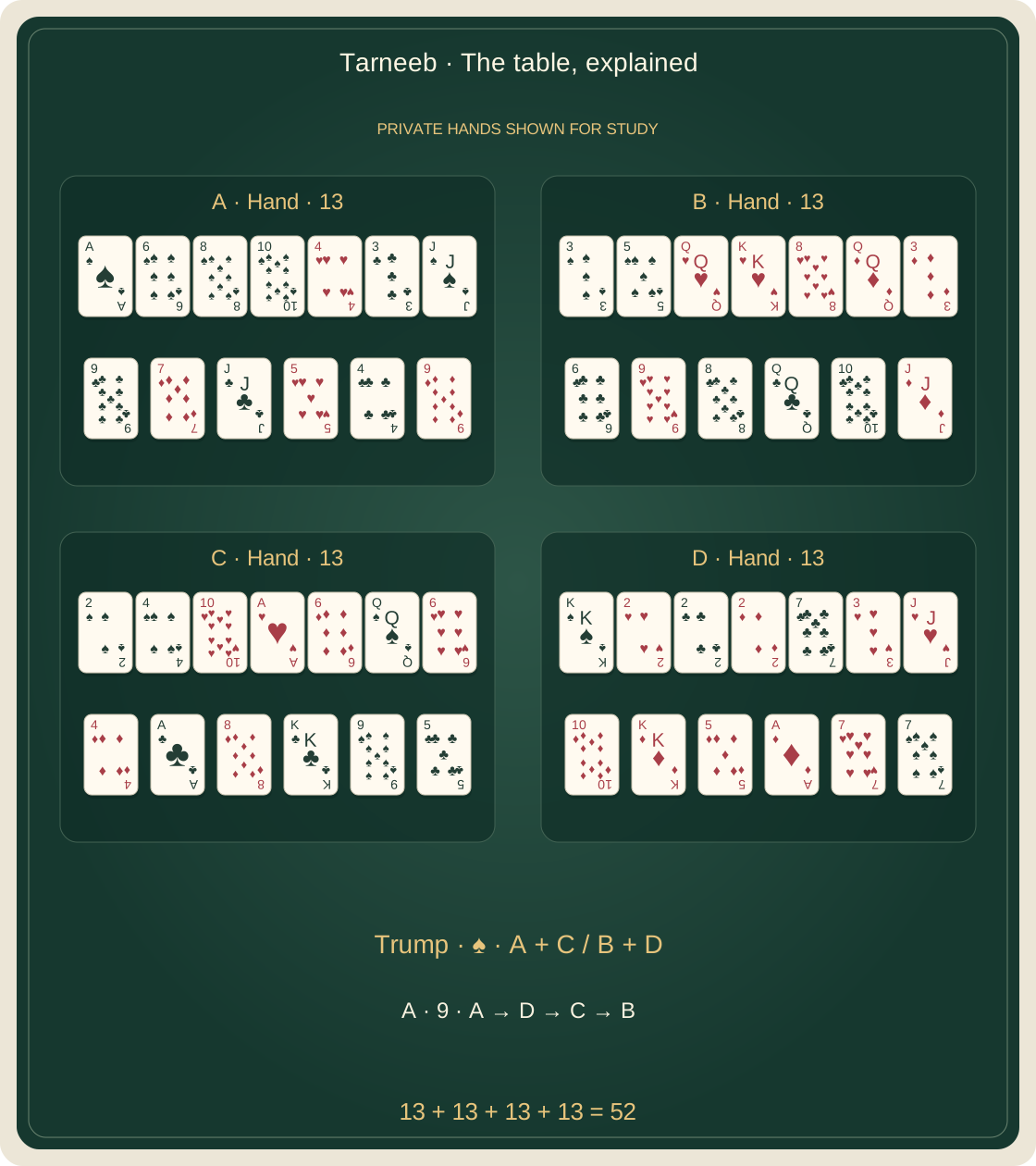
Choose the first dealer randomly, shuffle and offer the cut. Deal every card one at a time counterclockwise, 13 per player, no talon or exposed trump. Next deal moves right. Private hands remain hidden. In the lesson B deals; A is to B’s right and therefore opens the auction, followed by D, C and B.
03 /
How play proceeds
In turn bid a whole number from 7 to 13 higher than every previous bid, or pass. Passing removes you from the rest of this auction, including a later turn; you cannot re-enter when partner bids. Continue around active bidders until only one remains. If everybody passes first time, shuffle and redeal with the same dealer. The winner names trump and leads the first trick.
04 /
Rules that change your decision
Play counterclockwise, one card each. You must follow suit when able. If void, choose any card: trumping and overtrumping are not compulsory. Highest trump wins; without trump the highest led-suit card wins. In no trump only the led suit can win. The winner leads next. Keep completed tricks in team piles and count all 13 before settlement.
05 /
Finish and scoring
For bids below 13, making the contract scores the number of tricks actually taken, opponents 0. Failure subtracts the bid from bidders’ cumulative score; defenders add their own tricks. Taking all 13 after a lower bid is kaboot and scores 16 instead. A bid of 13 made scores 26. A bid of 13 failed subtracts 16, while defenders score twice their own tricks. Negative cumulative scores are possible.
06 /
A worked example
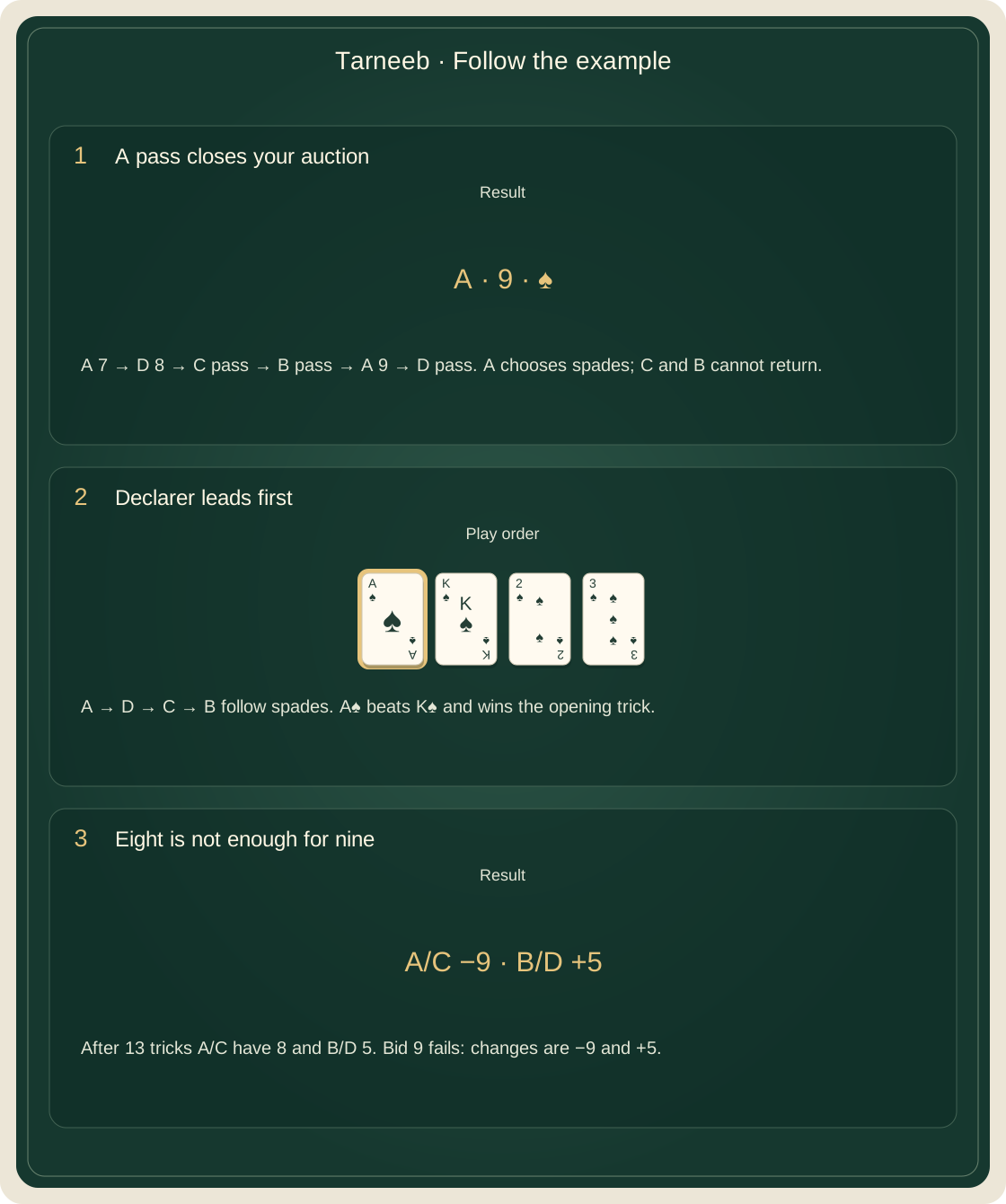
A bids 7, D 8, C passes, B passes, A raises to 9, D passes. C and B cannot return. A chooses spades and leads A♠; D K♠, C 2♠, B 3♠ follow, so A wins. Across the full 13 tricks A/C take 8 and B/D 5. The nine contract fails: A/C record −9, B/D +5. Had the bid been 7, the same eight tricks would instead score +8 and 0.
Open the complete deal record
| Trick | Play order | Winner |
|---|---|---|
| 1 | A: A♠ → D: K♠ → C: 2♠ → B: 3♠ | A |
| 2 | A: 6♠ → D: 7♠ → C: 4♠ → B: 5♠ | D |
| 3 | D: 2♥ → C: 10♥ → B: Q♥ → A: 4♥ | B |
| 4 | B: K♥ → A: 5♥ → D: 3♥ → C: A♥ | C |
| 5 | C: 6♦ → B: Q♦ → A: 7♦ → D: 2♦ | B |
| 6 | B: 8♥ → A: 8♠ → D: J♥ → C: 6♥ | A |
| 7 | A: 10♠ → D: 2♣ → C: Q♠ → B: 3♦ | C |
| 8 | C: 4♦ → B: J♦ → A: 9♦ → D: 10♦ | B |
| 9 | B: 6♣ → A: 3♣ → D: 7♣ → C: A♣ | C |
| 10 | C: 8♦ → B: 9♥ → A: J♠ → D: K♦ | A |
| 11 | A: 9♣ → D: 5♦ → C: K♣ → B: 8♣ | C |
| 12 | C: 9♠ → B: Q♣ → A: J♣ → D: A♦ | C |
| 13 | C: 5♣ → B: 10♣ → A: 4♣ → D: 7♥ | B |
← On a small screen, scroll the diagram horizontally. →
07 /
What to watch at the table
Update scores after the entire deal. First side to reach at least 31 wins. Both sides can receive points only when bidders fail; with the chosen scoring only defenders add positive points then, so there is no simultaneous positive crossing from that deal. Keep a ledger of bid, declarer, trump, tricks and signed changes. No bonus is paid merely for taking an ace.
08 /
Choose the rules before starting
Bid for the partnership’s realistic trick supply, not for the total number of high cards. Trumps may protect a short side suit, but a void never forces a cut in this version. Passing early sacrifices later bidding rights. Before committing to kaboot, remember that losing even one trick changes both sides’ score sharply; bidding 13 and taking 12 gives −16 and +2.
09 /
History and related games
Tarneeb is played in several Middle Eastern countries; the name refers to trump. Accounts sometimes suggest Lebanon as an origin, without establishing one certain birthplace or inventor. Egyptian Tarneeb includes suit-ranked bids and doubling; some Lebanese tables allow only one auction circuit. Forced dealer bids, clockwise play and targets 41, 51 or 61 are other agreements, not extra rules applied to this lesson.
10 /
Check your understanding
Can a player bid again after passing?
Show the answer
Not in this selected plain auction. Passing is permanent for the deal.
Must you trump when void in the led suit?
Show the answer
No. Any card is allowed, including a discard.
Common questions
What is the minimum bid?+
7 partnership tricks.
Who leads first?+
The final bidder, not automatically dealer’s neighbour.
How is an unsuccessful thirteen scored?+
Bidders lose 16; defenders add twice their own trick count.