← On a small screen, scroll the diagram horizontally. →
01 /
The game at a glance
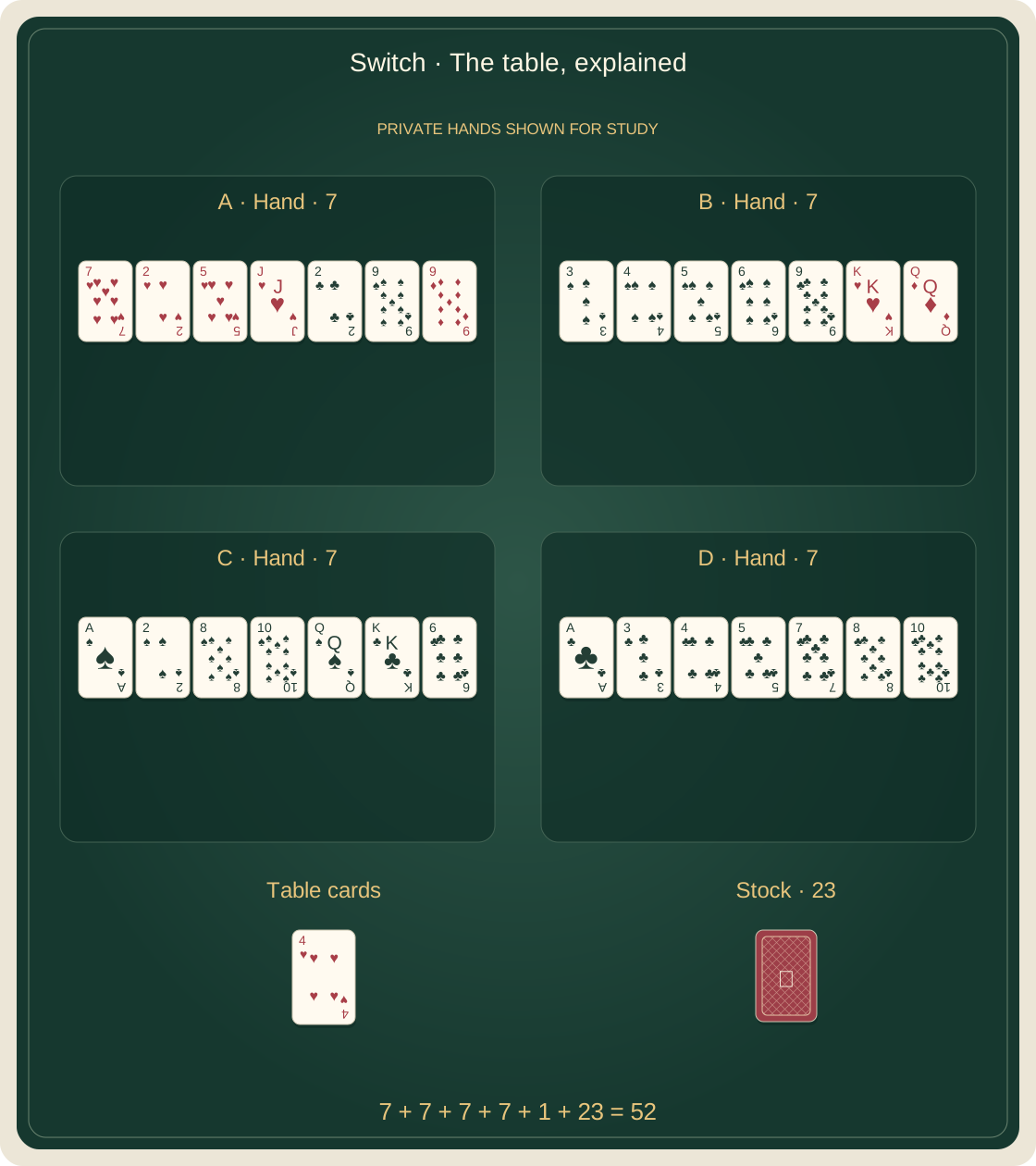
Be first to empty your hand. Deal 7 to each of 4 individuals. Start clockwise with the player left of dealer. Expose one plain starter: 3, 4, 5, 6, 9, K or a red Q. If it is special, reshuffle and redeal under this profile. The remaining 23 form stock. Hidden hands stay private; the diagrams expose them only for teaching.
02 /
Prepare and deal
Normally the first played card must match the discard top by rank or active suit. An A is wild and declares the new suit. A turn may contain several cards: after a legal first card each next card matches the previous rank, or belongs to a suit opened by a 7 earlier in that turn. After a turn, the final card or declared ace suit controls the next player.
03 /
How play proceeds
A 2 makes the next player draw 2, unless they answer with another 2; add the penalties. A black J makes the next player draw 5, and black jacks stack. Under a pending penalty only the answering rank is legal, so a wild ace cannot escape it. A red J cancels one black jack, then its player immediately draws any remainder and ends the response. Red and black jacks cannot be one mixed set.
04 /
Rules that change your decision
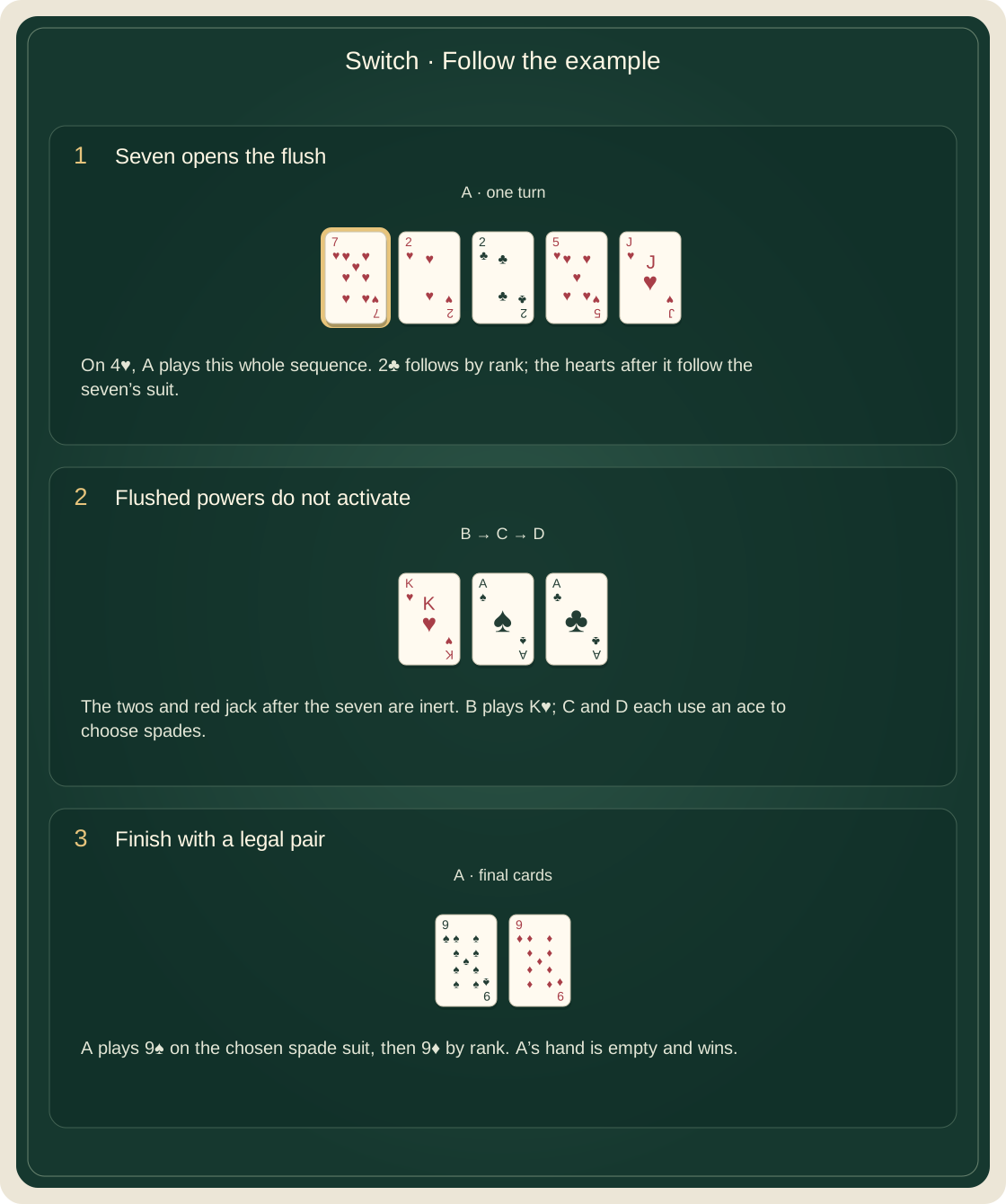
An 8 skips exactly one next player, even if several eights are played together. A 10 reverses direction permanently until another ten; two tens reverse twice. Black Q swaps your entire remaining hand with the next player in the current direction. A 7 opens a same-suit flush for the rest of that turn. Every card after the first seven is inert: a dumped 2, 8, J or Q produces no effect. Powers before the seven still resolve in play order.
05 /
Finish and scoring
With no legal play, draw exactly 1 and end: never play it immediately. Drawing is not optional while a legal card exists. A penalty draw replaces that normal draw. Recycle all discards except the top when stock runs out, at most 20 times in this selected online profile. Pass only when neither play nor draw is possible. Four consecutive passes end a blocked game: fewest cards wins, equal minimum is a draw.
06 /
A worked example
A starts on 4♥ with 7♥, 2♥, 2♣, 5♥, J♥, 9♠, 9♦. A plays 7♥, 2♥, 2♣, 5♥, J♥ in one turn. The off-suit 2♣ follows by rank; later hearts remain legal through the seven. No draw or jack effect fires. B plays K♥; C plays A♠ naming spades; D plays A♣ also naming spades. A finishes with 9♠, 9♦. The full record preserves all 52 cards.
← On a small screen, scroll the diagram horizontally. →
07 /
What to watch at the table
An empty hand wins immediately, except finishing on A requires drawing a replacement and continuing; if nothing can be drawn anywhere, that ace may win. A final black Q wins before a hand swap can occur. Other final cards end the game without resolving a penalty against a future player. Plan a legal finishing rank, not merely a spectacular special-card turn.
08 /
Choose the rules before starting
Compare two choices: 2♥ then 2♣ creates a live penalty of 4; putting them after 7♥ sheds them without a penalty. With 10 cards of pending jack penalty, a single red J cancels 5 and its player draws the remaining 5 immediately. Save a black queen when a neighbour has a short hand, but remember direction may change before the swap resolves.
09 /
History and related games
Switch belongs to the British and Irish matching-game tradition related to Crazy Eights. It has no single universal card-power chart or established inventor in the consulted operator accounts. Other tables make jacks reverse, wild jacks change suit, or demand a last-card call. The modern software profile used here supplies explicit answers for edge cases; its recycle cap and exact powers are not presented as ancient tradition.
10 /
Check your understanding
Does a two dumped after a seven force a draw?
Show the answer
No. Cards after the seven in that turn are inert.
Does an ace answer a pending two penalty?
Show the answer
No. Only another two can be played as the response.
Common questions
Can I play the card I just drew?+
No. Drawing ends your turn in this profile.
Do two eights skip two players?+
No. One or several eights in a turn skip just one.
Must I call last card?+
Not in this selected profile; other households may require it.