← On a small screen, scroll the diagram horizontally. →
01 /
The game at a glance
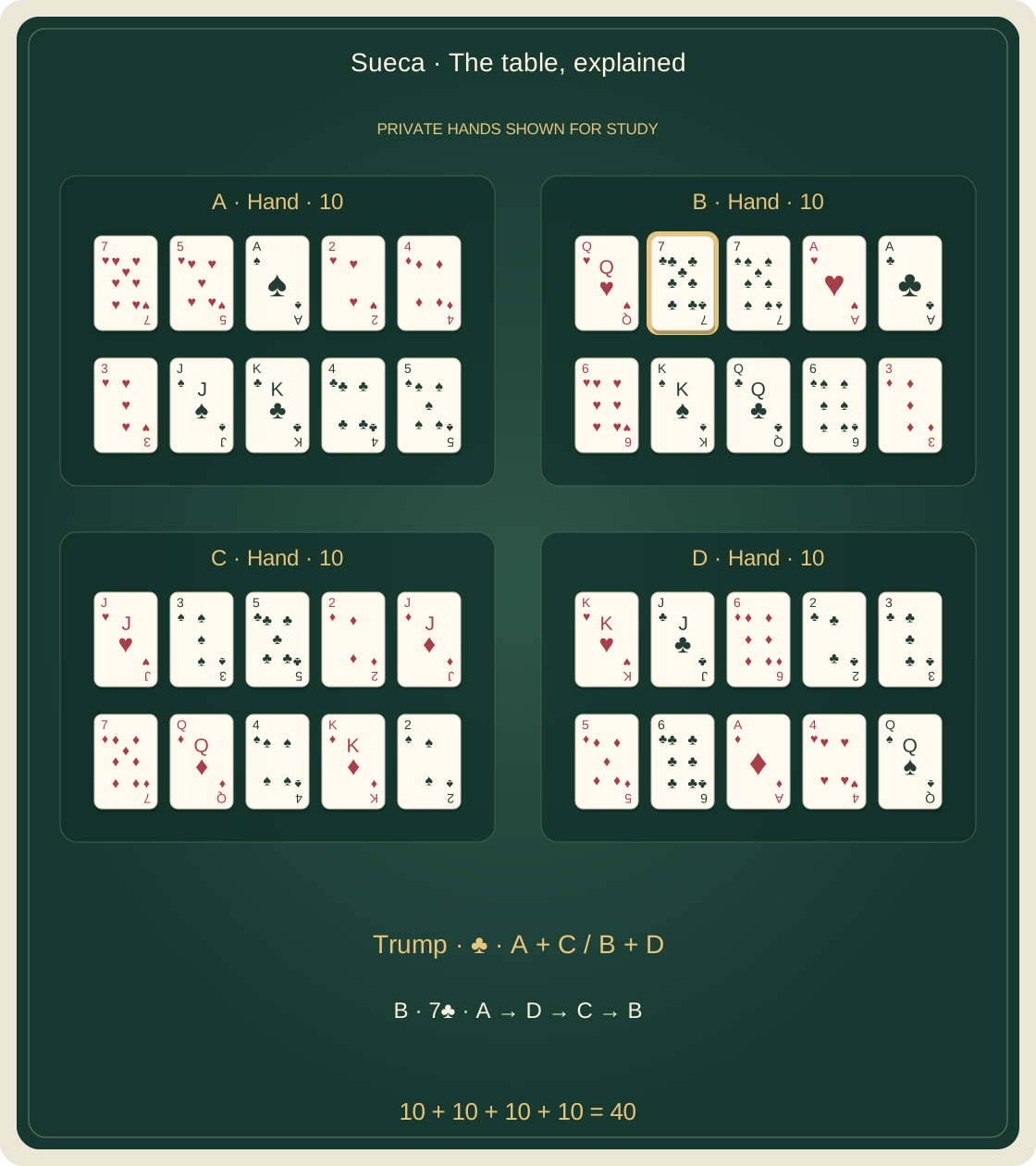
Sit with your partner opposite; the other pair are opponents. Remove 8, 9 and 10 from a standard pack. Each suit ranks A, 7, K, J, Q, 6, 5, 4, 3, 2, highest first. The seven is the manilha. Suits have equal standing except the trump suit selected for this deal.
02 /
Prepare and deal
Choose the first dealer randomly. The player on dealer’s right shuffles; the player on the left cuts. In our selected deal, give one packet of 10 to each player clockwise, starting left of dealer and ending with dealer. Show the bottom card as trump; it belongs to dealer’s 10, not a separate table card. Deal passes right next time.
03 /
How play proceeds
The player on dealer’s right leads, and play proceeds counterclockwise. Play one card each. You must follow the led suit when able. When void, discard anything or trump: trumping is optional, with no obligation to overtake. Highest trump wins; without trump, highest led-suit card wins. The winner leads next. Finish all 10 tricks before counting.
04 /
Rules that change your decision
Keep hands concealed and captured tricks in team piles. No spoken advice or secret partnership signals are allowed. The exposed trump indicator remains dealer’s property and can be played normally. For this teaching table, agree before play that a proven completed revoke gives opponents 2 game marks; it is a selected penalty convention, not a universal national rule.
05 /
Finish and scoring
Card values are A 11, 7 10, K 4, J 3, Q 2; other ranks 0. Total 120. Taking 61–90 gives 1 game mark, 91–120 gives 2. Taking every trick gives 4 and wins immediately; taking all points while losing an empty trick gives only 2. First to at least 4 marks wins. At 60–60 nobody scores; add 1 carry mark to the next decisive deal, accumulating after repeated ties.
06 /
A worked example
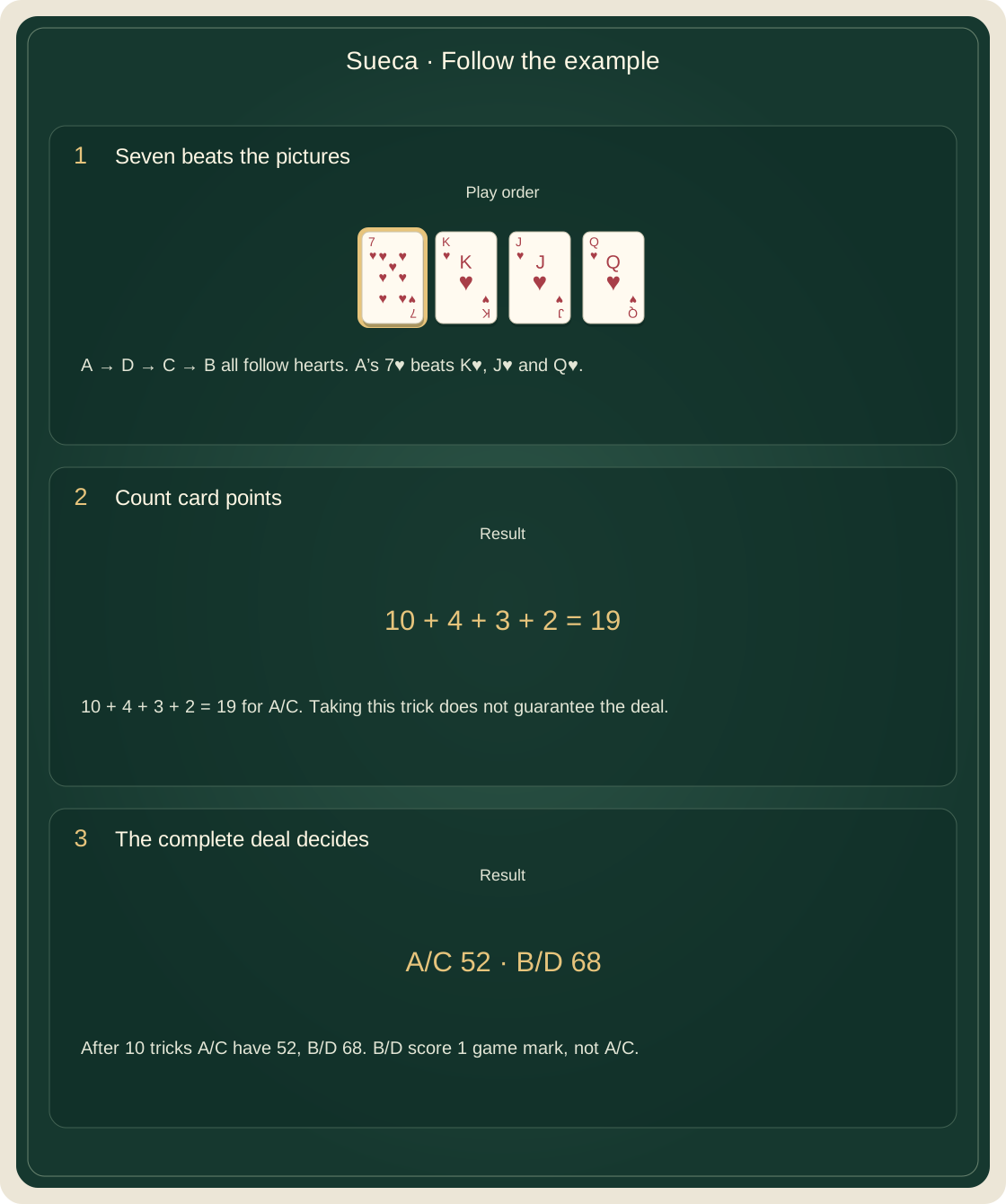
Clubs are trump and B dealt, with 7♣ retained as indicator. A leads 7♥, then D plays K♥, C J♥ and B Q♥. Everybody follows; A wins 19 card points because seven beats all three pictures. But across all 10 tricks A/C collect only 52 in 3 tricks; B/D collect 68 in 7 and score 1 game mark. An early valuable trick does not decide the deal.
Open the complete deal record
| Trick | Play order | Winner | Card points / last bonus |
|---|---|---|---|
| 1 | A: 7♥ → D: K♥ → C: J♥ → B: Q♥ | A | 19 |
| 2 | A: 5♥ → D: 4♥ → C: 3♠ → B: A♥ | B | 11 |
| 3 | B: 7♣ → A: K♣ → D: J♣ → C: 5♣ | B | 17 |
| 4 | B: 7♠ → A: A♠ → D: Q♠ → C: 4♠ | A | 23 |
| 5 | A: 2♥ → D: 6♦ → C: 2♦ → B: 6♥ | B | 0 |
| 6 | B: A♣ → A: 4♣ → D: 2♣ → C: J♦ | B | 14 |
| 7 | B: K♠ → A: J♠ → D: 3♣ → C: 2♠ | D | 7 |
| 8 | D: 5♦ → C: 7♦ → B: 3♦ → A: 4♦ | C | 10 |
| 9 | C: Q♦ → B: Q♣ → A: 3♥ → D: A♦ | B | 15 |
| 10 | B: 6♠ → A: 5♠ → D: 6♣ → C: K♦ | D | 4 |
← On a small screen, scroll the diagram horizontally. →
07 /
What to watch at the table
Track aces and sevens separately from the number of tricks. Save trump control when opponents still hold valuable cards, and feed points only when your partner’s winner is secure. A worthless card can take a useful trick, and a ten-trick sweep is different from merely collecting every counting card. You cannot trump while still holding the led suit.
08 /
Choose the rules before starting
Some Portuguese tournaments give no carry after 60–60; decide before the match. An alternative deal starts by giving dealer the first 10 counterclockwise and exposing dealer’s first card. Brazil usually plays clockwise. The Azores may use 10 as manilha and omit 7, 8, 9 instead. None changes halfway through this selected lesson. Sueca Italiana adds an auction and called partner and is a separate game profile.
09 /
History and related games
Sueca is firmly associated with Portuguese social play and is also played in Brazil and Angola. Its card-point structure places it in the Bisca and Briscola family. The name does not establish a documented Swedish inventor or a precise invention date. The unusual jack-over-queen order is commonly connected with older Portuguese court-card traditions, but that explanation is not proof of a single origin.
10 /
Check your understanding
Can you trump while holding a heart after a heart lead?
Show the answer
No. Following suit takes priority.
Does 120 points always mean a four-mark sweep?
Show the answer
No. You must win every trick, including tricks worth zero.
Common questions
How many cards are used?+
40, with 8, 9 and 10 removed; 10 per player.
Does the jack beat the queen?+
Yes. In every suit J ranks above Q.
What happens on a tied deal?+
In this profile 60–60 scores nothing and adds a carry mark to the next decisive deal.