← On a small screen, scroll the diagram horizontally. →
01 /
The game at a glance
Score as many total points as possible over 5 rounds. In captured cards, each card outside your pain colour scores +1 regardless of number; your pain-colour cards subtract their printed number. The chosen indicator itself also counts against you. Choosing a zero avoids an initial penalty, but does not make that colour harmless later.
02 /
Prepare and deal
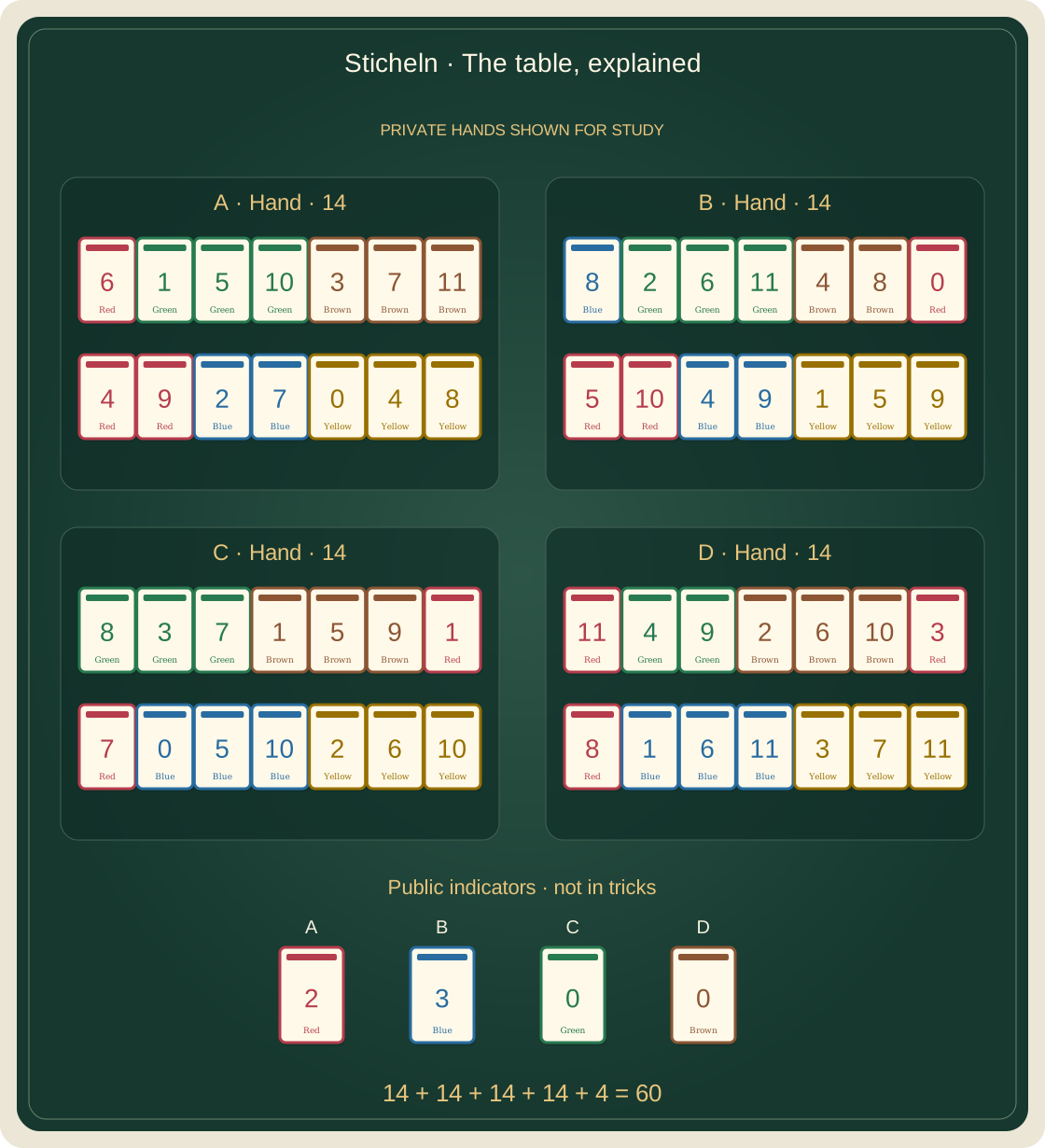
The edition has six colours, not ordinary suits. For 4 players take green, brown, red, blue and yellow, values 0–11: 60 cards. Deal 15 each. Privately choose 1 card from your own hand, place it down, then reveal all choices together. Indicators remain visible and outside play, leaving 14 cards and 14 tricks each. Players may choose the same pain colour.
03 /
How play proceeds
The youngest player leads the first round. Play clockwise, one card each. You never have to follow colour, trump or beat another card. The led colour is the starting colour; every other colour is trump for that trick, except any card numbered 0. Highest nonzero off-colour wins. On equal highest off-colour numbers, the earliest played wins. Winner leads next.
04 /
Rules that change your decision
If no nonzero off-colour was played, highest starting-colour card wins; an off-colour 0 cannot steal the trick. If every card is 0, the first one wins. Zero is still a captured card: outside your pain colour it gives +1, in your pain colour it gives 0. Pain colours do not change the winner calculation and are not personal trump suits.
05 /
Finish and scoring
After all 14 tricks, combine captured cards with your indicator and score them against your own pain colour. Keep signed totals, including negative scores. Shuffle for the next round; use the player left of dealer as next starter. After 5 rounds, greatest total wins, including the least negative if all are negative. We share tied final wins by explicit agreement.
06 /
A worked example
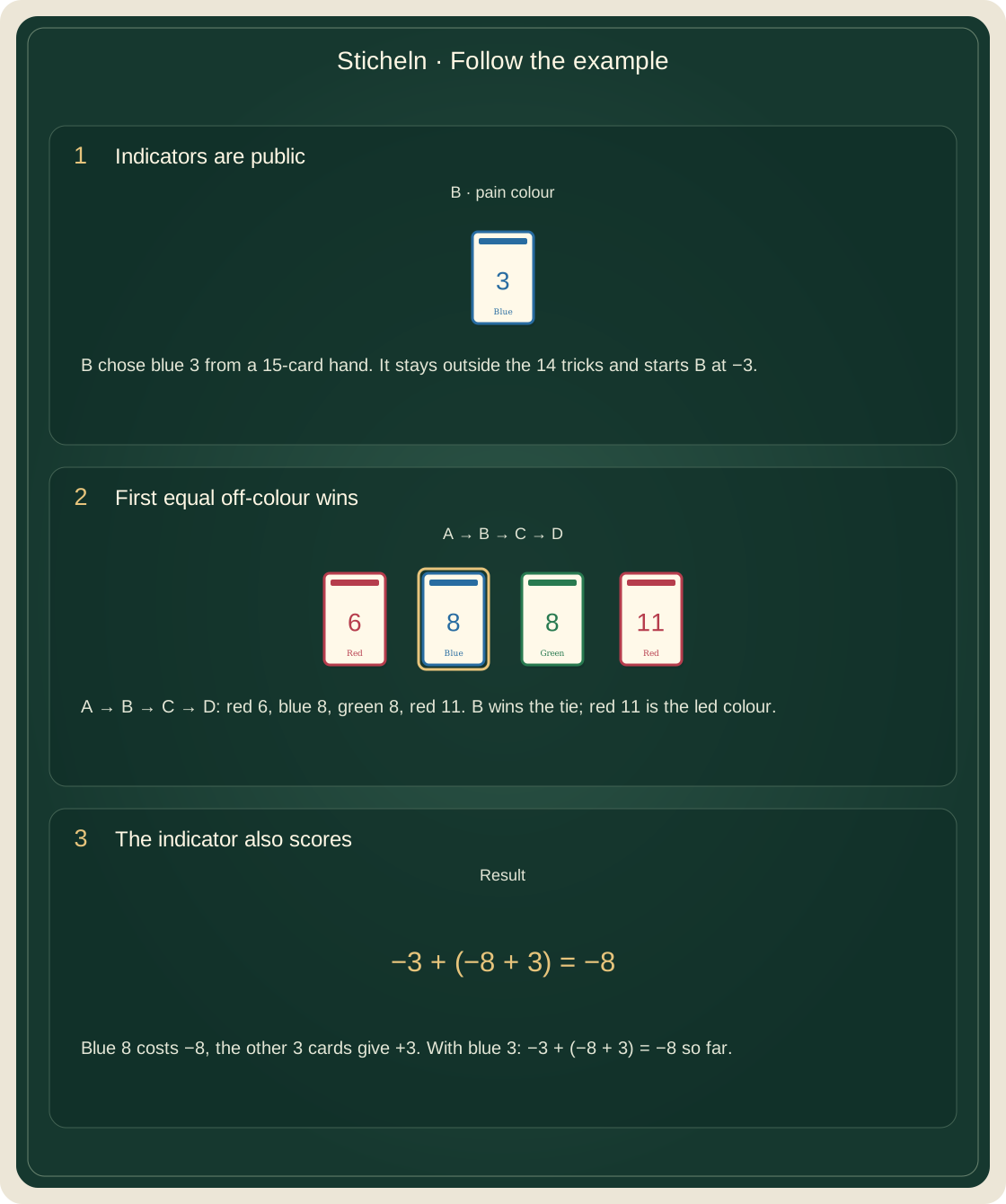
B’s indicator is blue 3, an initial −3. A leads red 6; B plays blue 8, C green 8, D red 11. B wins: the earliest off-colour 8 beats the later equal 8, while red 11 is the starting colour. B’s trick is −8 for blue 8 and +3 for the other cards, making −5. Including the indicator gives −3 + (−8 + 3) = −8 so far.
Open the complete record
| Trick | Play order | Winner |
|---|---|---|
| 1 | A: red 6 → B: blue 8 → C: green 8 → D: red 11 | B |
| 2 | B: green 2 → C: green 3 → D: green 4 → A: green 1 | D |
| 3 | D: green 9 → A: green 5 → B: green 6 → C: green 7 | D |
| 4 | D: brown 2 → A: green 10 → B: green 11 → C: brown 1 | B |
| 5 | B: brown 4 → C: brown 5 → D: brown 6 → A: brown 3 | D |
| 6 | D: brown 10 → A: brown 7 → B: brown 8 → C: brown 9 | D |
| 7 | D: red 3 → A: brown 11 → B: red 0 → C: red 1 | A |
| 8 | A: red 4 → B: red 5 → C: red 7 → D: red 8 | D |
| 9 | D: blue 1 → A: red 9 → B: red 10 → C: blue 0 | B |
| 10 | B: blue 4 → C: blue 5 → D: blue 6 → A: blue 2 | D |
| 11 | D: blue 11 → A: blue 7 → B: blue 9 → C: blue 10 | D |
| 12 | D: yellow 3 → A: yellow 0 → B: yellow 1 → C: yellow 2 | D |
| 13 | D: yellow 7 → A: yellow 4 → B: yellow 5 → C: yellow 6 | D |
| 14 | D: yellow 11 → A: yellow 8 → B: yellow 9 → C: yellow 10 | D |
| A / B / C / D | Pain indicator | Final totals |
|---|---|---|
| A / B / C / D | red 2 · blue 3 · green 0 · brown 0 | -5 / -3 / 0 / -20 |
C leads this round on 0; this is not the match result, which combines 5 rounds.
← On a small screen, scroll the diagram horizontally. →
07 /
What to watch at the table
Read every visible pain indicator before feeding a high off-colour card into a trick. The largest printed number is not automatically the winner, and a zero can be a safe discard without being a trump. Sometimes gaining several harmless cards is worth accepting a small pain card; compare the actual total rather than simply avoiding all tricks.
08 /
Choose the rules before starting
The player-count table below belongs to this edition; other boxes may contain fewer cards. Use the exact active range and remove the stated surplus before choosing indicators. Mild, reversed and two-pain-colour variants alter scoring or the winner and are outside this Classic lesson. Do not add their rules to the base game halfway through a round.
| Players | Colours | Numbers | Active cards | Dealt each | Set aside |
|---|---|---|---|---|---|
| 3 | 5 | 0–8 | 45 | 15 | 0 |
| 4 | 5 | 0–11 | 60 | 15 | 0 |
| 5 | 5 | 0–14 | 75 | 15 | 0 |
| 6 | 6 | 0–14 | 90 | 15 | 0 |
| 7 | 6 | 0–17 | 108 | 15 | 3 |
| 8 | 6 | 0–18 | 114 | 14 | 2 |
For the 5-colour sets use green, brown, red, blue and yellow; for 6 colours add violet. The “dealt each” column is before choosing an indicator, so each player will play one fewer card into tricks.
09 /
History and related games
The modern game is credited to Klaus Palesch and the AMIGO publication carries a 1993 copyright. Later editions and licensed titles have different component counts. Older card literature also uses the name Sticheln for another game; that shared name does not make its standard-deck rules applicable to this coloured-number design.
10 /
Check your understanding
Are pain colours kept secret throughout the round?
Show the answer
No. Choices are simultaneous, then all indicators remain face up.
Does a zero in another colour become trump?
Show the answer
No. Zero never trumps, although it still scores when captured.
Common questions
Do you have to follow the starting colour?+
No. Any held card may be played.
Does every captured card score its number?+
Only pain-colour cards subtract their number; other cards give one point each.
Can an ordinary deck play this exact profile?+
No. It needs the specified coloured-number cards, or an equivalent labelled teaching set.