← On a small screen, scroll the diagram horizontally. →
01 /
The game at a glance
In ordinary play the holders of Q♣ and Q♠ are partners; the others oppose them. The queen side needs 61 of 120 captured points, while opponents win on 60. Partners need not sit opposite. Record game points individually: the first completed deal with a unique highest score of at least 42 ends the match.
02 /
Prepare and deal
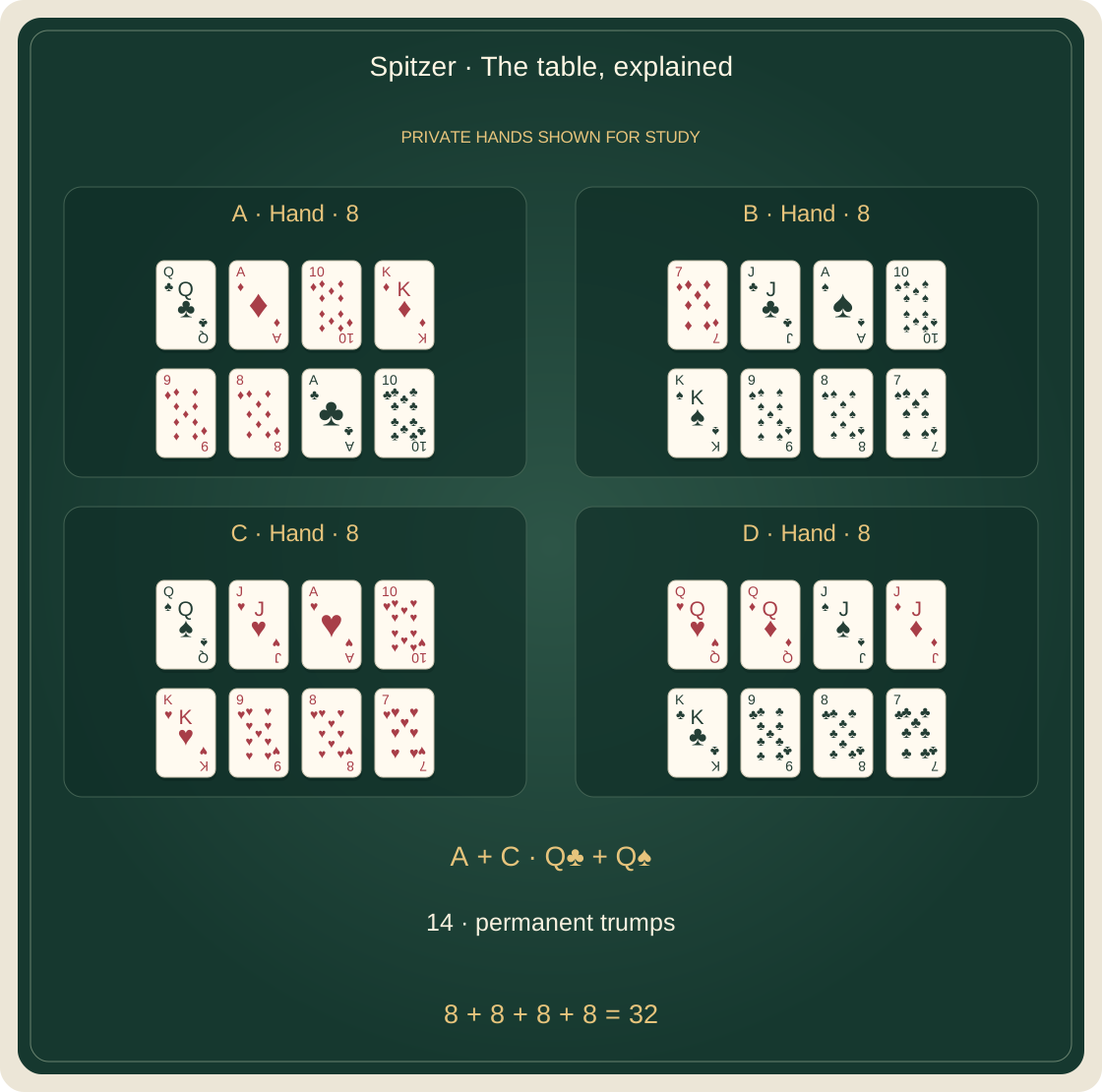
Use 32 cards by removing ranks 2 through 6 from an ordinary pack. Offer the cut to the player on the dealer’s right. Deal 8 each clockwise, traditionally in packets 3, 2, 3, with no talon. Dealer moves left after each deal. Allow everyone to inspect their hand and announce before the opening lead.
03 /
How play proceeds
The player left of dealer leads; play clockwise, and the trick winner leads next. Follow the effective suit: all 14 trumps form one suit, removed from printed suits. If void in the led suit, you must trump if able, even after another trump; otherwise discard anything. You never have to overtake. The trump and point tables below govern comparison, not ordinary poker rank.
Q♣ > 7♦ > Q♠ > Q♥ > Q♦ > J♣ > J♠ > J♥ > J♦ > A♦ > 10♦ > K♦ > 9♦ > 8♦
| A | 10 | K | Q | J | 9 / 8 / 7 |
|---|---|---|---|---|---|
| 11 | 10 | 4 | 3 | 2 | 0 |
♣ / ♠ / ♥: A > 10 > K > 9 > 8 > 7
04 /
Rules that change your decision
With both black queens, either stay silent and play alone as Stealer, announce a solo, or call a partner. Normally call a missing fail ace while holding another nontrump of that suit. If no such suit exists, call an ace in a void fail suit and trump it when played. If holding every fail ace, call the first other trick winner. The called ace cannot be discarded early and must answer another player’s first lead of its suit. Its holder may instead lead that suit themselves, even with a lower card; this reveals partnership and releases the ace restriction.
05 /
Finish and scoring
Count captured card points after all 8 tricks. Use the matrix for the queen/calling side: a positive entry is added to each winner on that side; a negative entry means add its magnitude to each opposing winner. Never subtract game points. All-trick and no-trick columns override point ranges. At the 42 target, tied leaders play another deal by our declared tie agreement; another player may overtake them.
| Action | No tricks | 0–30 | 31–60 | 61–89 | 90–120 | All tricks |
|---|---|---|---|---|---|---|
| Normal / partner call | — | −9 | −6 | +3 | +6 | +9 |
| Schneider | −18 | −15 | −12 | −9 | +9 | +12 |
| Stealer | — | −9 | −6 | +9 | +12 | +15 |
| Zola | −15 | −12 | −9 | +18 | +27 | +36 |
| Zola Schneider | −42 | −36 | −24 | −18 | +36 | +39 |
| Zola Schneider Schwartz | −42 | −42 | −39 | −33 | −27 | +54 |
06 /
A worked example
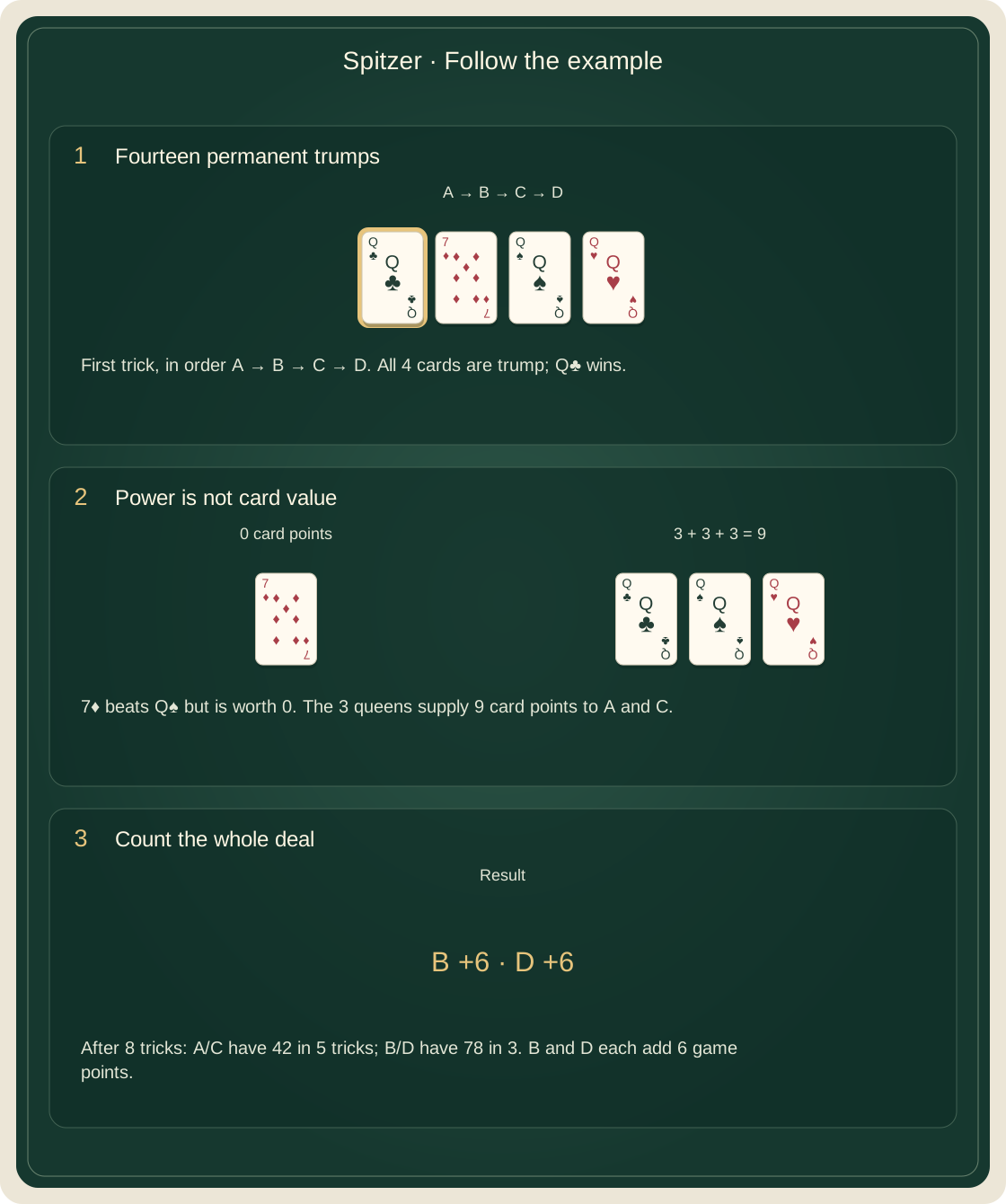
The first trick is A Q♣, B 7♦, C Q♠, D Q♥. A wins and takes 9 card points. A and C are partners. Across the complete 8-trick lesson they win 5 tricks but only 42 points; B and D take 78. The ordinary-game matrix therefore gives B and D 6 game points each, not A and C. The powerful 7♦ itself is worth 0 card points.
Open the complete record
| Trick | Play order | Winner | Card points |
|---|---|---|---|
| 1 | A: Q♣ → B: 7♦ → C: Q♠ → D: Q♥ | A | 9 |
| 2 | A: A♦ → B: J♣ → C: J♥ → D: Q♦ | D | 18 |
| 3 | D: J♠ → A: 10♦ → B: A♠ → C: A♥ | D | 34 |
| 4 | D: J♦ → A: K♦ → B: 10♠ → C: 10♥ | D | 26 |
| 5 | D: K♣ → A: A♣ → B: K♠ → C: K♥ | A | 23 |
| 6 | A: 9♦ → B: 9♠ → C: 9♥ → D: 9♣ | A | 0 |
| 7 | A: 8♦ → B: 8♠ → C: 8♥ → D: 8♣ | A | 0 |
| 8 | A: 10♣ → B: 7♠ → C: 7♥ → D: 7♣ | A | 10 |
A / C: 42 · 5; B / D: 78 · 3 → B +6, D +6.
← On a small screen, scroll the diagram horizontally. →
07 /
What to watch at the table
Identify effective suits before deciding you can discard. Track the black queens to establish your partner, then feed valuable cards to tricks your side can keep. A high-powered zero-value trump may win control without winning many card points. Do not confuse a peg on the game board with a point captured in the current hand.
08 /
Choose the rules before starting
Any player may announce Zola, a solo; Zola Schneider promises at least 90 points, and Zola Schneider Schwartz all 8 tricks. A partnership Schneider, if enabled, promises 90. Our conflict agreement gives priority to the more demanding announced solo, then ordinary solo, then partnership Schneider, then partner calls; equal calls go to the earliest clockwise from dealer’s left. Some local rules put brush at 30 instead of 31 and require 91 for schneider; do not mix those thresholds with this matrix.
09 /
History and related games
Specialist accounts document Spitzer around Rogers City, Alpena and Posen in northeastern Michigan. Its vocabulary and card system connect it to the German-American Schafkopf family, but that does not establish a definite German birthplace. Regional oral-history material also names the game; local testimony is evidence of practice, not proof that all communities use identical rules.
10 /
Check your understanding
Does the diamond seven determine the ordinary partnership?
Show the answer
No. Q♣ and Q♠ determine it, unless a call changes the teams.
Can you discard a fail card when void in the led suit but holding a trump?
Show the answer
No. You must play a trump; overtaking is not required.
Common questions
Are there only two trumps?+
No. Queens, jacks and diamonds together form fourteen trumps.
Does taking more tricks guarantee the hand?+
No. Captured card values determine the ordinary result.
Are negative matrix entries deducted?+
No. Their magnitude is added to every winning opponent.