← On a small screen, scroll the diagram horizontally. →
01 /
The game at a glance
Win by playing the last card of your goal pile onto a shared centre pile. An empty hand alone does not win. Players alternate turns; there is no race to slap a pile. Suits have no effect, but each physical copy remains a separate card.
02 /
Prepare and deal
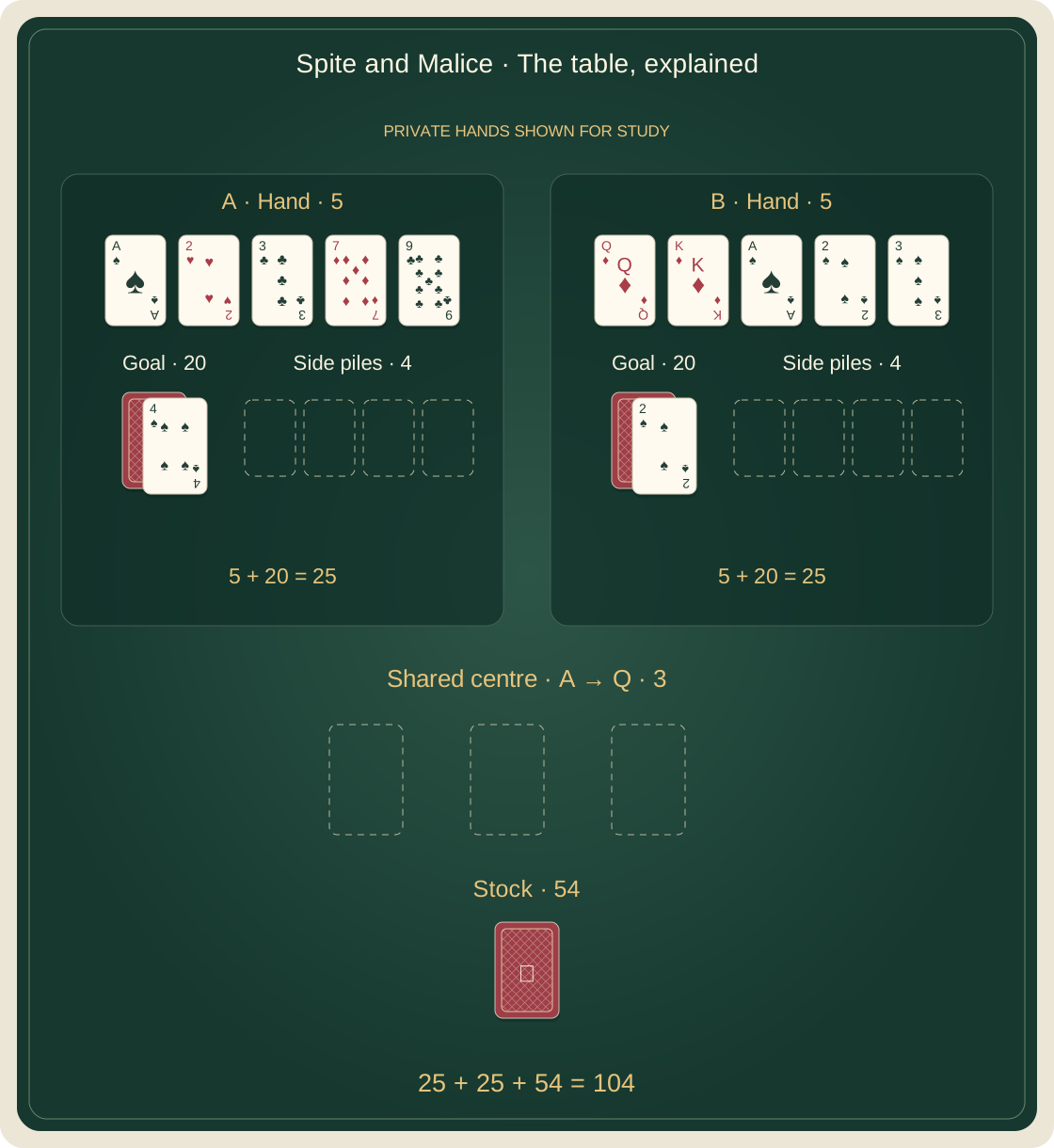
Shuffle 2 ordinary packs together. Give each player a face-down goal pile of 20 and a hand of 5; turn only the top goal card up. The remaining 54 form a shared draw stock. Start with empty centre and side spaces. The higher exposed goal card starts; for a tie shuffle the goal piles and reveal again. For this comparison use A low through K high.
03 /
How play proceeds
At the beginning of your turn, draw until you have 5 in hand. You may then play repeatedly from your hand, exposed goal top or a side-pile top. Start a centre with A, then build 2 through Q regardless of suit. After a goal card leaves, reveal its new top immediately. You may stop playing useful cards whenever you choose.
04 /
Rules that change your decision
A K played to the centre stands for the next required rank, including A in an empty space or Q to finish. Fix its value when played. Completed Q sequences are shuffled into the stock by the opponent. Never move centre cards elsewhere, move a side pile onto another side pile, or discard a goal card to a side pile.
05 /
Finish and scoring
Discard exactly 1 card from hand onto any of your side piles to end the turn. Side piles have no ordering requirement; only the top can later play. If you play your whole hand to the centre, draw another 5 and continue before making an ending discard. If a required draw cannot be completed because the stock runs out, our declared stock-exhaustion agreement makes the deal a draw. A last goal card wins immediately.
06 /
A worked example
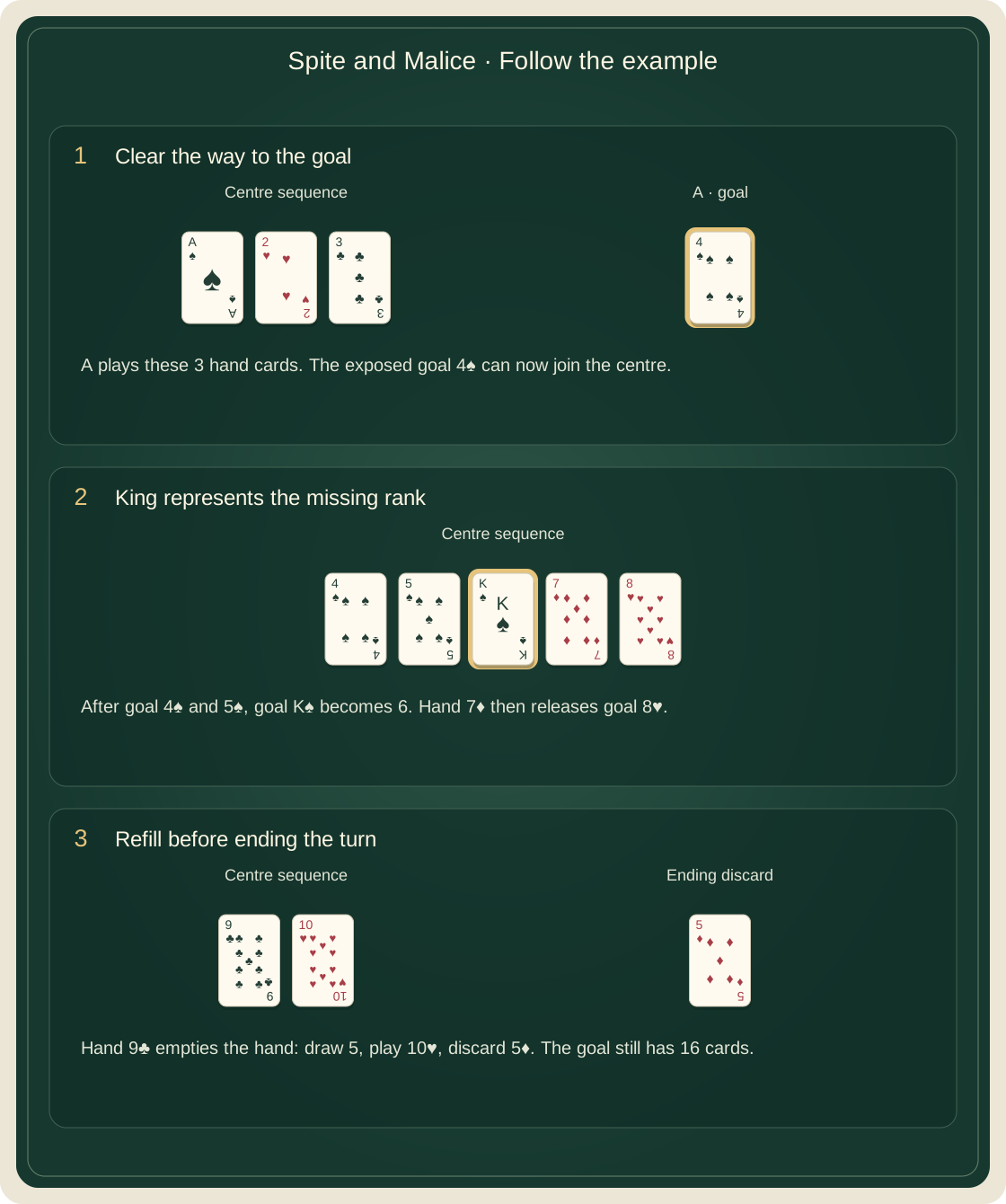
A begins with goal top 4♠ and plays A♠, 2♥, 3♣ from hand. Now 4♠ can leave the goal, revealing 5♠, which also plays. The next goal K♠ represents 6. Hand 7♦ releases goal 8♥; hand 9♣ empties the hand, so refill before continuing. The new hand supplies 10♥; a final discard of 5♦ ends the turn. Playing those hand cards has opened several goal cards, not won the whole game.
Open the complete record
| # | Action | Cards |
|---|---|---|
| 1 | Hand | A♠ |
| 2 | Hand | 2♥ |
| 3 | Hand | 3♣ |
| 4 | Goal | 4♠ |
| 5 | Goal | 5♠ |
| 6 | Goal | K♠ |
| 7 | Hand | 7♦ |
| 8 | Goal | 8♥ |
| 9 | Hand | 9♣ |
| 10 | Draw | 5♦ · 6♣ · 7♥ · 8♦ · 10♥ |
| 11 | Hand | 10♥ |
| 12 | Ending discard | 5♦ |
← On a small screen, scroll the diagram horizontally. →
07 /
What to watch at the table
Arrange side piles so their exposed ranks will help release the goal top. A low card buried under a high one may be unusable for a long time. Before advancing a shared centre, check the opponent’s visible goal: the next rank you create is available to them on their turn.
08 /
Choose the rules before starting
Some families use 26-card goals, include jokers or allow 4 centre piles. Others delay recycling completed piles. None applies here. Our explicit draw agreement resolves exhaustion at a refill; do not silently replace it with endless recycling of side piles. A commercial numbered-card relative may have its own setup and wild-card rules.
09 /
History and related games
Also known as Cat and Mouse, this is an American competitive-patience tradition with many household forms. Modern accounts distinguish the common king-wild form from a different book version. That variety explains conflicting goal sizes and centre limits; the title alone does not establish one universal ruleset.
10 /
Check your understanding
Can a goal card be discarded to a side pile?
Show the answer
No. Goal cards leave only by playing to the centre.
Does a king always mean the highest rank?
Show the answer
No. In a centre pile it becomes the next required rank.
Common questions
Must side piles descend?+
No. Any order is legal, but only their exposed tops are usable.
Does emptying the hand win?+
No. Refill and continue; the goal pile determines victory.
Can I use an opponent’s side pile?+
No. Only your own hand, goal and side-pile tops are available.