← On a small screen, scroll the diagram horizontally. →
01 /
The game at a glance
Try to shed your personal cards across successive layouts. During a layout race to empty the columns; then both people take centre cards for a new layout. Final victory occurs when you clear a reduced layout while having no private spit reserve, so no cards need come back to you.
02 /
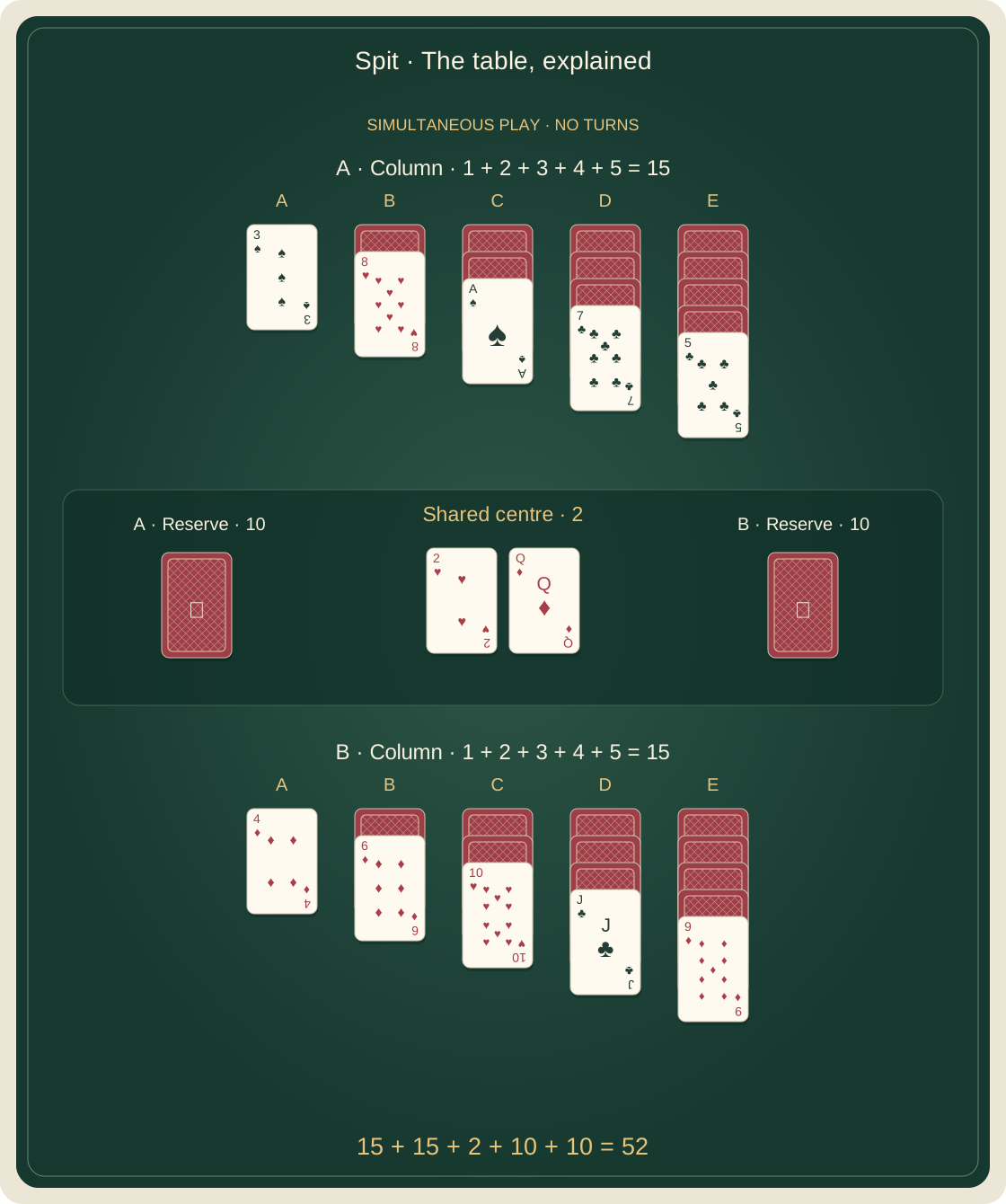
Prepare and deal
Divide 52 cards equally, 26 each. From your own cards make columns of 1, 2, 3, 4 and 5 cards: 15 on the tableau, only each end card face up. Keep the other 11 face down as a private spit reserve without looking. Together turn one reserve card each into the centre: 2 shared piles and 10 cards now left in each reserve.
03 /
How play proceeds
There are no turns. Move an exposed end card onto either centre top exactly one rank higher or lower, ignoring suit. A connects K and 2; equal ranks do not fit. Reveal the next hidden card when uncovered. You may move a single exposed card into an empty personal column to reveal another. Never keep more than 5 columns.
04 /
Rules that change your decision
When neither person can play or expose something useful by filling a gap, both turn the next private spit card onto their original centre pile. If only one reserve remains, that player turns alone and chooses a centre pile, using that same pile for subsequent restarts. Reserves are not cards to inspect or use freely.
05 /
Finish and scoring
When a tableau empties, or both are blocked with no reserve cards, choose centre piles by touching them. Different choices: take your chosen pile. Same choice: first touch takes it, the other person takes the other. Add your remaining tableau and unused spit cards, shuffle your new holding and redeal. All cards stay accounted for; a smaller centre pile is usually advantageous.
06 /
A worked example
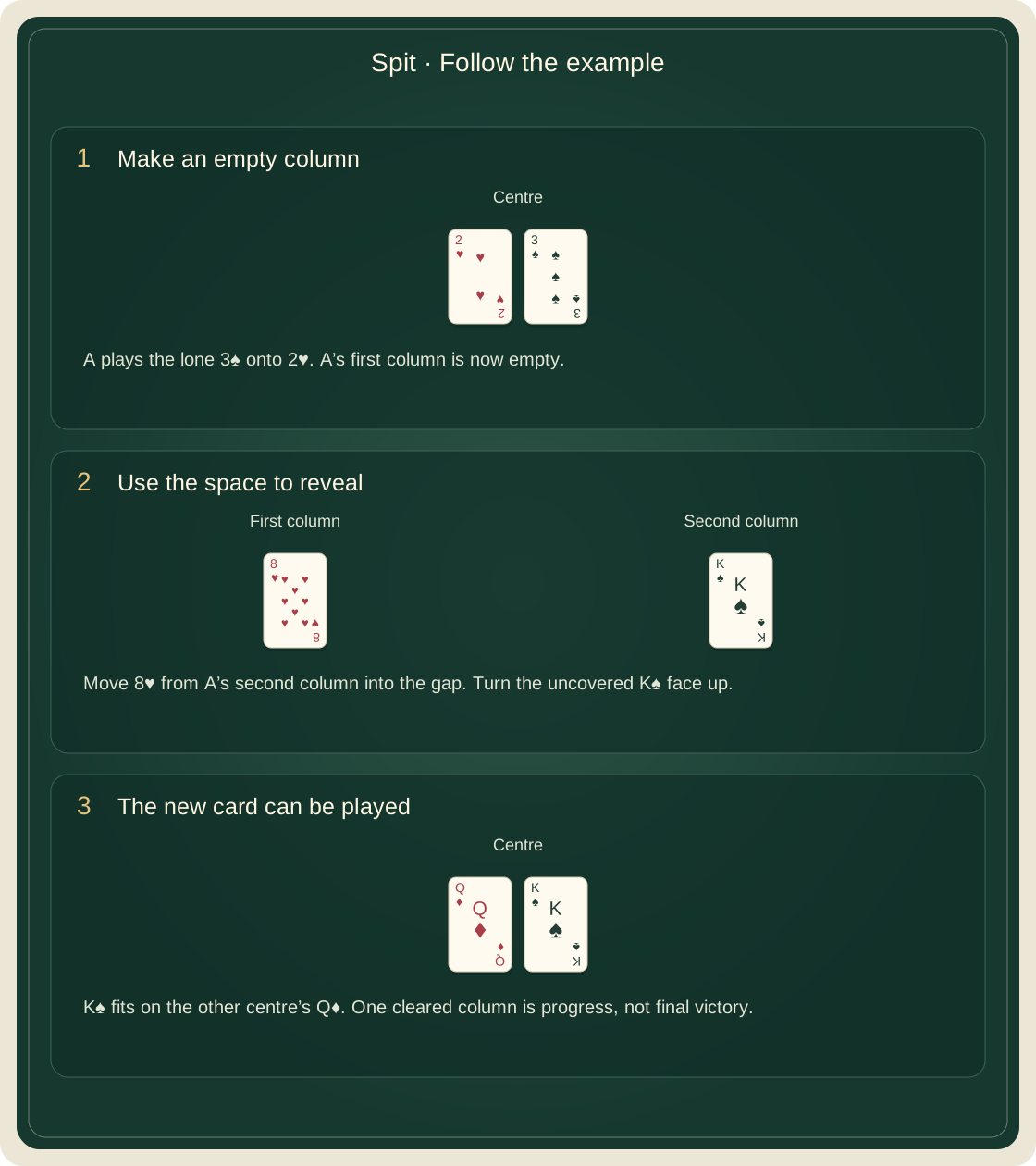
A’s first column is 3♠; the next has K♠ hidden beneath 8♥. The centre starts with 2♥ and Q♦. A plays 3♠ onto 2♥, leaving an empty column. A moves 8♥ into that gap and reveals K♠. A can then play K♠ onto Q♦. This 3-step lesson opens cards legally; it does not claim that emptying one column wins the game.
← On a small screen, scroll the diagram horizontally. →
07 /
What to watch at the table
Use empty columns to uncover information instead of parking a card without benefit. Watch both centre piles: an opponent’s play can create your next move. If you clear the tableau, still check whether you have unused spit cards; those are carried forward even when you take no centre pile in the one-pile ending.
08 /
Choose the rules before starting
If your new holding has 15 or fewer cards, deal as far as possible into columns of capacities 1–5. With no spit reserve, only the other person starts a centre pile. In that one-pile layout, whoever clears takes no centre cards; the other receives the centre and keeps their own remaining cards. If the clearer also has no reserve, they have no cards and win; otherwise they keep that reserve for the next layout.
09 /
History and related games
Spit is a competitive patience with several household layouts. Specialist accounts distinguish its exposed columns and repeated redistribution from five-card-hand Speed. Some versions replace the touch race with a free choice for the person who clears. This guide states the touch-race rule explicitly; a local name alone cannot identify all the rules.
10 /
Check your understanding
Does clearing your columns always win the whole game?
Show the answer
No. You may still own spit cards and need another layout.
May you put any exposed card into a personal gap?
Show the answer
Yes, a single exposed card; this can uncover another card.
Common questions
Is Spit the same as hand-held Speed?+
No. This profile uses exposed columns and repeated redistribution.
May cards of equal rank go on the centre?+
No. A neighbouring rank is required.
Who flips when only one reserve remains?+
Its owner flips alone, continuing on the same chosen centre pile.