← On a small screen, scroll the diagram horizontally. →
01 /
The game at a glance
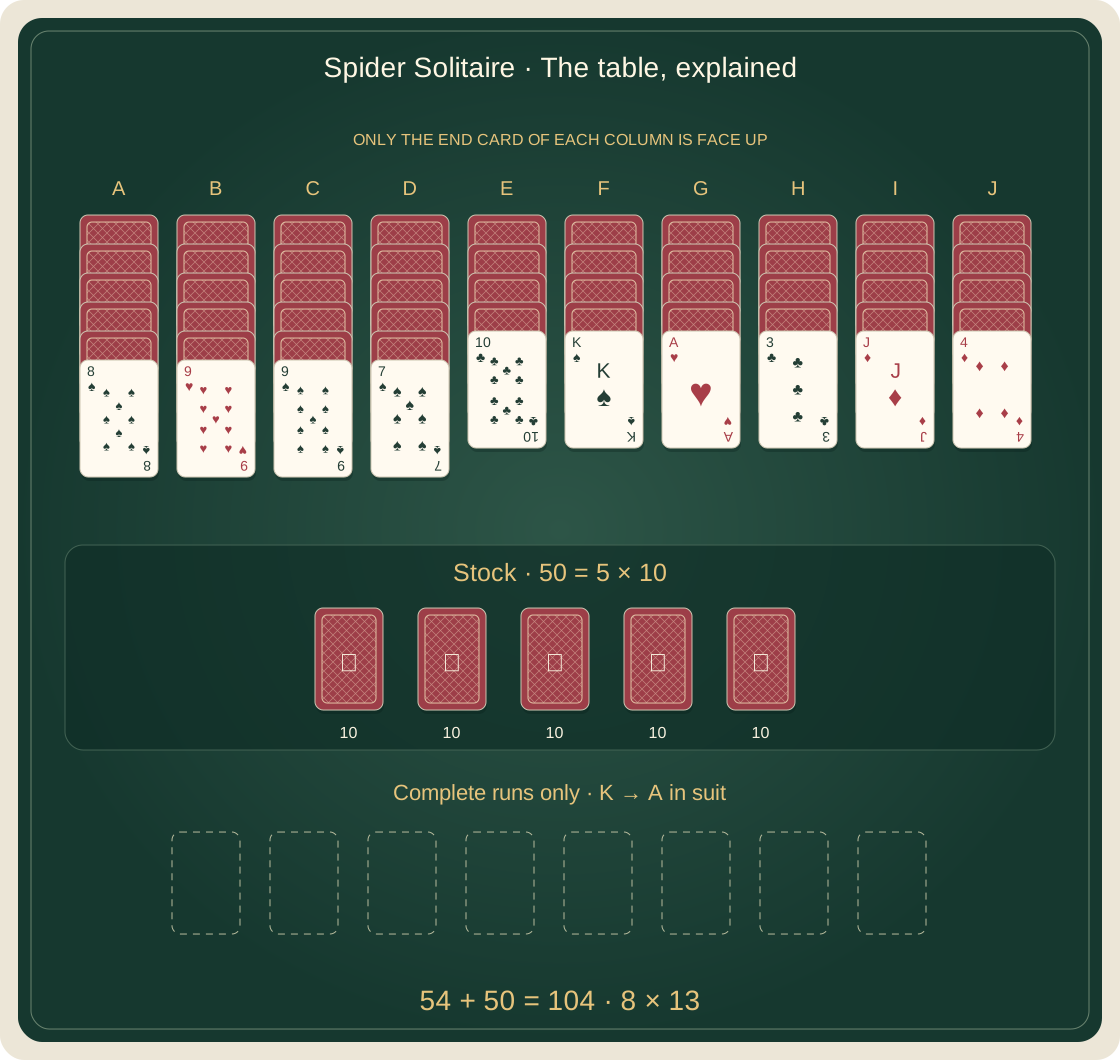
Remove every card by completing 8 same-suit sequences from K down to A. Each complete sequence contains 13 cards and is removed as a whole. Individual aces do not start ordinary foundations. The empty sequence slots are destinations for complete runs, not free cells for spare cards.
02 /
Prepare and deal
Shuffle 2 complete packs without jokers: 104 cards. Deal 10 columns, the first 4 with 6 cards and the other 6 with 5. Only the exposed end card of each column is face up. There are 54 on the tableau and 50 in stock, available as 5 rows of 10. Hidden cards stay in their original column until uncovered.
03 /
How play proceeds
Move an exposed end card onto a card exactly one rank higher, regardless of suit or colour. A descending same-suit tail may move together; you may also move only a lower part of that tail. The highest card of the moving group must fit the destination. Turn a newly uncovered face-down card up immediately. A does not wrap onto K.
04 /
Rules that change your decision
Any available single card or legal same-suit group may fill an empty column. A king needs an empty destination. Mixed-suit descending cards can stay stacked, but cannot move as one unit. When a same-suit K-to-A sequence forms at an exposed column end, remove all of it and reveal the next covered card. Do not remove only part of a complete run.
05 /
Finish and scoring
When you choose to deal, every column must contain a card. Put the next 10 stock cards face up, one on each column, even if they interrupt good sequences. No redeal. Win only after all 8 runs are removed. With no useful legal continuation and no legal stock deal, the position is lost; moving cards in circles is not progress.
06 /
A worked example
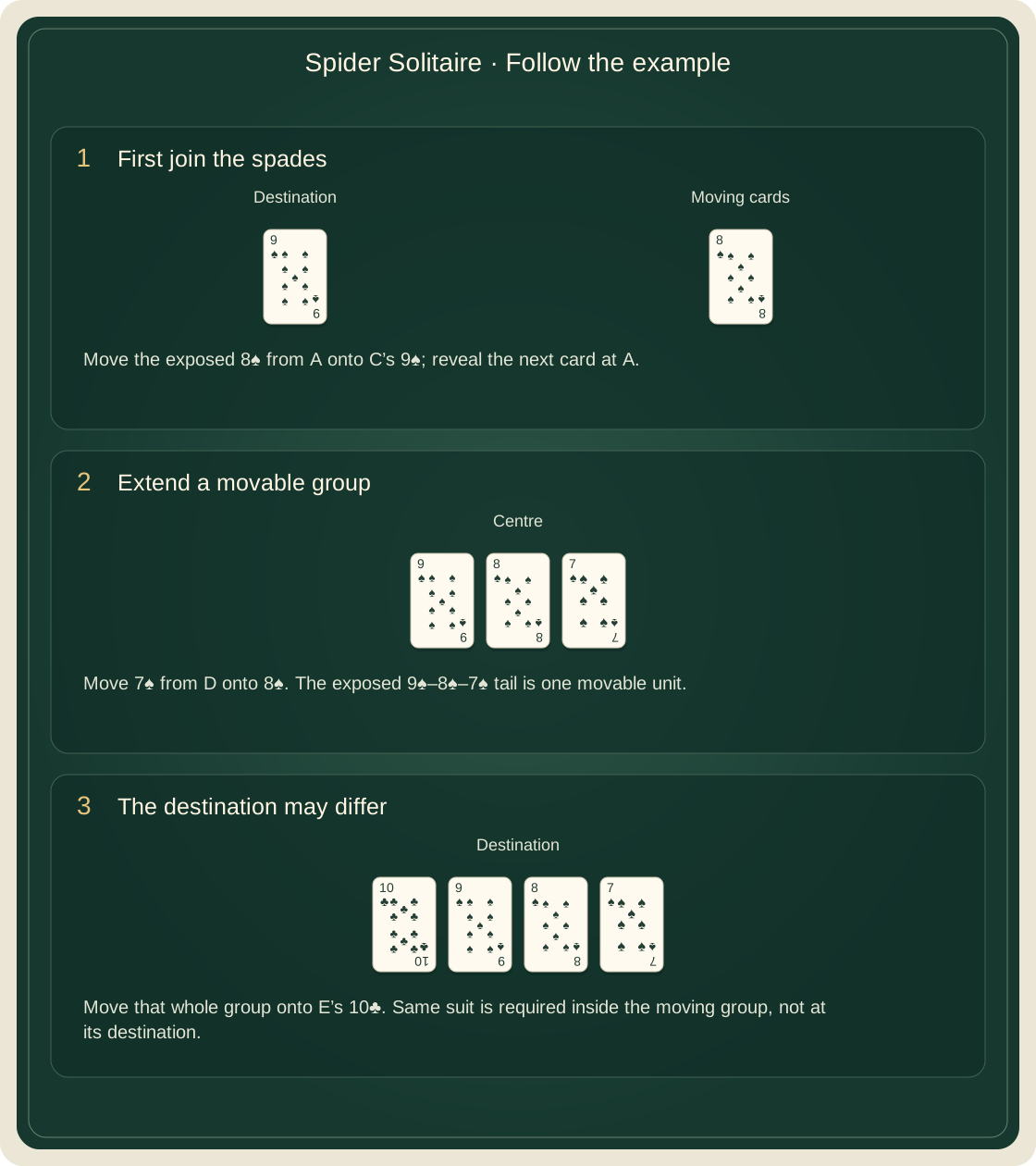
The opening shows 8♠ at column A, 9♠ at C, 7♠ at D and 10♣ at E. Move 8♠ onto 9♠, revealing the next card at A. Move 7♠ onto 8♠, revealing D. Now the 3-card tail 9♠–8♠–7♠ can move together onto 10♣. That destination is legal despite its suit. In contrast, 9♠–8♥–7♠ cannot be lifted as one group.
← On a small screen, scroll the diagram horizontally. →
07 /
What to watch at the table
Prefer moves that uncover a hidden card or join suits while preserving useful empty columns. Before filling an empty column, identify how the occupying group could leave again. Do not rush a stock row just because there is no same-suit build: a temporary mixed-suit move can still release an important card.
08 /
Choose the rules before starting
In 2-suit mode there are 4 copies of every rank in each chosen suit; 1-suit mode has 8 copies of every rank, still 104 cards. Software can remap suits; those modes are not made by simply removing suits from 2 packs. Bicycle also describes an opening of 50 with a partial last deal; do not mix it with our 54-card opening or its 50-card stock.
09 /
History and related games
Spider is a classic patience whose printed and software descriptions do not all use the same opening. Digital collections made its reduced-suit modes especially familiar. This guide does not assign an unverified inventor or exact birth date, and it does not repeat fixed win-rate percentages: those depend on the deal generator, rules and solver.
10 /
Check your understanding
May a same-suit group land on a different suit?
Show the answer
Yes, if the destination is exactly one rank higher than the group’s highest card.
May you deal while a column is empty?
Show the answer
No. Fill every empty column before dealing from stock.
Common questions
May any card fill a space?+
Yes, an available single card or a legal same-suit descending group.
Can a mixed-suit run move together?+
No. It must be separated into legal movable units.
Does a full run go back into stock?+
No. It is removed permanently from this deal.