← On a small screen, scroll the diagram horizontally. →
01 /
The game at a glance
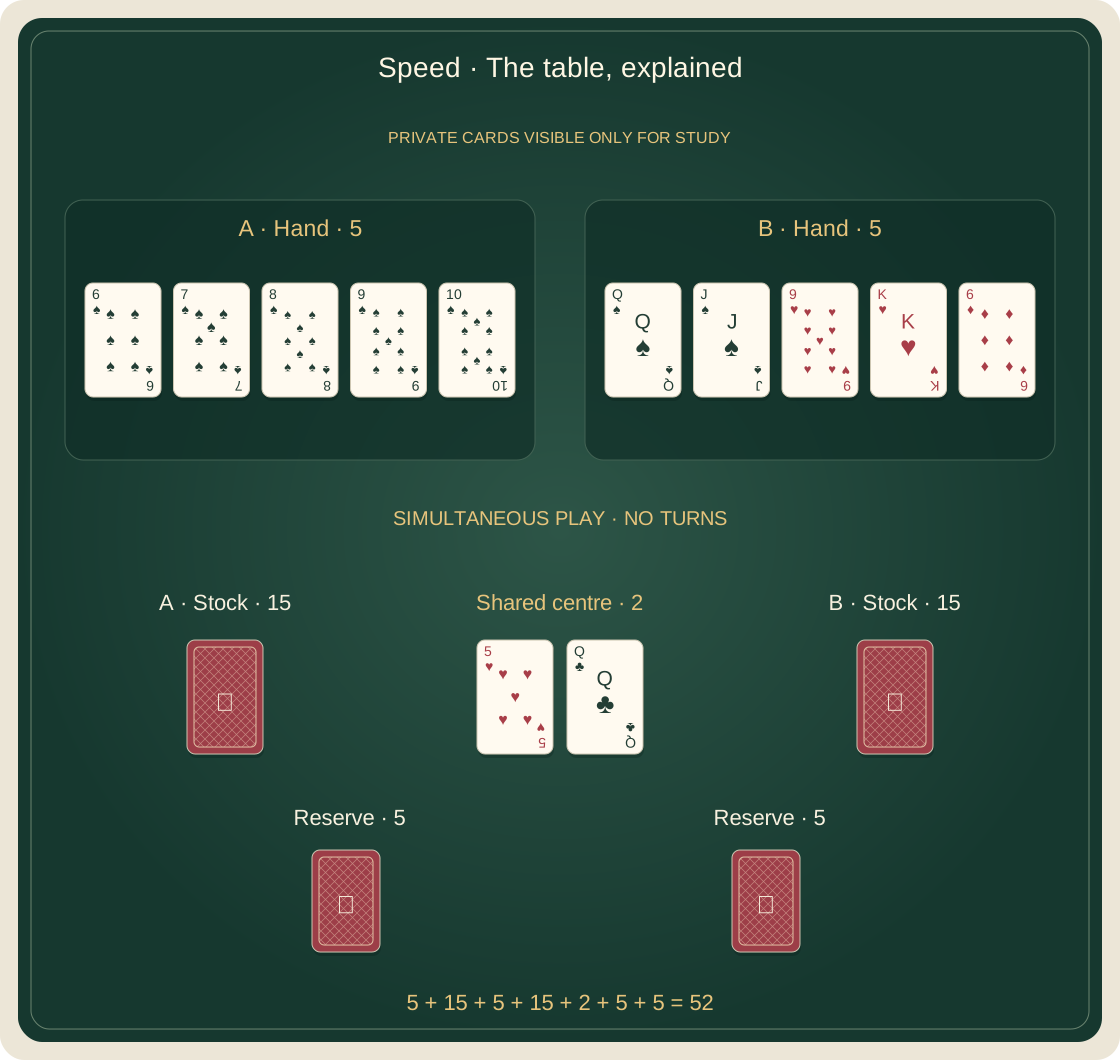
Race to play every card in both your hand and personal stock. There are no turns: either person may play on either centre pile. Use one playing hand and put down a single card at a time. The other hand may hold your cards; never cover both piles with a batch.
02 /
Prepare and deal
Shuffle 52 cards without jokers. Give each player 20: take 5 into hand and leave 15 face down as a personal draw pile. Put 2 single starting cards in the centre and a closed reserve of 5 at either side. Together turn the centre cards face up. The accounting is 20 + 20 + 2 + 5 + 5 = 52.
03 /
How play proceeds
Play a held card exactly one rank above or below either exposed top. Ignore suit and colour. Ranks form the loop A–2–3 through J–Q–K–A. Equal ranks do not fit. After playing, draw from your own stock to restore your hand to 5 while cards remain. Refill before declaring a position blocked.
04 /
Rules that change your decision
When neither player has a legal play, agree to restart and simultaneously turn a side-reserve card onto each centre pile. Do not flip merely because you alone are stuck. If reserves run out, leave each centre top exposed, mix the covered cards beneath them and divide those into fresh side reserves. Private hands and personal stocks never enter that recycling.
05 /
Finish and scoring
With your personal stock empty, play the remaining hand without refilling. Empty both to win the deal. In our scoring option, score 1 point for every card left in the opponent’s hand and personal stock; side reserves do not count. First to 25 wins the session. If the final placements cannot be distinguished, replay without points by agreement.
06 /
A worked example
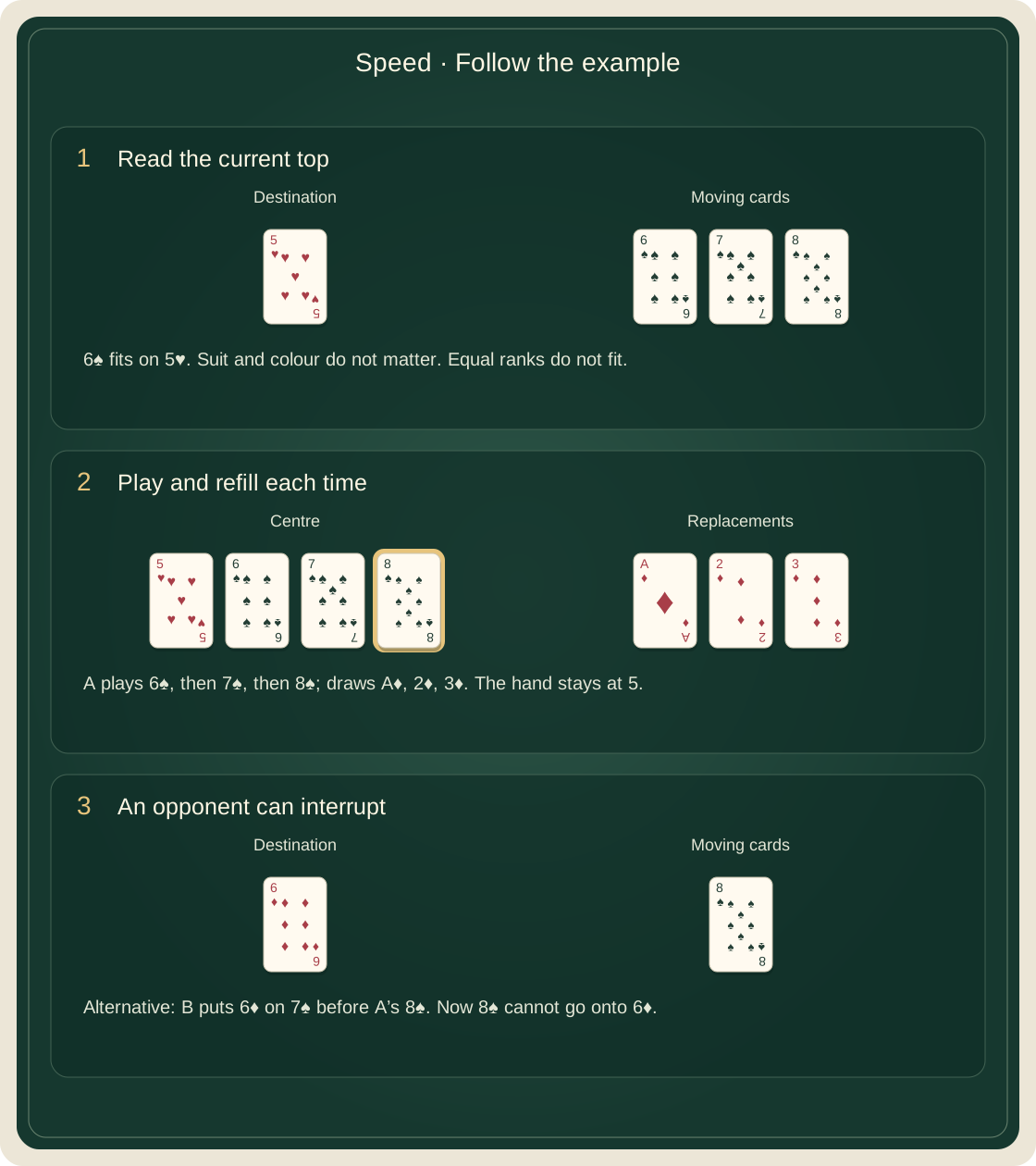
The left centre starts at 5♥. A holds 6♠, 7♠ and 8♠ among the hand. A plays 6♠, refills, then 7♠, refills, then 8♠ and refills: each move fits the new top. If B puts 6♦ on the 7♠ before that last move, A cannot still put 8♠ there. It is the actual top, not the intended sequence, that matters.
Open the checked play record
| Step | Player / action | Cards | Cards remaining |
|---|---|---|---|
| 1 | A | 6♠ → A♦ | 19 / 20 |
| 2 | A | 7♠ → 2♦ | 18 / 20 |
| 3 | A | 8♠ → 3♦ | 17 / 20 |
| 4 | A | 9♠ → A♠ | 16 / 20 |
| 5 | A | 10♠ → 2♠ | 15 / 20 |
| 6 | B | J♠ → 8♥ | 15 / 19 |
| 7 | B | Q♠ → 10♥ | 15 / 18 |
| 8 | B | K♥ → J♥ | 15 / 17 |
| 9 | A | A♠ → 3♠ | 14 / 17 |
| 10 | B | 9♥ → Q♥ | 14 / 16 |
| 11 | A | 2♠ → 4♠ | 13 / 16 |
| 12 | B | 8♥ → A♣ | 13 / 15 |
| 13 | A | A♦ → 5♠ | 12 / 15 |
| 14 | A | 2♦ → K♠ | 11 / 15 |
| 15 | A | 3♠ → A♥ | 10 / 15 |
| 16 | A | 4♠ → 2♥ | 9 / 15 |
| 17 | A | 3♦ → 3♥ | 8 / 15 |
| 18 | A | 2♥ → 4♥ | 7 / 15 |
| 19 | A | A♥ → 6♥ | 6 / 15 |
| 20 | A | K♠ → 7♥ | 5 / 15 |
| 21 | B | A♣ → 2♣ | 5 / 14 |
| 22 | A | 7♥ | 4 / 14 |
| 23 | B | 6♦ → 3♣ | 4 / 13 |
| 24 | B | 2♣ → 4♣ | 4 / 12 |
| 25 | A | 5♠ | 3 / 12 |
| 26 | B | 3♣ → 5♣ | 3 / 11 |
| 27 | A | 4♥ | 2 / 11 |
| 28 | A | 6♥ | 1 / 11 |
| 29 | B | 5♣ → 6♣ | 1 / 10 |
| 30 | B | 6♣ → 7♣ | 1 / 9 |
| 31 | B | 7♣ → 8♣ | 1 / 8 |
| 32 | B | 8♣ → 9♣ | 1 / 7 |
| 33 | B | 9♣ → 10♣ | 1 / 6 |
| 34 | B | 10♥ → J♣ | 1 / 5 |
| 35 | B | J♥ | 1 / 4 |
| 36 | B | 10♣ | 1 / 3 |
| 37 | B | J♣ | 1 / 2 |
| 38 | B | Q♥ | 1 / 1 |
| 39 | Restart centre | K♣ / 9♦ | — |
| 40 | Restart centre | 4♦ / 10♦ | — |
| 41 | A | 3♥ | 0 / 1 |
← On a small screen, scroll the diagram horizontally. →
07 /
What to watch at the table
Keep the hand readable and watch both tops. Playing a card changes opportunities for both people, so do not assume you own a pile. Fast recognition is more useful than throwing cards blindly. If cards collide, identify the first legal placement and return the other card to its owner; agree this handling rule before racing.
08 /
Choose the rules before starting
Some rules distribute 15 total personal cards rather than 20, with larger side reserves. Some allow equal ranks or wild jokers. None of those changes applies here. Spit uses face-up columns and repeated redistribution; California Speed covers matching values. Names overlap in households, but their setup and victory conditions differ.
09 /
History and related games
Speed belongs to the family of simultaneous competitive patience games. Its rules circulate as a traditional teaching game rather than one publisher’s unique invention. A university activity guide documents the five-card-hand layout, while specialist descriptions distinguish it from tableau Spit. These sources establish the selected form without proving a particular inventor or birthplace.
10 /
Check your understanding
Can a king go on an ace?
Show the answer
Yes. The rank loop connects them; suit does not matter.
May you restart while the opponent can still play?
Show the answer
No. A restart requires both players to be blocked.
Common questions
Does the same rank fit?+
Not in this adjacent-rank profile.
Is an empty hand enough while stock remains?+
No. Refill and finish the personal stock too.
Do side reserves belong to either player?+
No. They restart the shared piles and do not count as personal cards.