← On a small screen, scroll the diagram horizontally. →
01 /
The game at a glance
Own the highest trump at the end of the deal. A card’s owner can change through an agreed sale. Cards outside trump never win the pool, however high their rank. Keep the central pool distinct from the counters paid directly to sellers.
02 /
Prepare and deal
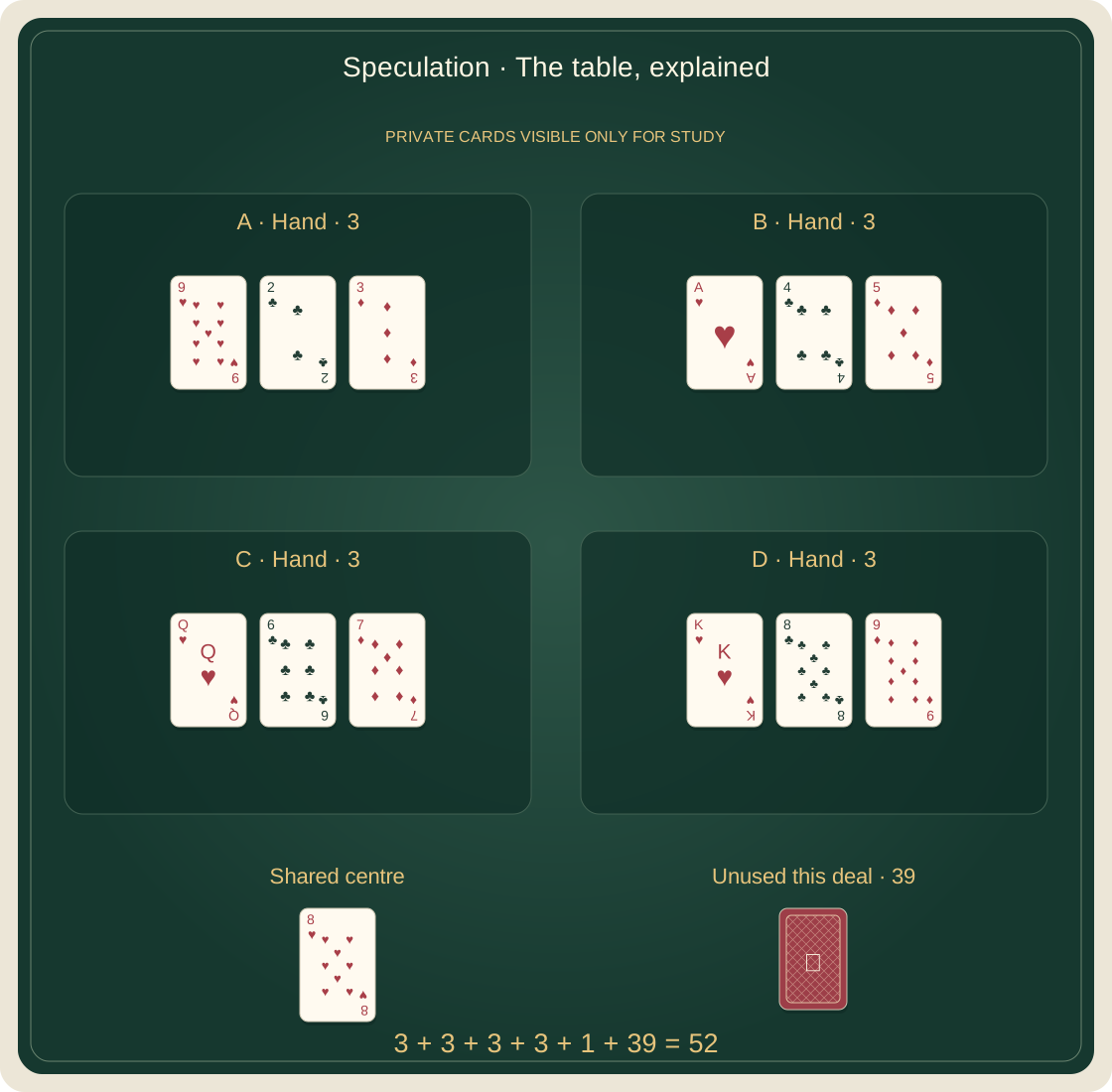
Use 52 cards without jokers, ranked A K Q J 10 down to 2. Each player contributes 1 counter. Deal 3 face-down cards in a stack to each player, then turn another card up as trump. The turn-up belongs to the dealer, in addition to that stack. The unused pack stays out of this deal. Do not inspect hidden cards.
03 /
How play proceeds
If the turn-up is an ace, the dealer wins immediately. Otherwise the dealer may retain or sell it. Begin revealing at the dealer’s left, or the buyer’s left after a sale. Turn only the top card of your stack. Continue clockwise, skipping the current owner of the highest trump. After a higher trump appears, continue from its owner’s left, or its buyer’s left if sold.
04 /
Rules that change your decision
Owners may refuse offers, negotiate a price or auction a card. Payment goes to its seller, not into the pool. Hidden cards may also be sold without inspection; the buyer places them at the bottom of their stack. Never let a purchase secretly reveal a card. An accepted sale transfers ownership; an offer alone does not.
05 /
Finish and scoring
An exposed trump ace ends the deal immediately. Otherwise finish once no rival of the highest-trump owner has a hidden card left; the holder’s remaining cards cannot change who wins, so reveal them for checking without reopening trade. Award the whole pool to the highest-trump owner. Move dealer left and agree the number of deals before a session.
06 /
A worked example
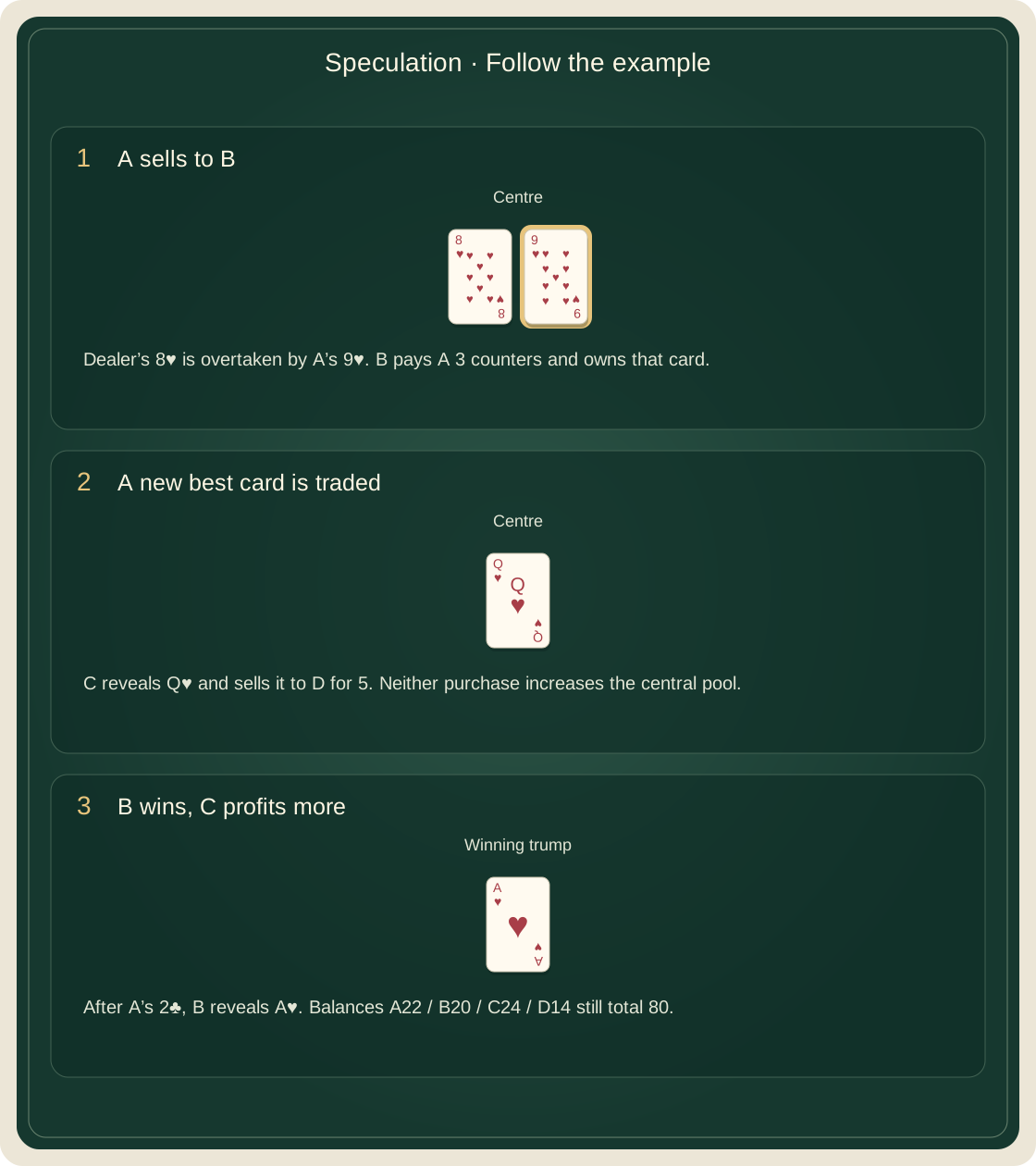
Four players start with 20 counters each and contribute 1: pool 4. Dealer D shows 8♥. A reveals 9♥ and sells it to B for 3. Continue at C, who reveals Q♥ and sells it to D for 5. A next shows 2♣; B then exposes A♥ and wins. Final balances: A 22, B 20, C 24, D 14. Total remains 80; the winning buyer need not make the largest profit.
← On a small screen, scroll the diagram horizontally. →
07 /
What to watch at the table
Before buying, count trumps that could still beat the card and compare the price with the pool. An ace guarantees ownership of the pool, but a king does not while the ace is hidden. A sale can be rational even if you expect your card to win: the price may exceed the uncertain prize.
08 /
Choose the rules before starting
The original historical account uses different contributions for dealer and others. Some tables add a spare hand that can carry the pool over, or penalties on certain ranks. These are excluded here. The end procedure above explicitly resolves the highest holder’s delayed cards; it does not allow rivals another purchase after they have exhausted their stacks.
09 /
History and related games
Speculation appears in English domestic card-game literature and in Jane Austen’s Mansfield Park. Parlett prints an older Hoyle account alongside his reconstruction for a film adaptation. Those descriptions differ in details; our equal-ante lesson follows the reconstruction rather than silently combining both accounts.
10 /
Check your understanding
Does a queen of another suit beat the trump 8?
Show the answer
No. Only the trump suit can win this pool.
Does the seller’s payment increase the pool?
Show the answer
No. It goes directly from buyer to seller.
Common questions
Are there tricks?+
No. Cards are revealed and traded; nobody follows a led suit.
May a seller reject the highest offer?+
Yes. Selling is voluntary.
Can a buyer inspect a face-down card?+
No. It stays hidden and goes under the buyer’s stack.