← On a small screen, scroll the diagram horizontally. →
01 /
The game at a glance
Each player faces the dealer, not the other players. Make a total no higher than 21 and beat the dealer, or survive while the dealer busts. A player’s natural blackjack beats even a dealer natural. Ordinary equal totals below 21 push. A total over 21 loses immediately, even if the dealer later busts.
02 /
Prepare and deal
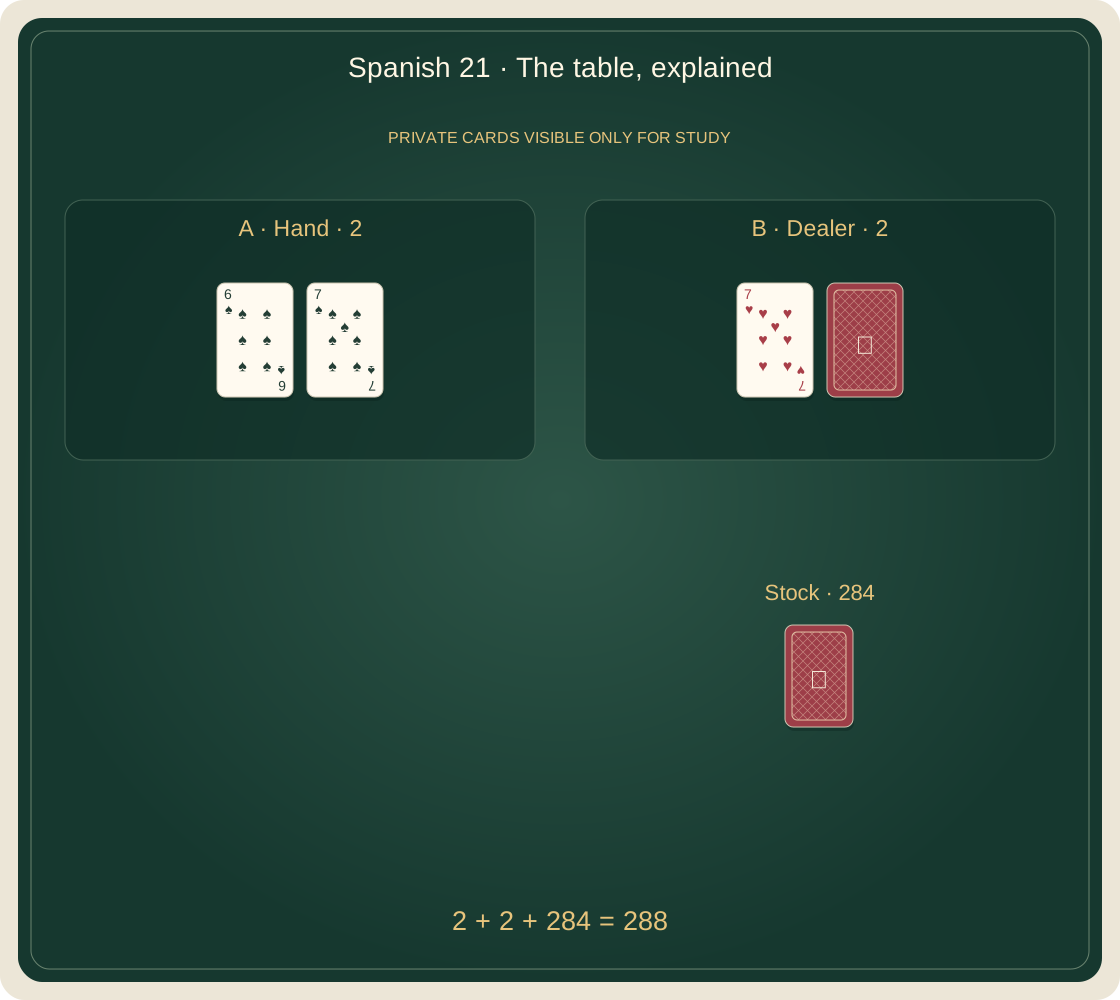
Remove the 10 of every suit from each pack, leaving A, 2–9, J, Q, K: 48 per pack and 288 in the 6-pack shoe. No jokers or special illustrated cards are needed. J/Q/K count 10, aces 1 or 11, other cards their number. Place the initial stake before receiving 2 cards; dealer has 1 exposed and 1 hidden card.
03 /
How play proceeds
Against an exposed ace, insurance is optional, up to half the original stake; it pays 2:1 only on dealer blackjack. With an ace or picture showing the dealer checks before further player actions. Pay player naturals at 3:2; other hands lose to dealer blackjack. Otherwise act in seat order: hit, stand, split, double or late surrender. An unsplit initial ace plus picture is a natural; split-card 21 is not.
04 /
Rules that change your decision
Late surrender gives up the first 2 cards and loses half the original stake after the dealer check. Split equal values, including aces, with an equal extra stake, to at most 4 hands; those hands may hit and double. Double once on 2 or more cards: add the original stake and receive exactly 1 card. With a non-busted doubled hand, rescue returns that added stake and loses the original. No rescue after busting.
05 /
Finish and scoring
The dealer reveals the hidden card after player actions, draws on soft 17 or lower and stands on hard 17 or higher. An ace counts high only while the total permits it. A player 21 wins against a dealer 21. Ordinary wins pay 1:1 profit, naturals 3:2. In this profile ordinary bonuses remain available after splitting, but not after doubling; a split hand never receives a natural-blackjack payout.
06 /
A worked example
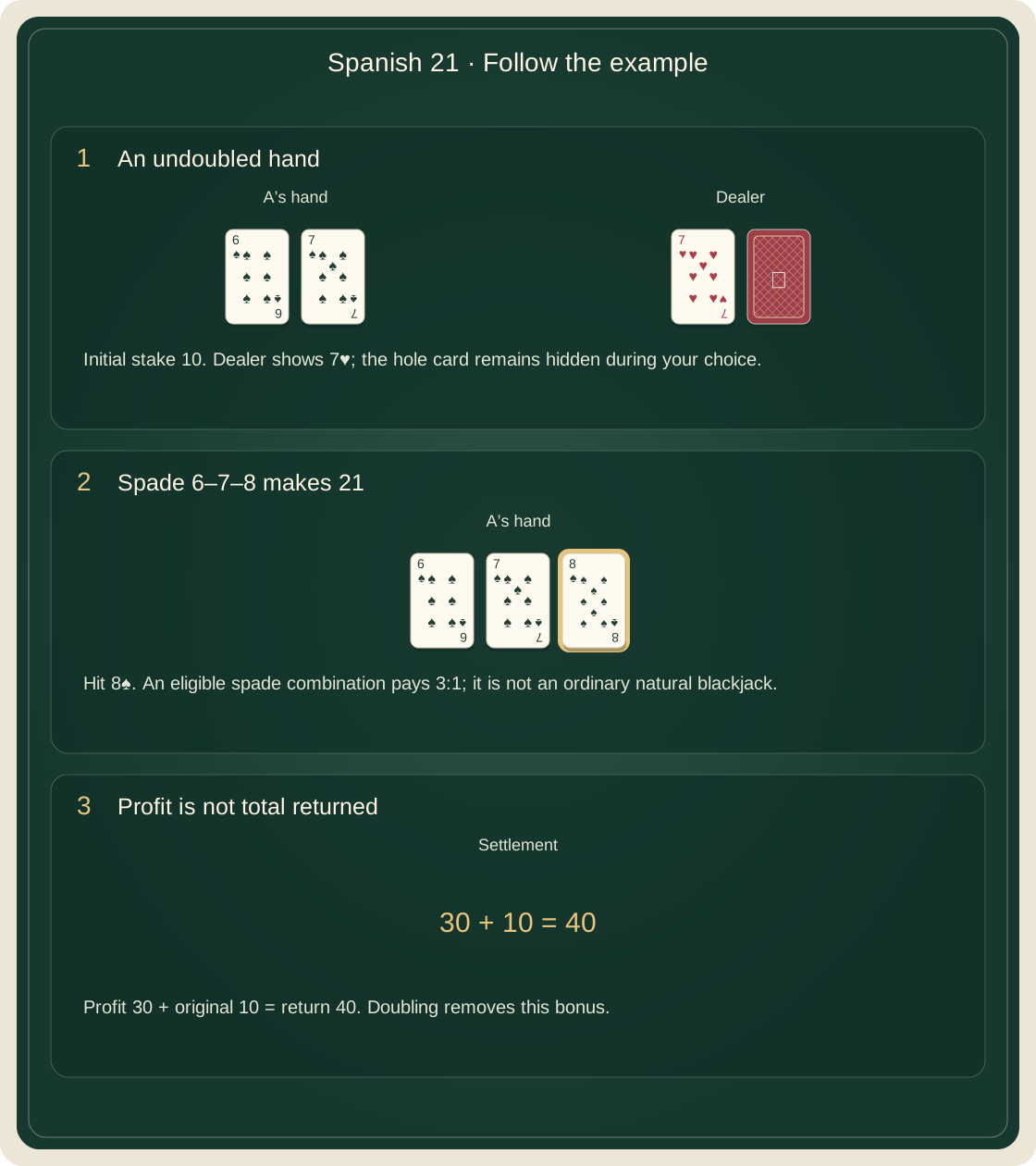
You stake 10 and receive 6♠, 7♠; the dealer shows 7♥ with 9♦ hidden. Hit 8♠: your 21 is the spade 6–7–8 bonus, paying 3:1. Profit 30, returned stake 10, total returned 40. If you had doubled before drawing 8♠, that bonus would be unavailable: a winning doubled stake of 20 returns 40, only 20 profit. The first result does not require predicting the dealer’s next card.
← On a small screen, scroll the diagram horizontally. →
07 /
What to watch at the table
Undoubled 21 bonuses: 5 cards pay 3:2; 6 cards 2:1; 7 or more 3:1. The combinations 6–7–8 and 7–7–7 pay 3:2 in mixed suits, 2:1 in one suit, 3:1 in spades. Apply the qualifying payout, not several bonuses added together. Read the stake as well as the ratio: 3:1 is profit plus return of the stake.
08 /
Choose the rules before starting
The selected Super Bonus requires unsplit, undoubled suited 7–7–7 against a dealer 7: original stakes $3–24 receive $1000, $25 or more $5000; other betting players receive $50. These are this published schedule, not a universal promise. Insurance is separate; Match the Dealer and progressives are outside this lesson. Check local soft-17, split limits, split bonuses and redemption rules before play.
09 /
History and related games
Spanish 21 is a modern casino variant using an ordinary French-suited pack with numbered tens removed; it does not require a traditional Spanish-suited deck. The inspected Clearwater document carries approvals from 2012, evidence for that published ruleset rather than an invention date. Other operators publish different conditions, so the game’s name alone cannot establish every payout.
10 /
Check your understanding
Does removing tens also remove J, Q and K?
Show the answer
No. Picture cards remain and each counts 10.
Does a doubled spade 6–7–8 earn the bonus?
Show the answer
No. Doubling excludes bonus payouts in this profile.
Common questions
Can a soft ace become low later?+
Yes. Its value changes to avoid busting where possible.
Is 21 after splitting a natural?+
No. It is a winning total but not an original-hand blackjack.
Does rescue return every stake?+
No. It returns the added double stake and forfeits the original.