← On a small screen, scroll the diagram horizontally. →
01 /
The game at a glance
Be the first to empty your hand. The leader chooses a card, then the holders of the next cards in the same suit supply them. A sequence stops after 5 cards or sooner if the next card is unavailable. Its last player chooses the next opening.
02 /
Prepare and deal
Remove jokers and shuffle. Deal all 52 cards singly clockwise, beginning on the dealer’s left. Unequal hands are allowed when the pack does not divide evenly. Everyone looks at their own cards. The first leader is the player to the dealer’s left; move the deal left after each hand.
03 /
How play proceeds
Cards run A, 2 through 10, J, Q, K in each suit. Lead any held card and say “snip”. Whoever holds its immediate successor in that suit plays it, regardless of seating order. The next calls are “snap”, “snorum”, “high cockalorum”, “jingo”. Play a required successor even if it is your own card again.
04 /
Rules that change your decision
The 5th card ends the sequence. It also ends early at a king or if the required successor has already been played. The last player says “jingo” and leads any remaining card. Suits never change within a sequence, and K does not connect to A. Since the entire pack is dealt, a missing successor is an earlier played card, not an unseen stock card.
05 /
Finish and scoring
As soon as somebody plays their final card, stop immediately, even before a sequence is complete. Every opponent pays that player 1 counter per card still held. Use counters simply as points. For a session, agree a fixed number of deals and compare net counters; the hand winner need not be the session leader.
06 /
A worked example
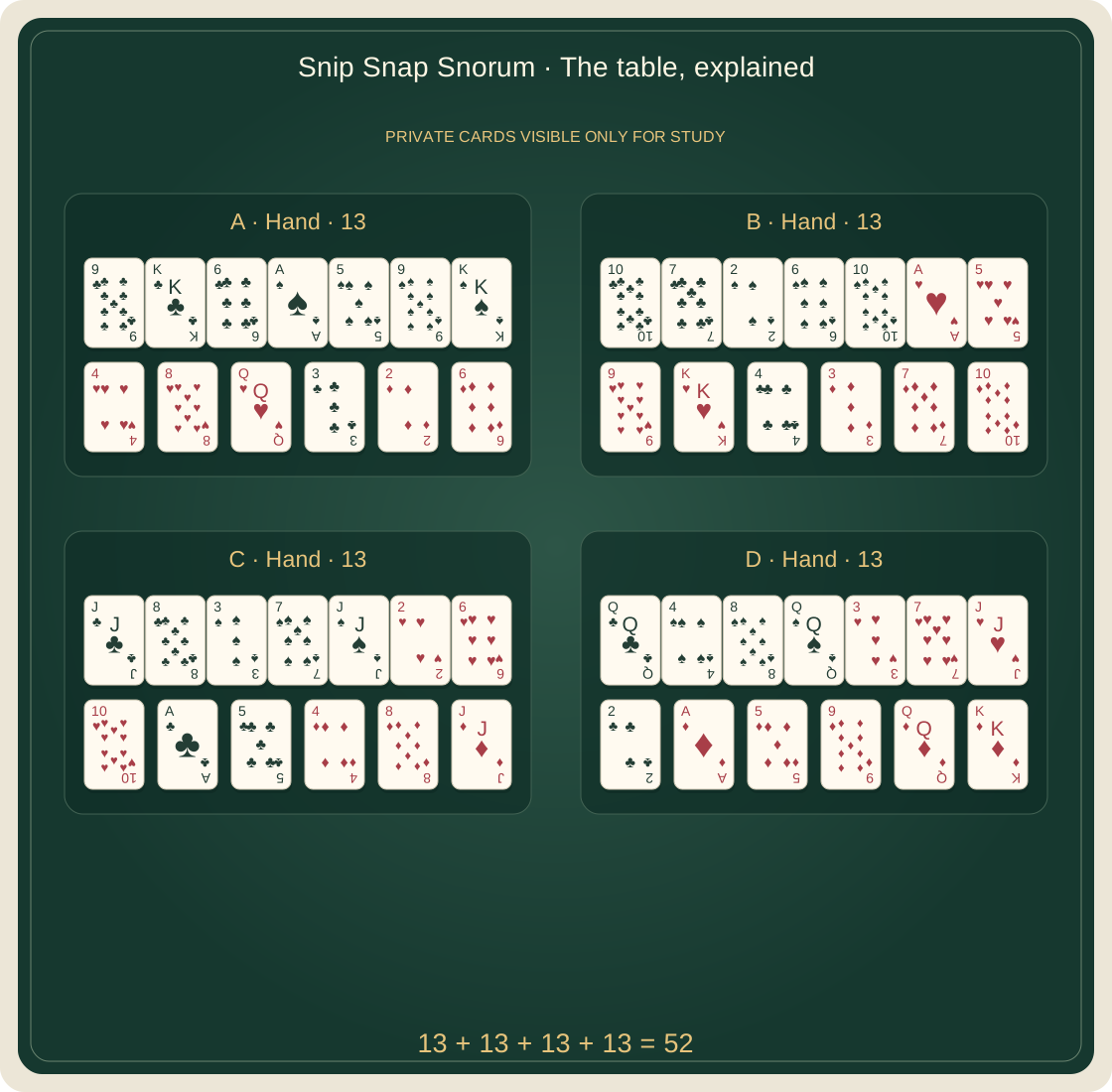
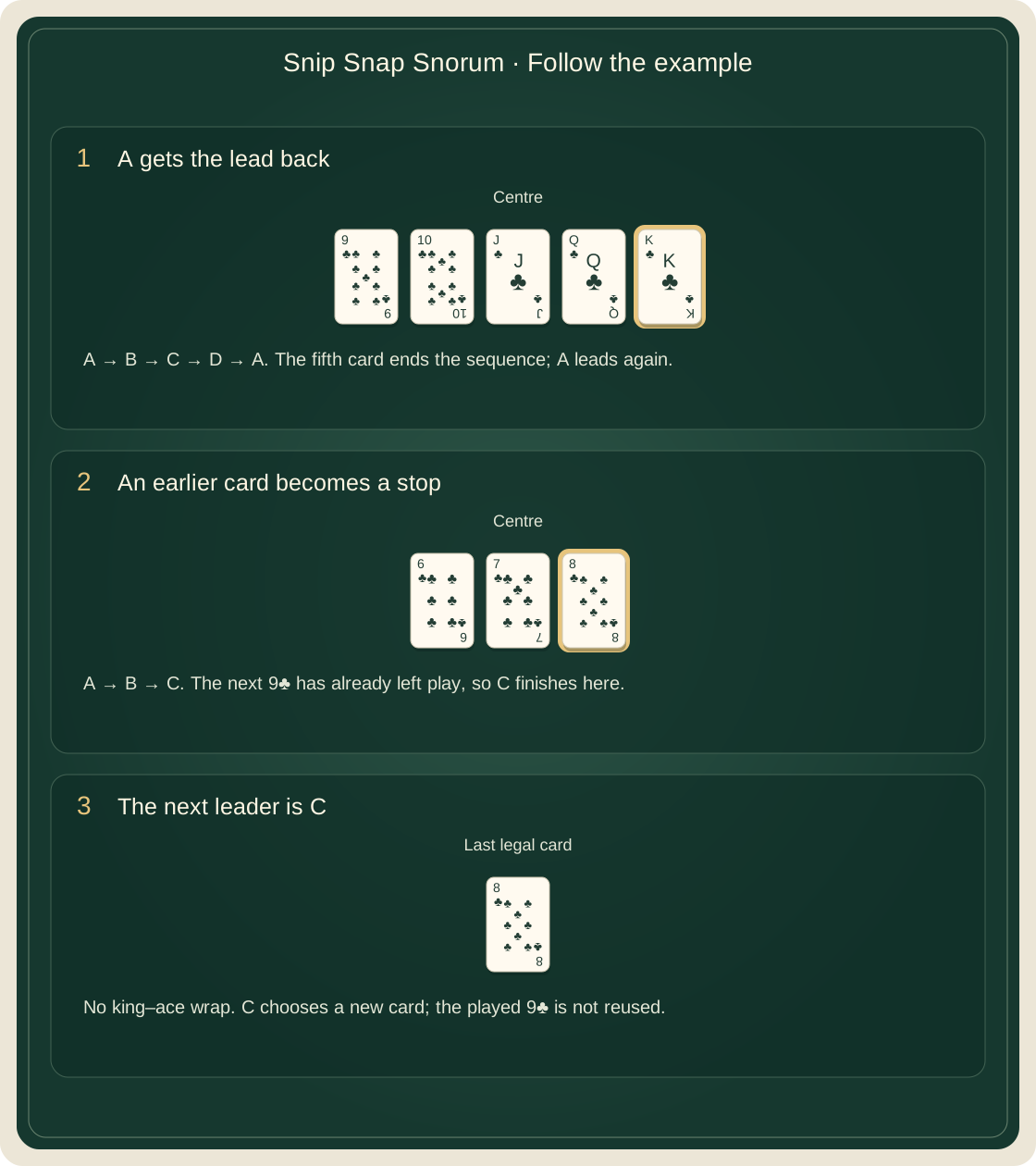
A opens 9♣. B plays 10♣, C J♣, D Q♣ and A K♣: 5 cards, so A leads again. A chooses 6♣; B supplies 7♣ and C 8♣. The required 9♣ is already out, so this sequence ends after 3 cards and C leads next. The illustrated hands contain each physical card only once.
Open the checked play record
| Step | Player / action | Cards | Cards remaining |
|---|---|---|---|
| 1 | A | 9♣ | 12 / 13 / 13 / 13 |
| 2 | B | 10♣ | 12 / 12 / 13 / 13 |
| 3 | C | J♣ | 12 / 12 / 12 / 13 |
| 4 | D | Q♣ | 12 / 12 / 12 / 12 |
| 5 | A | K♣ | 11 / 12 / 12 / 12 |
| 6 | A | 6♣ | 10 / 12 / 12 / 12 |
| 7 | B | 7♣ | 10 / 11 / 12 / 12 |
| 8 | C | 8♣ | 10 / 11 / 11 / 12 |
| 9 | C | 3♠ | 10 / 11 / 10 / 12 |
| 10 | D | 4♠ | 10 / 11 / 10 / 11 |
| 11 | A | 5♠ | 9 / 11 / 10 / 11 |
| 12 | B | 6♠ | 9 / 10 / 10 / 11 |
| 13 | C | 7♠ | 9 / 10 / 9 / 11 |
| 14 | C | J♠ | 9 / 10 / 8 / 11 |
| 15 | D | Q♠ | 9 / 10 / 8 / 10 |
| 16 | A | K♠ | 8 / 10 / 8 / 10 |
| 17 | A | A♠ | 7 / 10 / 8 / 10 |
| 18 | B | 2♠ | 7 / 9 / 8 / 10 |
| 19 | B | 10♠ | 7 / 8 / 8 / 10 |
| 20 | B | A♥ | 7 / 7 / 8 / 10 |
| 21 | C | 2♥ | 7 / 7 / 7 / 10 |
| 22 | D | 3♥ | 7 / 7 / 7 / 9 |
| 23 | A | 4♥ | 6 / 7 / 7 / 9 |
| 24 | B | 5♥ | 6 / 6 / 7 / 9 |
| 25 | B | 9♥ | 6 / 5 / 7 / 9 |
| 26 | C | 10♥ | 6 / 5 / 6 / 9 |
| 27 | D | J♥ | 6 / 5 / 6 / 8 |
| 28 | A | Q♥ | 5 / 5 / 6 / 8 |
| 29 | B | K♥ | 5 / 4 / 6 / 8 |
| 30 | B | 4♣ | 5 / 3 / 6 / 8 |
| 31 | C | 5♣ | 5 / 3 / 5 / 8 |
| 32 | C | 6♥ | 5 / 3 / 4 / 8 |
| 33 | D | 7♥ | 5 / 3 / 4 / 7 |
| 34 | A | 8♥ | 4 / 3 / 4 / 7 |
| 35 | A | 9♠ | 3 / 3 / 4 / 7 |
| 36 | A | 3♣ | 2 / 3 / 4 / 7 |
| 37 | A | 2♦ | 1 / 3 / 4 / 7 |
| 38 | B | 3♦ | 1 / 2 / 4 / 7 |
| 39 | C | 4♦ | 1 / 2 / 3 / 7 |
| 40 | D | 5♦ | 1 / 2 / 3 / 6 |
| 41 | A | 6♦ | 0 / 2 / 3 / 6 |
← On a small screen, scroll the diagram horizontally. →
07 /
What to watch at the table
Before leading, locate the likely last card of your proposed sequence. It can be worth keeping a low card until higher cards have left play: that low run will then stop earlier. Do not assume that clockwise seating determines who contributes the next card; ownership of the required card does.
08 /
Choose the rules before starting
The equal-rank version collects the other cards of a rank and may charge pass or matching penalties. It is not the sequence profile above. Other sequence versions use 4 cards or allow K–A wrap. Changing either rule changes who gains the next lead, so agree before the deal rather than halfway through it.
09 /
History and related games
The name belongs to an old family of British and German round games. Historical descriptions include sequence play, while later accounts also use matching ranks. Surviving descriptions therefore establish a family of rules rather than a single universal version. Similar chants do not by themselves prove that Snap has exactly the same origin.
10 /
Check your understanding
Does a king need an ace next?
Show the answer
No. In this profile the king stops the sequence; there is no wrap.
Who leads after 6♣, 7♣, 8♣ if 9♣ was played earlier?
Show the answer
The player of 8♣. The earlier 9♣ blocks any continuation.
Common questions
Do players act clockwise?+
The deal does; within a sequence the holder of the required card plays.
Is a same-rank card enough?+
No. This profile requires the next higher card of the same suit.
Must a player wait to finish a sequence to win?+
No. Playing the last held card ends the hand immediately.