← On a small screen, scroll the diagram horizontally. →
01 /
A session and its contracts
4 play in opposite partnerships. A standard session has 3 sets of 8 deals, changing partners between sets so everyone partners everyone: 4 Kitty deals then 4 Kotka deals per set. A short session uses 2 plus 2 per partnership, 12 deals total. Highest individual cumulative score wins. A second pack is convenient for shuffling but never mixed into the active 52 cards.
02 /
Level and denomination
Ranks are A high, K, Q, J, 10 down to 2. A trump or grand bid at level L promises at least 6+L tricks; grand means no trump. Misère promises at most 7−L tricks, with no trump and additional penalties for capturing aces. Thus 5 hearts needs 11 tricks, 6 misère allows at most 1. Ordinary card values do not score in positive contracts.
03 /
The Kitty deal and first auction
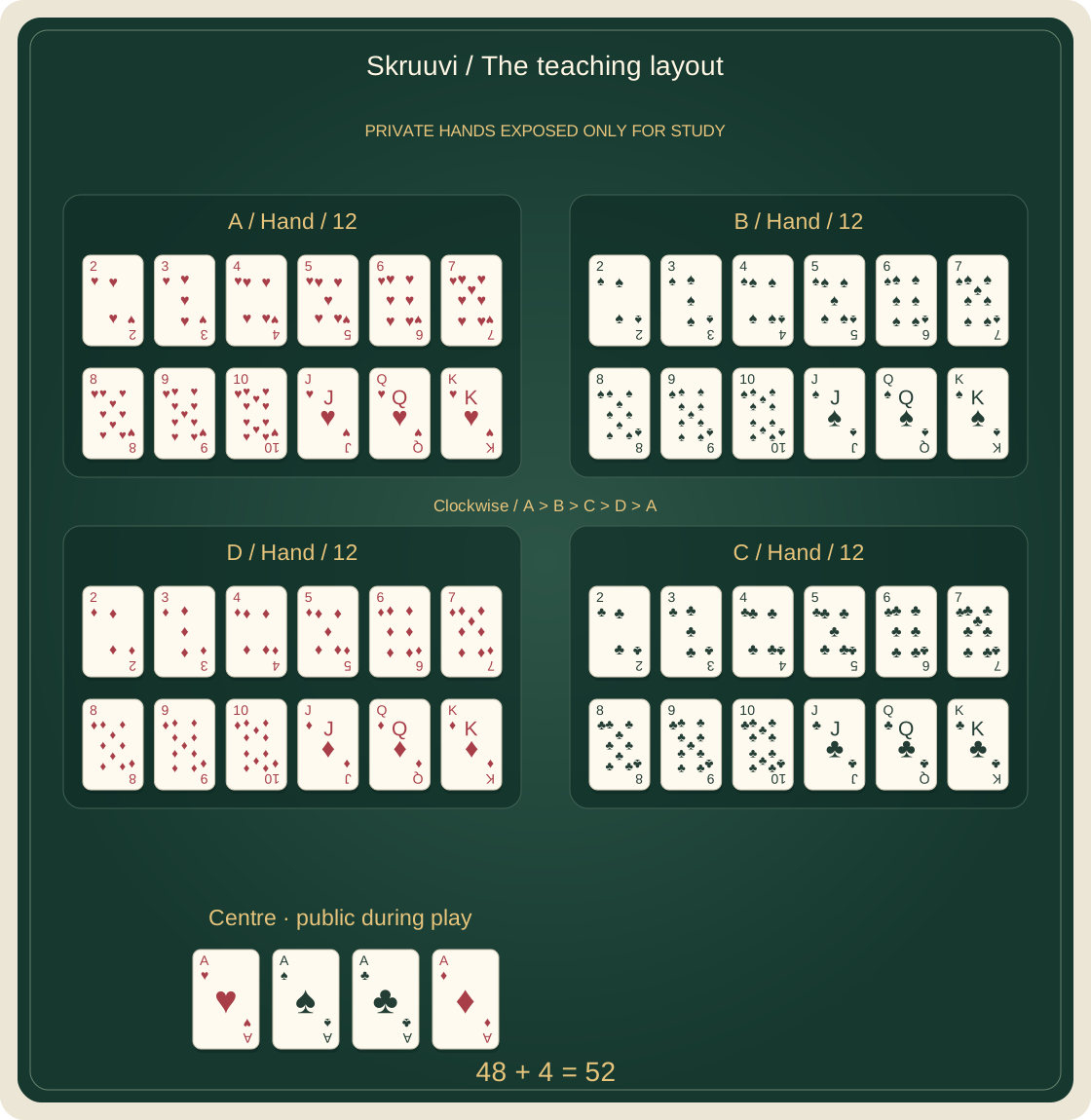
Deal 12 each and 4 face-down kitty cards during the deal. The kitty cannot contain top or bottom card or 4 consecutive cards. Dealer bids first. Ascending denominations are misère, spades, clubs, diamonds, hearts, grand. Levels run 1–7; raise the level or same-level denomination. 4 initial passes lead to all-pass misère. Otherwise 8 consecutive passes end the auction; a passer may re-enter.
04 /
Kitty exchange and extended auction
The last bidder exposes and takes all 4 kitty cards, then passes any 4 face down to partner. Partner adds them and gives 1 card to each other player, keeping 13. Bidder also finishes 13. Only these main players now bid, starting with kitty bidder; 4 consecutive passes end this stage. Final level must be at least 5. Final bidder is declarer, not necessarily the first to name the denomination.
05 /
Defender exchange and doubling
If the main side’s first bid was below level 6, defenders may exchange 1: declarer’s left passes 1 across, partner returns 1. Then declarer’s left has first chance to double, followed by the other defender. After a double, the main player left of the doubler may redouble, then partner if needed. Double is factor 2, redouble factor 3. Keep ace penalties outside either multiplier.
06 /
Kotka has no kitty
Deal 13 each. Dealer starts; minimum level is 6. Denominations now ascend spades, clubs, diamonds, hearts, misère, grand. The first auction still needs 8 consecutive passes after a bid. Highest bidder passes 4 to partner and receives 4 back. Main players extend until 4 passes; defenders do not exchange, but may double and be redoubled in the same order. Do not call the 4-card kitty Kotka.
07 /
All-pass misère
After 4 initial passes, in a Kitty deal give 1 kitty card to each player. Dealer’s left and dealer’s partner each pass 1 across; receivers return 1. Dealer gets first double opportunity, then clockwise; opponents of a doubler may redouble, left first. Dealer’s left leads. Each captured trick costs its team 1, multiplied if doubled or redoubled; every captured ace separately costs its trick number. Compare both teams’ penalties for the score difference.
08 /
All 13 tricks
In a bid contract declarer’s left leads. Everyone follows suit if able; otherwise any card, with no duty to trump or overtrump. Highest trump wins, or highest card of led suit without trump. Winner leads next. All 4 play their own hidden hands throughout. A suit’s bidding priority never breaks a trick tie and never changes card rank.
09 /
Scoring the bid
For levels 5, 6, 7, successful trump or grand scores 25, 35, 50; successful misère 10, 20, 35. Each extra favourable trick scores 2: extra tricks above target in positive contracts, fewer tricks than allowed in misère. Failure scores no success bonus. First shortfall costs 5, 10, 15 in positive play, or 10, 15, 20 in misère; each further unfavourable trick costs 5.
10 /
Ace penalties and individual totals
In misère each captured ace costs its team the trick number, from 1 to 13; each ace in the same trick is charged separately. These penalties are never multiplied. For a redoubled 6 misère, suppose declarers take exactly 1 trick with an ace on trick 4, and opponents take the other aces on tricks 2, 9 and 13. The result is 20 × 3 − 4 + 2 + 9 + 13 = 80.
11 /
Record a signed result
Write 1 signed partnership result per deal; opponents have the opposite result. At the end of the partnership set add that result to each partner’s individual total and subtract it from each opponent. Change partners for the next set, keeping individual totals. The no-bid ace-and-trick penalties also settle as a difference. Optional Bolshevik has separate solo scoring and is not added to this partnership session without an explicit extra rules agreement.
12 /
A complete exchange and grand-sweep lesson
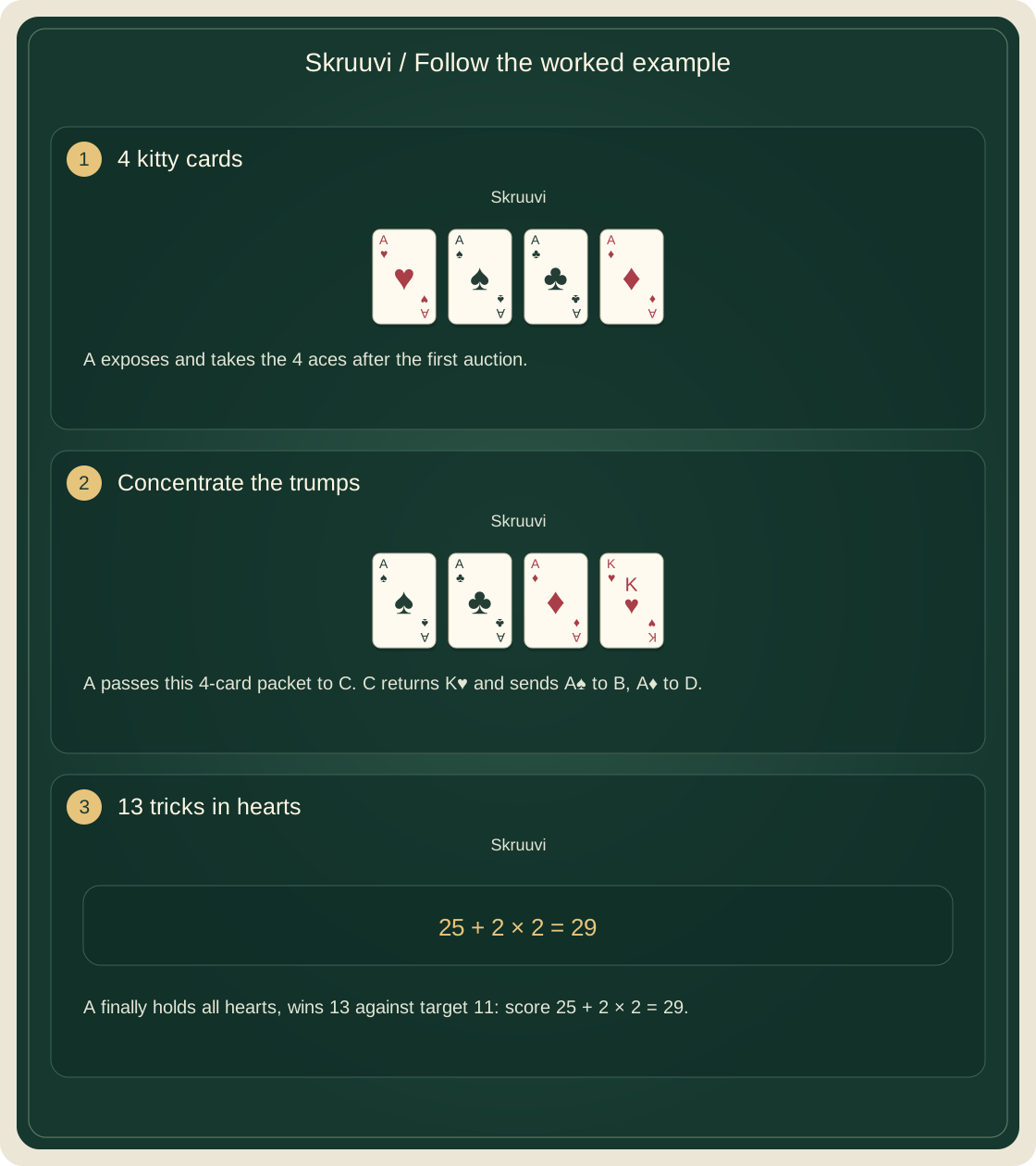
A deals and bids 5 hearts; after 8 passes A takes kitty A♥ A♠ A♣ A♦. A passes A♠ A♣ A♦ K♥ to C. C gives K♥ to A, A♠ to B and A♦ to D. Main players pass 4 times. B and D exchange 2♠ for 2♦; nobody doubles. A now has all 13 hearts. B leads, A trumps and wins every trick. Contract needs 11, takes 13: 25+2×2=29, not a special unlisted slam bonus.
Open the full play record
| Step | Play order | Cards | Winner |
|---|---|---|---|
| 1 | B → C → D → A | A♠ A♣ 2♠ 2♥ | A |
| 2 | A → B → C → D | 3♥ K♠ K♣ A♦ | A |
| 3 | A → B → C → D | 4♥ Q♠ Q♣ K♦ | A |
| 4 | A → B → C → D | 5♥ J♠ J♣ Q♦ | A |
| 5 | A → B → C → D | 6♥ 10♠ 10♣ J♦ | A |
| 6 | A → B → C → D | 7♥ 9♠ 9♣ 10♦ | A |
| 7 | A → B → C → D | 8♥ 8♠ 8♣ 9♦ | A |
| 8 | A → B → C → D | 9♥ 7♠ 7♣ 8♦ | A |
| 9 | A → B → C → D | 10♥ 6♠ 6♣ 7♦ | A |
| 10 | A → B → C → D | J♥ 5♠ 5♣ 6♦ | A |
| 11 | A → B → C → D | Q♥ 4♠ 4♣ 5♦ | A |
| 12 | A → B → C → D | K♥ 3♠ 3♣ 4♦ | A |
| 13 | A → B → C → D | A♥ 2♦ 2♣ 3♦ | A |
← On a small screen, scroll the diagram horizontally. →
13 /
From Vint to modern Finnish play
Skruuvi developed from Russian Vint in Finland; its name corresponds to screw, suggesting tightening bids. The Helsinki Finnish Club records play since its founding in 1876 and an early guide in 1895. The modern 2016 handbook documents extensive later development. Historical tables with 36 or 49 and factor-4 redoubles belong to earlier rules, not this selected profile.
14 /
Conventions are information, not extra legality
Bidding and the order of a passed packet can convey agreed information about suits, honours or voids. Such conventions must be disclosed and explained to opponents; they do not change the legal auction or replace following suit. Beginners can start with natural descriptions and honest agreed signals. No coded table talk or secret partnership system is needed to execute the example.
15 /
Check your understanding
Does redouble multiply ace penalties?
Reveal the answer
No. Multiply contract and over/undertrick amounts by 3; then settle ace penalties separately.
Does a successful level 5 require only 5 tricks?
Reveal the answer
No. A positive level 5 contract needs 11 tricks; level 5 misère allows at most 2.
Common questions
Is there a dummy?+
No. All 4 play their own cards.
Does Kotka use a kitty?+
No. Kotka is the no-kitty format.
Do 3 passes end the first auction?+
No. After a bid this profile needs 8 consecutive passes.