← On a small screen, scroll the diagram horizontally. →
01 /
Your first round
Expose one stock card. Play it directly to a legal foundation or put it on any holding pile. Only then expose the next stock card. Whenever useful, move an exposed holding-pile top onto a legal foundation. Repeat until all cards are home or no progress is possible. Never move a card from one holding pile to another, even into an empty pile.
02 /
Cards, seats and the deal
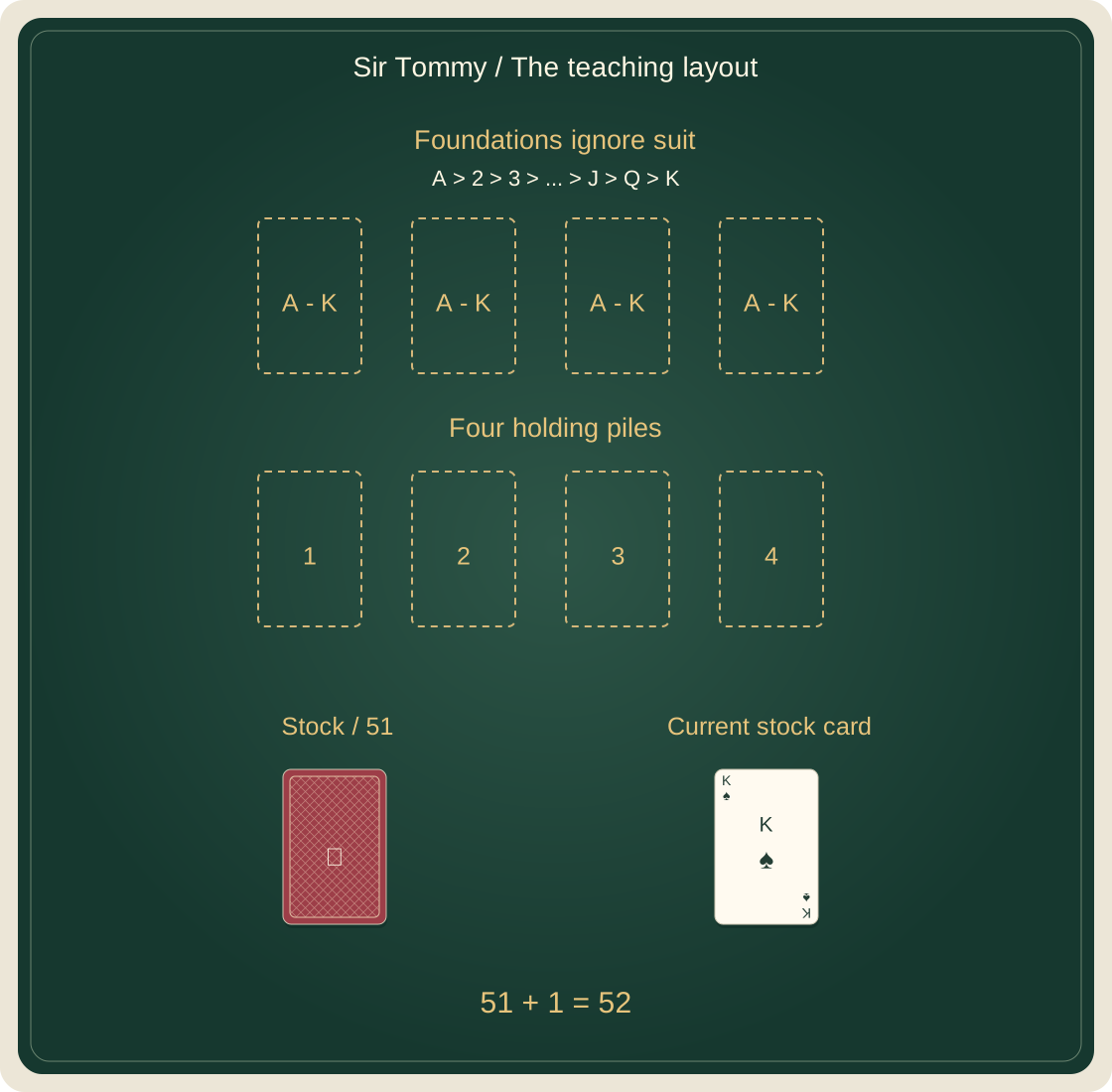
Shuffle all 52 ordinary cards, without jokers. Make a face-down stock and turn its top card face up as the current card. Leave four foundation positions and four holding positions empty. The visible current card belongs to the stock process, not a fifth storage pile. In the diagram K♠ is current and 51 remain closed: 1 + 51 = 52, with no initial cards hidden in the empty piles.
03 /
Foundations ignore suit
Any ace starts an empty foundation. Then add the next rank, regardless of suit or colour, until king: A, 2, 3, 4, 5, 6, 7, 8, 9, 10, J, Q, K. For example A♠–2♥–3♣ is legal. A foundation has exactly one card of each rank when complete. Do not wrap king to ace, remove a foundation card or transfer it to another foundation. You may choose which legal foundation to advance.
04 /
What happens on your turn
A current stock card can be put on any holding pile without a building condition. Only the fully exposed end of each pile can later go to a foundation; covered cards wait. You cannot move a packet or sort within a pile. Empty holding spaces can receive only a stock card, never another pile’s top. After stock is exhausted, continue any foundation moves still possible, but do not recycle the holding piles.
05 /
How to choose a holding pile
Try to leave small ranks above larger ranks: a 3 on a king is often useful, a king on a needed 3 often blocks progress. This is advice, not a compulsory descending rule. Spread dangerous duplicate ranks and preserve access to twos. An empty pile is valuable only while future stock cards can enter it; it never becomes a free cell for rearranging already stored cards.
06 /
A complete worked example
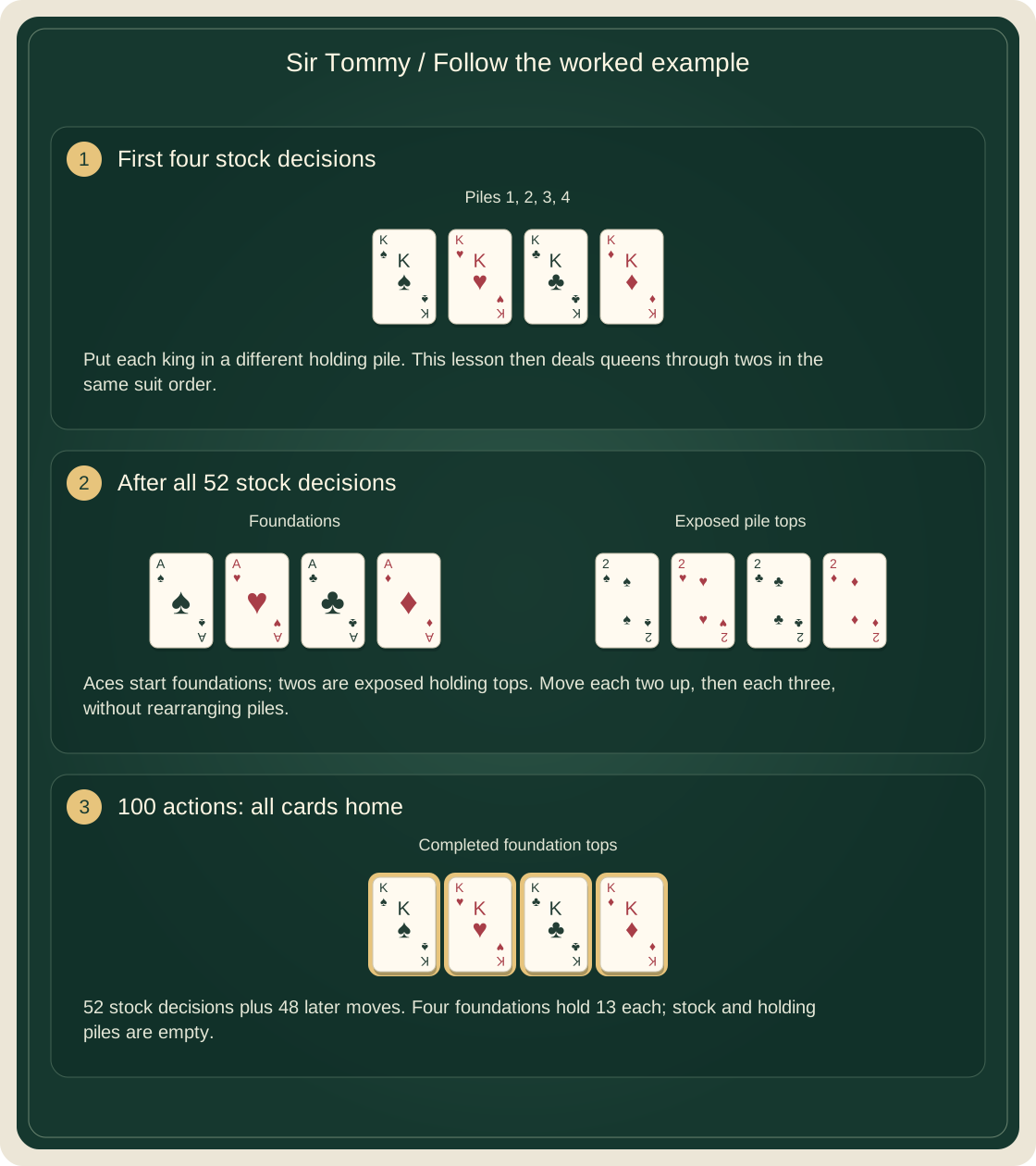
The lesson uses a deliberately ordered stock: K♠ K♥ K♣ K♦, then queens in that suit order, then jacks, tens, down to twos, then aces. Put each non-ace on its numbered holding pile: spades 1, hearts 2, clubs 3, diamonds 4. After 48 placements all four tops are twos; each king lies at the bottom. Put the final four aces directly on the four foundations.
← On a small screen, scroll the diagram horizontally. →
07 /
The complete solution
Now lift the exposed twos to the aces, then threes to twos, and continue to kings. The full record contains 52 stock decisions and 48 later foundation moves: 100 actions, four foundations of 13, no leftover stock or holding cards. Suit-separated storage makes this designed solution readable; mixed-suit foundations remain legal.
Open all 100 actions
| Action | Card | From | To |
|---|---|---|---|
| 1 | K♠ | Stock | Pile 1 |
| 2 | K♥ | Stock | Pile 2 |
| 3 | K♣ | Stock | Pile 3 |
| 4 | K♦ | Stock | Pile 4 |
| 5 | Q♠ | Stock | Pile 1 |
| 6 | Q♥ | Stock | Pile 2 |
| 7 | Q♣ | Stock | Pile 3 |
| 8 | Q♦ | Stock | Pile 4 |
| 9 | J♠ | Stock | Pile 1 |
| 10 | J♥ | Stock | Pile 2 |
| 11 | J♣ | Stock | Pile 3 |
| 12 | J♦ | Stock | Pile 4 |
| 13 | 10♠ | Stock | Pile 1 |
| 14 | 10♥ | Stock | Pile 2 |
| 15 | 10♣ | Stock | Pile 3 |
| 16 | 10♦ | Stock | Pile 4 |
| 17 | 9♠ | Stock | Pile 1 |
| 18 | 9♥ | Stock | Pile 2 |
| 19 | 9♣ | Stock | Pile 3 |
| 20 | 9♦ | Stock | Pile 4 |
| 21 | 8♠ | Stock | Pile 1 |
| 22 | 8♥ | Stock | Pile 2 |
| 23 | 8♣ | Stock | Pile 3 |
| 24 | 8♦ | Stock | Pile 4 |
| 25 | 7♠ | Stock | Pile 1 |
| 26 | 7♥ | Stock | Pile 2 |
| 27 | 7♣ | Stock | Pile 3 |
| 28 | 7♦ | Stock | Pile 4 |
| 29 | 6♠ | Stock | Pile 1 |
| 30 | 6♥ | Stock | Pile 2 |
| 31 | 6♣ | Stock | Pile 3 |
| 32 | 6♦ | Stock | Pile 4 |
| 33 | 5♠ | Stock | Pile 1 |
| 34 | 5♥ | Stock | Pile 2 |
| 35 | 5♣ | Stock | Pile 3 |
| 36 | 5♦ | Stock | Pile 4 |
| 37 | 4♠ | Stock | Pile 1 |
| 38 | 4♥ | Stock | Pile 2 |
| 39 | 4♣ | Stock | Pile 3 |
| 40 | 4♦ | Stock | Pile 4 |
| 41 | 3♠ | Stock | Pile 1 |
| 42 | 3♥ | Stock | Pile 2 |
| 43 | 3♣ | Stock | Pile 3 |
| 44 | 3♦ | Stock | Pile 4 |
| 45 | 2♠ | Stock | Pile 1 |
| 46 | 2♥ | Stock | Pile 2 |
| 47 | 2♣ | Stock | Pile 3 |
| 48 | 2♦ | Stock | Pile 4 |
| 49 | A♠ | Stock | Foundation 1 |
| 50 | A♥ | Stock | Foundation 2 |
| 51 | A♣ | Stock | Foundation 3 |
| 52 | A♦ | Stock | Foundation 4 |
| 53 | 2♠ | Pile 1 | Foundation 1 |
| 54 | 2♥ | Pile 2 | Foundation 2 |
| 55 | 2♣ | Pile 3 | Foundation 3 |
| 56 | 2♦ | Pile 4 | Foundation 4 |
| 57 | 3♠ | Pile 1 | Foundation 1 |
| 58 | 3♥ | Pile 2 | Foundation 2 |
| 59 | 3♣ | Pile 3 | Foundation 3 |
| 60 | 3♦ | Pile 4 | Foundation 4 |
| 61 | 4♠ | Pile 1 | Foundation 1 |
| 62 | 4♥ | Pile 2 | Foundation 2 |
| 63 | 4♣ | Pile 3 | Foundation 3 |
| 64 | 4♦ | Pile 4 | Foundation 4 |
| 65 | 5♠ | Pile 1 | Foundation 1 |
| 66 | 5♥ | Pile 2 | Foundation 2 |
| 67 | 5♣ | Pile 3 | Foundation 3 |
| 68 | 5♦ | Pile 4 | Foundation 4 |
| 69 | 6♠ | Pile 1 | Foundation 1 |
| 70 | 6♥ | Pile 2 | Foundation 2 |
| 71 | 6♣ | Pile 3 | Foundation 3 |
| 72 | 6♦ | Pile 4 | Foundation 4 |
| 73 | 7♠ | Pile 1 | Foundation 1 |
| 74 | 7♥ | Pile 2 | Foundation 2 |
| 75 | 7♣ | Pile 3 | Foundation 3 |
| 76 | 7♦ | Pile 4 | Foundation 4 |
| 77 | 8♠ | Pile 1 | Foundation 1 |
| 78 | 8♥ | Pile 2 | Foundation 2 |
| 79 | 8♣ | Pile 3 | Foundation 3 |
| 80 | 8♦ | Pile 4 | Foundation 4 |
| 81 | 9♠ | Pile 1 | Foundation 1 |
| 82 | 9♥ | Pile 2 | Foundation 2 |
| 83 | 9♣ | Pile 3 | Foundation 3 |
| 84 | 9♦ | Pile 4 | Foundation 4 |
| 85 | 10♠ | Pile 1 | Foundation 1 |
| 86 | 10♥ | Pile 2 | Foundation 2 |
| 87 | 10♣ | Pile 3 | Foundation 3 |
| 88 | 10♦ | Pile 4 | Foundation 4 |
| 89 | J♠ | Pile 1 | Foundation 1 |
| 90 | J♥ | Pile 2 | Foundation 2 |
| 91 | J♣ | Pile 3 | Foundation 3 |
| 92 | J♦ | Pile 4 | Foundation 4 |
| 93 | Q♠ | Pile 1 | Foundation 1 |
| 94 | Q♥ | Pile 2 | Foundation 2 |
| 95 | Q♣ | Pile 3 | Foundation 3 |
| 96 | Q♦ | Pile 4 | Foundation 4 |
| 97 | K♠ | Pile 1 | Foundation 1 |
| 98 | K♥ | Pile 2 | Foundation 2 |
| 99 | K♣ | Pile 3 | Foundation 3 |
| 100 | K♦ | Pile 4 | Foundation 4 |
08 /
When the round and match end
Win only when all 52 cards have reached the foundations. Running out of stock is not a win: keep playing exposed holding cards while legal. If stock is empty and no exposed card fits a foundation, the game is lost. There is no redeal and no rescue by turning piles over. For informal scoring count foundation cards out of 52 and compare later attempts without pretending the score guarantees a solution.
09 /
Check your understanding
Can 2♥ follow A♠?
Reveal the answer
Yes. Foundations use rank only, not suit or colour.
An empty pile lets you move a blocked card out?
Reveal the answer
No. Only current stock cards enter holding spaces; covered cards wait and no pile-to-pile move exists.
10 /
History and other versions
Sir Tommy is an old patience in the family of rank-building games, also published as Old Patience or Try Again. A single inventor and exact first date are not established by the rule sources used here. Some software called Old Patience deals four cards before foundation play; this article instead uses the one-card profile. Strategy also restricts the timing of foundation play, so sharing a family does not make their rules interchangeable.
Common questions
Can I rearrange holding piles?+
No. A stored card leaves only from the exposed top to a legal foundation.
Must I deal the whole stock before building?+
No. Foundation moves are available during dealing in this profile.
Is every shuffled deal winnable?+
No such promise. The arranged example demonstrates a legal complete solution only for its stated stock.