← On a small screen, scroll the diagram horizontally. →
01 /
Your first round
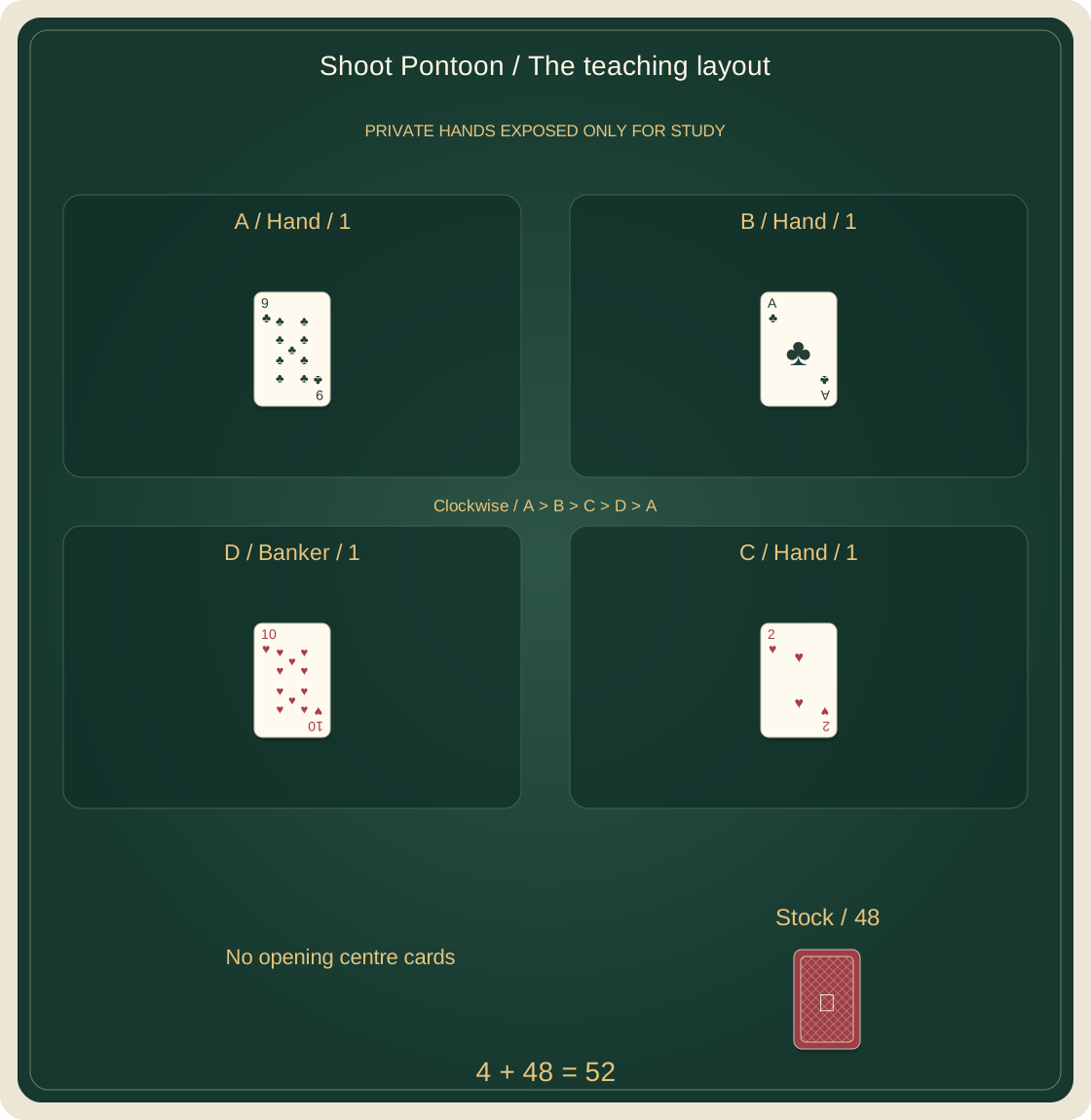
Banker funds the kitty. Deal one down each; players make normal wagers, then optional shoot wagers in seat order. Deal a second down each and check banker’s Pontoon immediately. Otherwise players act one at a time clockwise, then banker reveals and plays. Settle normal wagers against banker and shoot wagers against kitty. A bust loses immediately, before banker plays.
02 /
Cards, seats and the deal
Use one 52-card pack without jokers; this guide covers 2–8 including banker. Ace counts 1 or 11, courts and tens 10, others face value. Choose banker by high-card cut and agree limits. Banker may not inspect the first card when others make their wagers. All other players may inspect theirs. Deal clockwise from banker’s left, ending with banker; cards start face down, not as a blackjack up-card.
03 /
Hand strength and card values
Strongest: Pontoon, ace plus a ten-value card in two cards. Next: any five cards totaling at most 21, even if their total is below an ordinary 21. Then ordinary hands by total, highest up to 21. More than 21 busts. Equal totals and equal categories favour banker, including two five-card tricks. Three- or four-card 21 is not Pontoon. No sixth card is allowed.
04 /
What happens on your turn
Below 21 you may buy a face-down card or twist a face-up card. The first buy adds between your original wager and twice that wager. Each later buy adds between the original wager and your previous buy amount. Twist adds no normal wager, but after twisting you may never buy on that hand. You may stick with 15–21, must stop on 21 or a valid five-card trick, and immediately reveal and lose on bust.
05 /
Splitting a pair
Two equal ranks may split: add a second ordinary wager equal to the original, receive one new card per hand, then play them separately in order. Q and J cannot split merely because both count 10. Equal pairs can split again if dealt, up to the cards available. An existing shoot belongs to the hand with the first original card; a new shoot for the other hand is optional and must fit kitty capacity.
06 /
The kitty and shoot limits
After first-card normal wagers, offer optional shoots clockwise. Outstanding shoots together may never exceed current kitty. A second opportunity comes only before taking a fourth card, with three cards totaling below 21; it is available whether or not you shot earlier. No new shoot before the third or fifth card. Bust adds that hand’s shoot to kitty immediately and removes its outstanding liability, increasing later capacity.
07 /
Scoring and settlement
Banker Pontoon on the initial two cards ends play: all shoots lose, and each normal wager loses double. Otherwise banker chooses draws or a stop, with no fixed draw-to-17 rule. Banker bust: surviving ordinary hands win one stake, Pontoon/five-card winners two. Banker ordinary stop: higher hands win, ties/lower lose one; winning Pontoon/five-card hands receive two. Banker five-card trick: Pontoon wins two, every other surviving hand loses two. Already-busted hands are not charged again.
08 /
Separate shoot settlement
Settle each live shoot separately: a hand better than banker wins its shoot amount from kitty; equal or worse adds its shoot to kitty. Always even money, including Pontoon and five-card tricks. Winnings described here are profit: return the player’s own surviving wager too. Before a new deal banker may add to kitty but not withdraw. Empty kitty requires new funding or offering the bank for sale; it does not automatically pass the bank.
09 /
A complete worked example
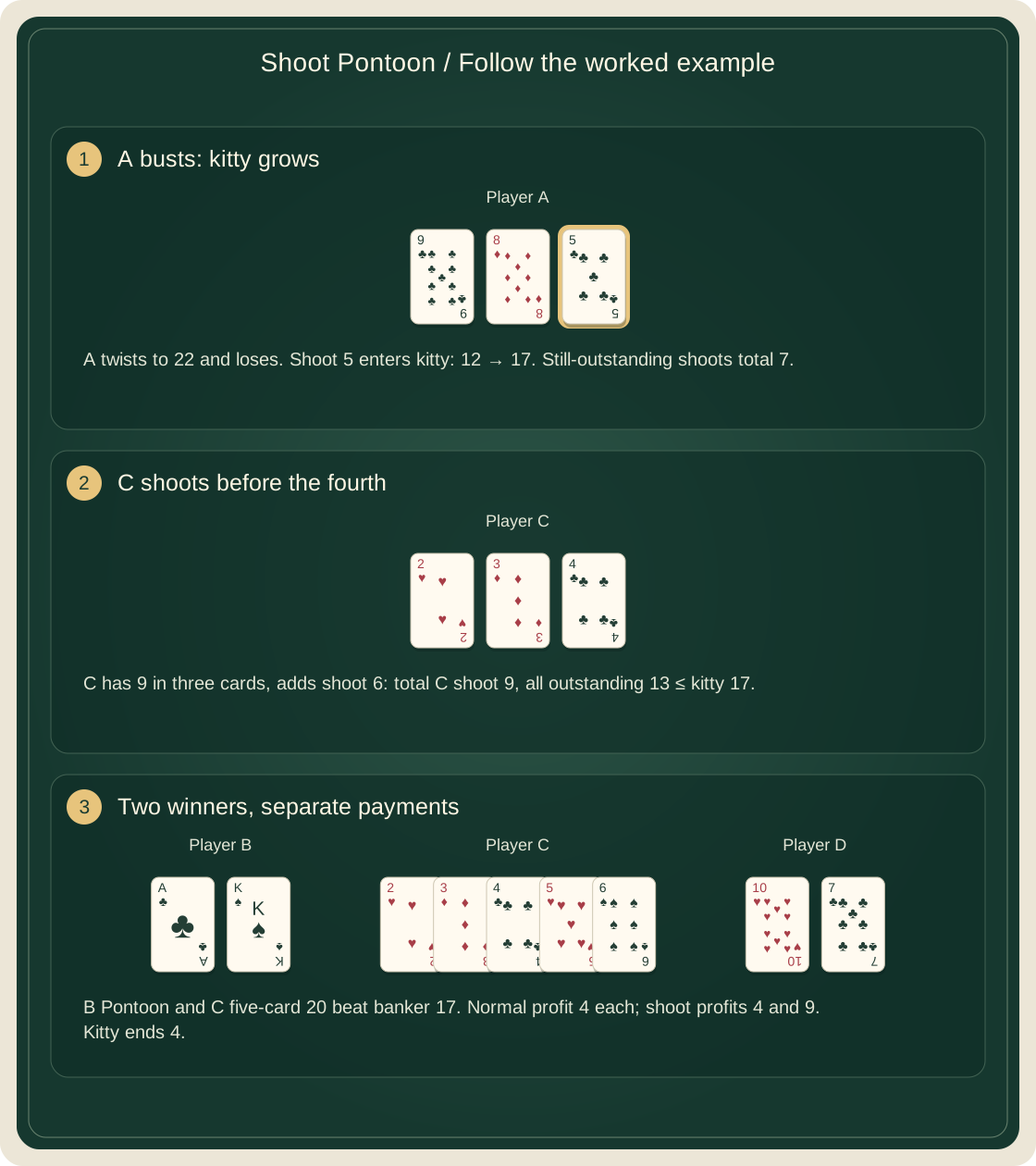
Player A
9♣ 8♦ 5♣
Player B
A♣ K♠
Player C
2♥ 3♦ 4♣ 5♥ 6♠
Player D
10♥ 7♣
D funds kitty 12. A/B/C each wager 2 normally and shoot 5/4/3, using all capacity. After second cards A has 17, twists 5♣ and busts at 22: shoot 5 enters kitty, now 17, with 7 still promised. B has Pontoon. C twists to three cards totaling 9, adds shoot 6 before fourth, then twists to five cards totaling 20. D stops at 17. B and C win; A stays lost.
← On a small screen, scroll the diagram horizontally. →
10 /
Exact accounts for the example
| Player | Normal | Shoot | Total |
|---|---|---|---|
| A | -2 | -5 | -7 |
| B | 4 | 4 | 8 |
| C | 4 | 9 | 13 |
| D | -6 | -8 | -14 |
11 /
When the round and match end
The kitty finishes at 12 + 5 − 4 − 9 = 4; normal payouts do not come from it. A non-split player Pontoon changes banker next deal, nearest left first if several; here B becomes banker. D takes back the remaining kitty, B funds a fresh one. Shuffle after a Pontoon; otherwise put used cards under the pack without shuffling. Stop the session at your agreed time or number of rounds.
12 /
Check your understanding
Can you shoot before the fifth card?
Reveal the answer
No. Opportunities are before the second and before the fourth card only.
Does a Pontoon double the shoot profit?
Reveal the answer
No. Shoot wins even money; the normal wager has its separate double payout.
13 /
History and other versions
British Pontoon descends from Vingt-et-un. The Shoot form combines that card play with a separate limited kitty; Jeffrey Burton’s published account places its popularity in Britain in the mid-1950s. Different tables use stick at 16, special three sevens or casino rules. Those are not silently added here, and a depleted kitty is not an automatic bank-transfer trigger.
Common questions
Who wins a tie?+
Banker, for both normal and shoot comparisons.
Must banker draw to 17?+
No. This British profile gives banker a choice.
Can a shoot be compulsory?+
No. It is optional and limited by current uncommitted kitty capacity.