← On a small screen, scroll the diagram horizontally. →
01 /
Your first round
Deal six cards each and two to the blind. In clockwise order players pass or pick. The picker takes both blind cards, buries two and plays with the J♦ holder. Play six tricks, following the effective suit led. Count card points, including the buried cards for the picker’s side, then transfer score units. Partners may not announce their cards or coach one another.
02 /
Cards, seats and the deal
Choose a dealer and cut from the right. Deal clockwise: three cards to each, two face down in the blind, then three more to each. Left of dealer gets the first chance to pick; continue around once, including dealer. Picking ends the offers. Add the blind to make eight, then bury any two face down. Keep the bury separate and do not inspect it again once play starts. Move dealer left next hand.
03 /
Effective suits, ranks and values
The 14 trumps, strongest first: Q♣ Q♠ Q♥ Q♦ J♣ J♠ J♥ J♦ A♦ 10♦ K♦ 9♦ 8♦ 7♦. Each other suit contains only A, 10, K, 9, 8, 7, descending. A queen or jack is never part of its printed suit for following purposes. Thus Q♥ follows a trump lead, not a heart lead.
| Rank | Points |
|---|---|
| A | 11 |
| 10 | 10 |
| K | 4 |
| Q | 3 |
| J | 2 |
| 9, 8, 7 | 0 |
04 /
The hidden partner and solo
The player holding J♦ is the picker’s partner, silently, until play reveals the card. If the picker held J♦ or found it in the blind, the picker plays alone against four; do not call a replacement jack. Burying J♦ does not create a new partner. In this no-call-off profile a picker cannot reject the J♦ partner or nominate another card.
05 /
What happens on your turn
Dealer’s left leads, even if someone else picked. Everyone plays one card clockwise and must follow the effective suit if able. If void, any card is legal: trumping and overtrumping are optional. Highest trump wins; without trumps, highest card of the led suit wins. Off-suit cards cannot win. Winner leads next. A trump lead requires a trump, including any queen or jack, rather than the printed suit.
06 /
Scoring and settlement
Card points always total 120, bury included. Picker’s side needs 61; defenders win on 60. Defenders need 30 to escape Schneider, but the picker’s side needs 31 when losing. No-trick is tested before point thresholds. Table entries are score units per person; the losing-picker rows already include double on the bump. In this JD profile the partner pays even when the team takes no trick.
| Outcome | Picker | Partner | Each defender |
|---|---|---|---|
| Picker wins, defenders 30+ | +2 | +1 | −1 |
| Picker wins, defenders below 30 | +4 | +2 | −2 |
| Picker takes every trick | +6 | +3 | −3 |
| Picker loses, has 31+ | −4 | −2 | +2 |
| Picker loses, at most 30 | −8 | −4 | +4 |
| Picker takes no tricks | −12 | −6 | +6 |
07 /
Solo and the session
For a solo remove the partner column: the picker receives or pays four times each defender’s opposite transfer. An ordinary solo win is +4 versus four −1; an ordinary solo loss is −8 versus four +2. Apply the same Schneider or no-trick factors. Agree a session length, for example 15 hands so each player deals equally often. Highest cumulative score wins; every hand must sum to zero.
08 /
A complete worked example
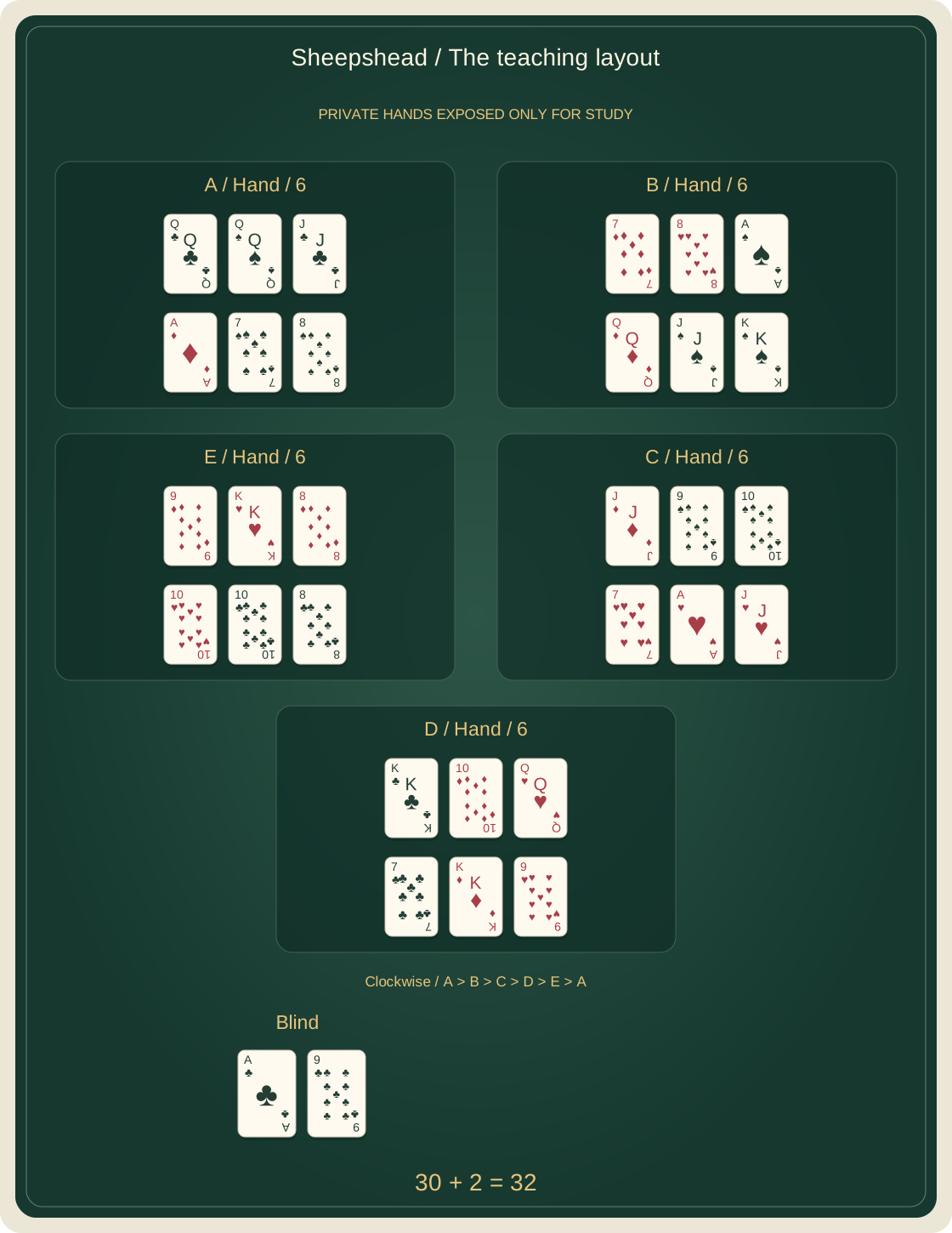
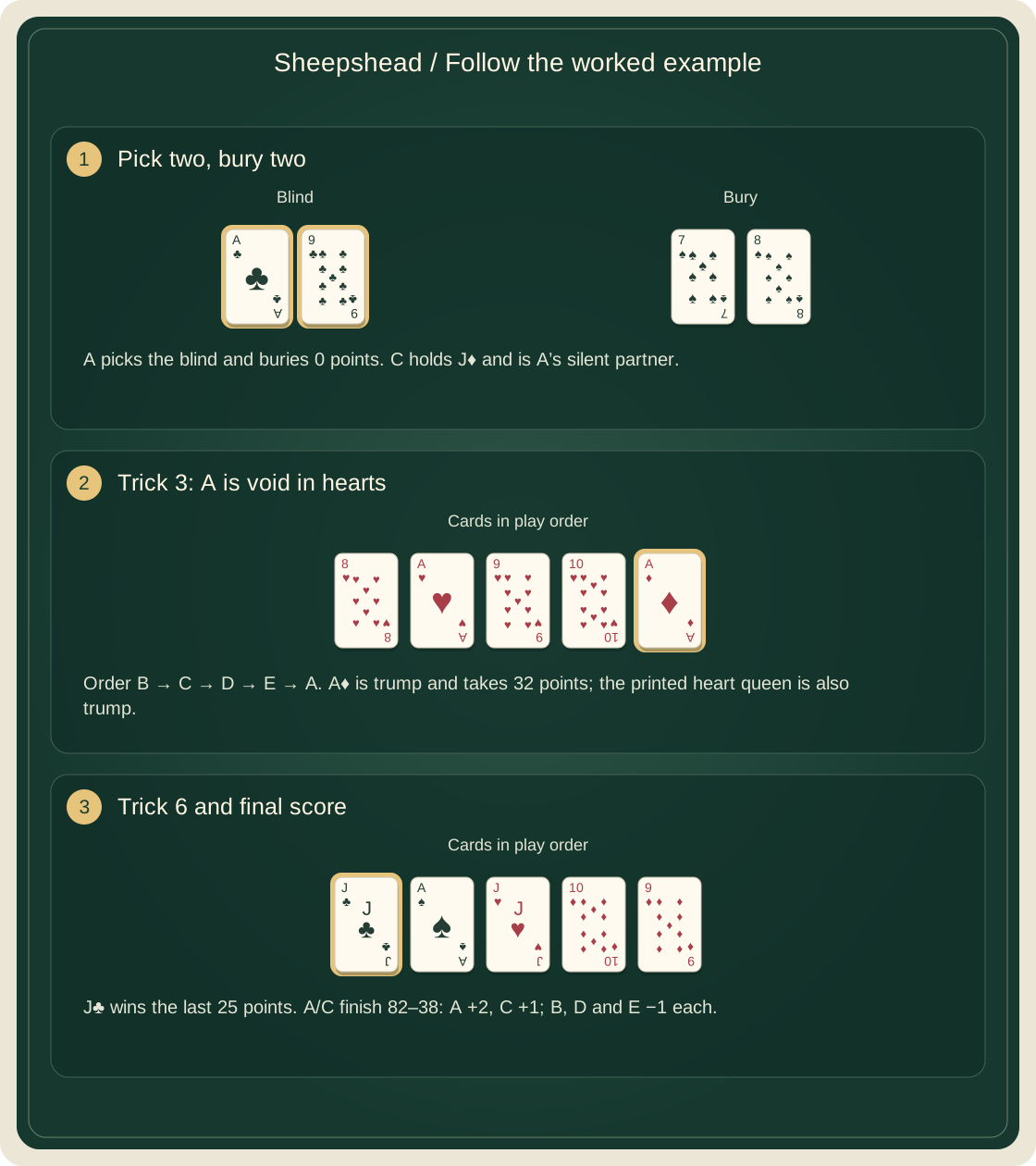
E deals. A picks A♣ 9♣ and buries 7♠ 8♠, worth 0. C holds J♦ and is partner. All hands in the setup diagram are exposed for study only; normal opponents cannot see them. Follow the complete six-trick record. A and C collect 82, the defenders 38, so the result is an ordinary win: A +2, C +1, B/D/E −1 each.
| Trick | Order | Cards | Winner | Points |
|---|---|---|---|---|
| 1 | A → B → C → D → E | Q♠ J♠ J♦ Q♥ 8♦ | A | 10 |
| 2 | A → B → C → D → E | 9♣ Q♦ 9♠ K♣ 8♣ | B | 7 |
| 3 | B → C → D → E → A | 8♥ A♥ 9♥ 10♥ A♦ | A | 32 |
| 4 | A → B → C → D → E | A♣ 7♦ 10♠ 7♣ 10♣ | B | 31 |
| 5 | B → C → D → E → A | K♠ 7♥ K♦ K♥ Q♣ | A | 15 |
| 6 | A → B → C → D → E | J♣ A♠ J♥ 10♦ 9♦ | A | 25 |
← On a small screen, scroll the diagram horizontally. →
09 /
All-pass: the Leaster
If everyone passes, leave the blind untouched and play six tricks with the same trump order. Each plays alone, aiming for the fewest points but needing at least one trick to qualify. The last trick takes the blind and its points. Lowest qualifying total wins +4; everyone else −1. For tied low totals this guide uses the earlier first-trick agreement declared above. Do not award victory to someone with zero tricks.
10 /
Check your understanding
A heart is led. Must Q♥ follow?
Reveal the answer
No. Q♥ is trump. If you have a nontrump heart you must play that; otherwise any card is legal.
Picker has 90 points, defenders 30. Schneider?
Reveal the answer
No. Defenders reached 30. Ordinary win; 91 would leave only 29 and earn Schneider.
11 /
History and other versions
Sheepshead is the American descendant of the German Schafkopf tradition, particularly associated with Wisconsin communities. It is not simply Bavarian Schafkopf translated: five players, a blind and the JD partnership give it a different structure. Called-ace partnership is also widespread. Club and family rules vary on no-trick payments, Leaster ties and extra multipliers, so those agreements must travel with the article rather than be assumed universal.
Common questions
How many trumps?+
14: all queens, all jacks and the other six diamonds.
Does 60 win for the picker?+
No. The picking side needs 61; defenders win on 60.
Do buried points disappear?+
No. They belong to the picker’s side. The full deck still totals 120.