← On a small screen, scroll the diagram horizontally. →
01 /
Your first round
Keep your total at or below 7½ and try to beat the banker. On your turn stand or request another card. Above 7½ is bust and loses immediately. An exact 7½ must be shown and ends your turn, but does not automatically beat the banker’s equal hand. No one is required to chase a particular minimum total.
02 /
Card values without guesswork
Aces are 1, numbers 2–7 their printed value, and J/Q/K each ½. Suits never break a tie. A picture does not change between high and low as an ace can in blackjack; an ace is not eleven. For example 6 plus a king is 6½, while 7 plus a queen is 7½. Two sevens total 14 and bust in this basic profile.
03 /
Cards, seats and the deal
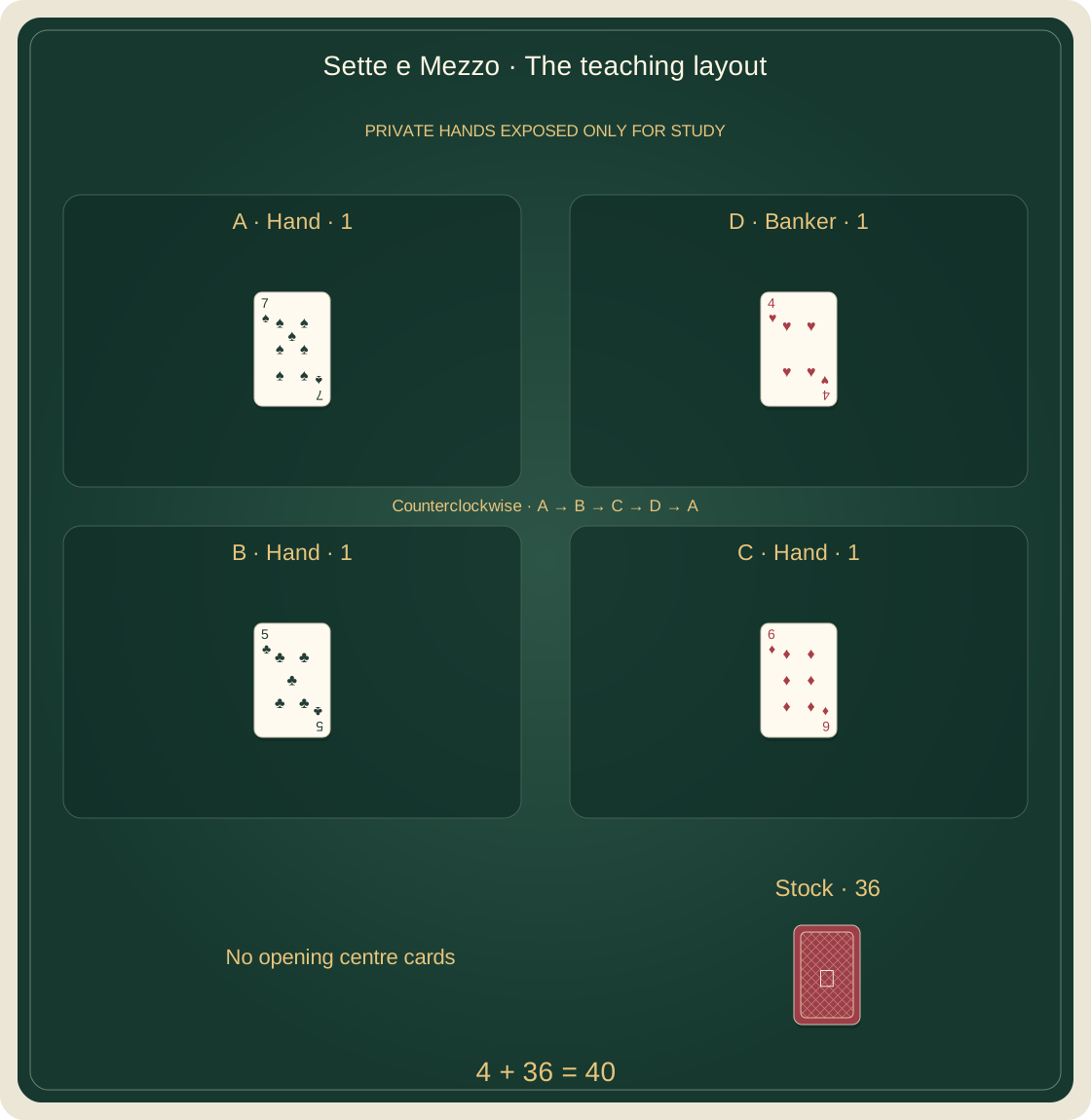
Choose the first banker by lot; that player deals. Agree a minimum and maximum unit before play, or use the fixed teaching unit. Shuffle and cut, then each other player commits their unit before seeing a card. Deal one face down to each, starting right of banker and anticlockwise, ending with banker. Each player may inspect only their own first card.
04 /
What happens on your turn
Starting right of banker, finish one player before moving on. That player stands or asks for a face-up card, then decides again if still below 7½. Keep the original card hidden while standing. Busts reveal everything and settle immediately; exactly 7½ also reveals everything. There is no exchanging an unwanted first card or asking for a concealed replacement in the selected basic rules.
05 /
The banker’s turn
After everyone else, banker reveals the initial card and chooses draws or standing. The banker sees the exposed portions of other hands, not their concealed first cards. If banker busts, all non-bust players win; a player who already busted still loses. Otherwise compare each standing total separately: higher than banker wins, equal or lower loses.
06 /
Scoring and settlement
A winning player receives the committed unit back plus one equal unit from banker; a loser transfers the committed unit to banker. A returned original unit is not profit. For a paper ledger record only net changes; banker’s change is the opposite sum of all player changes. No bonus for card count or suit in the basic profile.
07 /
When the round and match end
The banker normally stays until another player wins with exactly 7½. That winner becomes next banker; if several do so, the first anticlockwise from old banker takes over. Banker ties are still losses to players, so an equal 7½ does not take the bank. For a learning session choose four rounds, total net paper units, and share victory on equal highest totals. That session length is a table agreement, not a traditional universal target.
08 /
A complete worked example
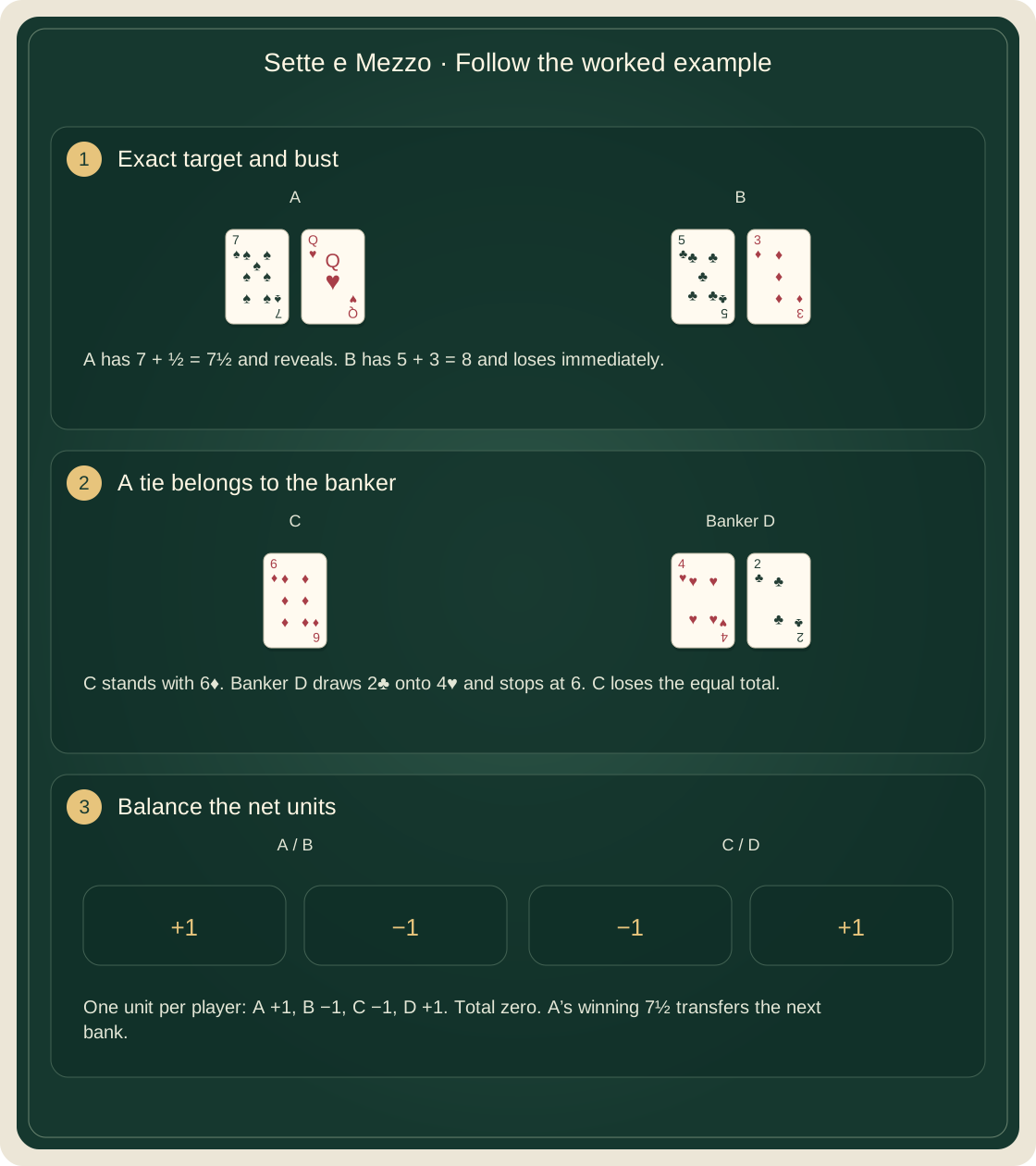
D banks, with A then B then C in play order. Initial cards A 7♠, B 5♣, C 6♦, D 4♥. A asks and receives Q♥: 7 + ½ = 7½, reveals and stops. B receives 3♦: 5 + 3 = 8, busts immediately. C stands on 6 without drawing. D reveals 4♥, draws 2♣ and elects to stand on 6. These are discretionary choices, not a claim of optimal strategy.
← On a small screen, scroll the diagram horizontally. →
09 /
Resolve every hand separately
With one unit each A gains 1, B loses 1, C loses 1 because the banker wins their tie, and D gains 1 overall. Net sum is zero. A becomes next banker through a winning 7½; A is not paid double in this basic profile. Seven cards were used and 33 remain in the forty-card pack. If D had busted instead, B would still lose, while A and C would win.
10 /
Check your understanding
Does the banker’s bust rescue a bust player?
Reveal the answer
No. That player already lost before the banker played.
Does every two-card hand earn a premium?
Reveal the answer
No. Special two-card premiums are optional rules, not part of this basic profile.
11 /
History and other versions
Sette e Mezzo is the Italian name; Siete y Media and Sete e Meio identify Spanish and Brazilian traditions. Italian Christmas play is documented, but no invention date is asserted. Italian additions often include a wild picture and a stronger two-card 7½; Spanish tables may allow picture splitting or concealed replacement draws. These change comparison and payout rules, so agree them explicitly rather than adding them mid-round.
Common questions
Does an ace count eleven?+
No. It is one in this game.
Is a wild card required?+
Not in this basic profile; many Italian tables add one by agreement.
Can another player’s stronger hand beat mine?+
Only the banker is compared with you; other players’ totals do not decide your result.