← On a small screen, scroll the diagram horizontally. →
01 /
Your first round
Play any card when it is your turn. A card wins provisionally if it matches the trick’s very first rank or is a seven. After a full circuit the original leader either stops or continues with another matching card or seven. Only after the trick finally ends do players draw and a new leader begin.
02 /
Cards, seats and the deal
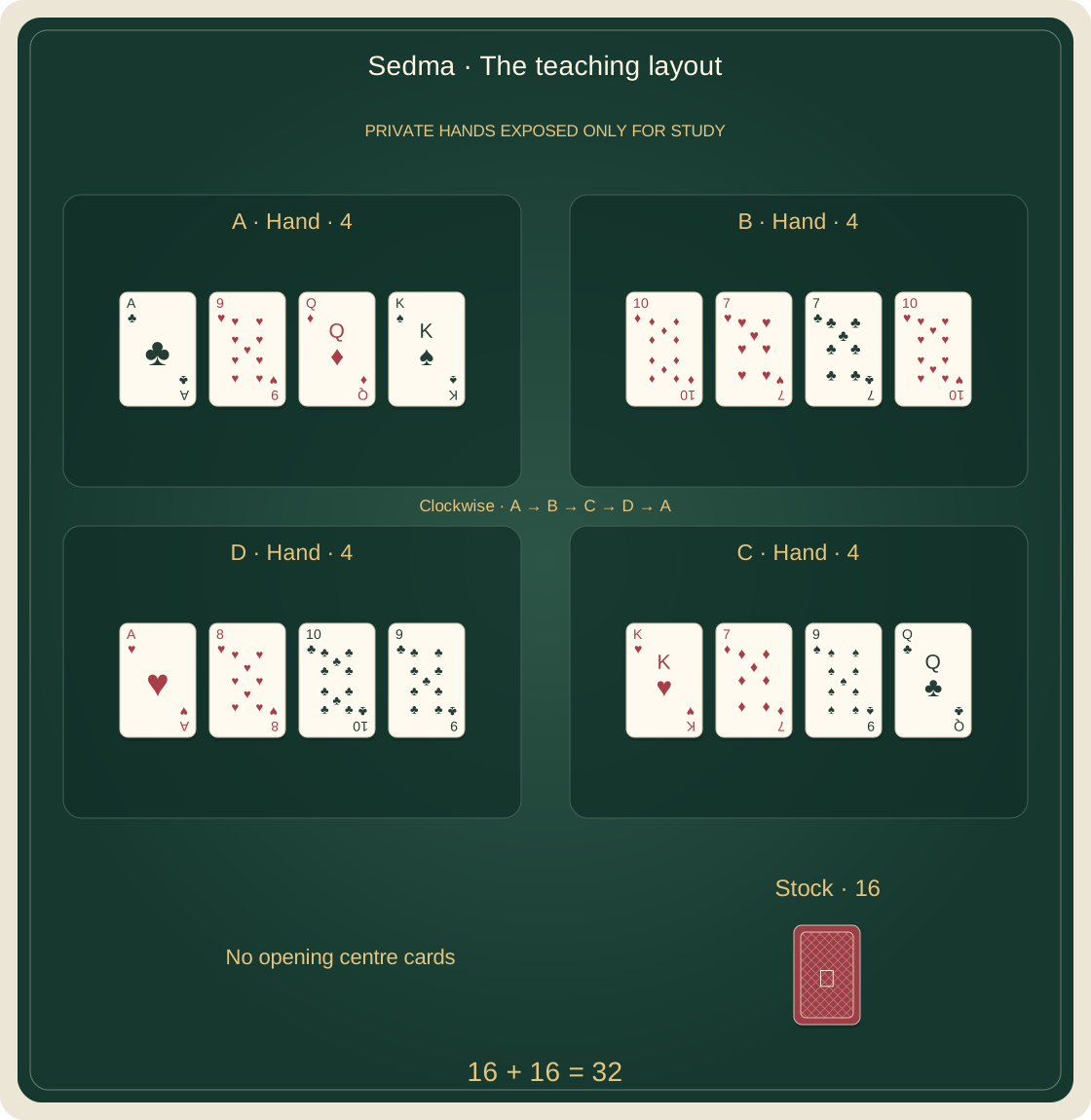
A/C partner opposite B/D. Deal four each, commonly two at a time, clockwise; sixteen remain face down. For the first deal choose dealer at random and left neighbour leads. Later a loser deals and a winner leads. With partners, if the dealing team wins dealer passes left; if it loses dealer passes to the partner. Shuffle all cards before the next deal.
03 /
What happens on your turn
The first card sets the target rank, not a trump suit. All later cards may ignore both suit and rank. If A leads an ace, every later ace and every seven beats the currently winning card. A king cannot win merely because it looks high. If nobody matches or plays a seven, the opening card wins. When the lead is a seven, only later sevens can take over.
04 /
Continuing a trick
Only the original leader decides to extend, and must play a card matching the original target or a seven. Each other player then contributes one more card, freely. The original target never changes when a seven or another card wins temporarily. There is no drawing between circuits. You may continue while your own team is winning. At most four circuits fit an original four-card hand, fewer late in the deal.
05 /
Taking and refilling
When the leader stops, the last matching rank or seven takes all cards across every circuit of that trick. Winner draws the first stock card, then the others clockwise one at a time; repeat until everyone has four or stock ends. Winner leads the next trick. Once stock is exhausted finish the held cards without refilling. Partner captures form one team pile.
06 /
Scoring and settlement
Each ace and ten captured is 10 card points. All other cards are zero; the last trick adds 10, so a deal contains 90. Most card points wins one paper point. All 90 but not all cards wins two; every card wins three. For a session we select first to 10 paper points. Do not add the 90 card-point scale directly to this session target.
07 /
A complete worked example
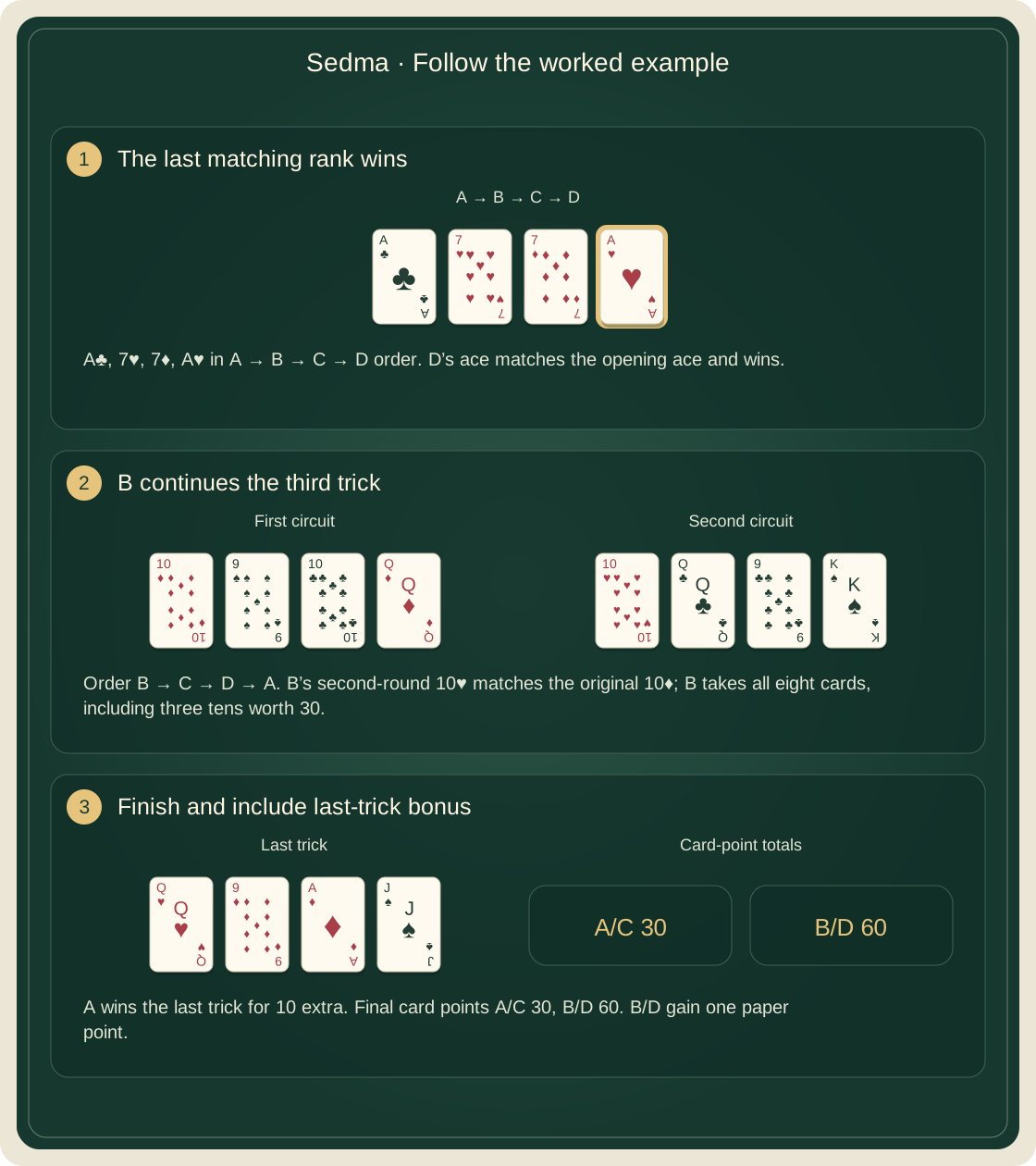
A leads A♣; B 7♥, C 7♦ and D A♥ follow. D wins, not C’s seven, because the later ace matches the opening rank. In the third trick B leads 10♦ and D’s 10♣ is winning after the first circuit. B continues with 10♥; the others add Q♣, 9♣, K♠. B now wins all eight cards for three tens, 30 card points. No one drew between those circuits.
| Trick | Order | Cards | Winner |
|---|---|---|---|
| 1 | A → B → C → D | A♣ 7♥ 7♦ A♥ | D |
| 2 | D → A → B → C | 8♥ 9♥ 7♣ K♥ | B |
| 3 | B → C → D → A | 10♦ 9♠ 10♣ Q♦ / 10♥ Q♣ 9♣ K♠ | B |
| 4 | B → C → D → A | J♣ K♣ J♦ A♠ / 7♠ 8♦ J♥ K♦ | D |
| 5 | D → A → B → C | 8♣ 8♠ 10♠ Q♠ | A |
| 6 | A → B → C → D | Q♥ 9♦ A♦ J♠ | A |
← On a small screen, scroll the diagram horizontally. →
08 /
Reconcile cards and score
The full six-trick deal ends with A/C holding 8 cards and B/D 24. A/C capture two scoring cards for 20, plus the last trick 10: 30. B/D capture the other six for 60 and win one paper point. Both 30 + 60 = 90 and 8 + 24 = 32 reconcile. Counting tricks alone would miss the value of the long battles.
09 /
Check your understanding
Does a seven become the new target rank?
Reveal the answer
No. Every circuit uses the rank of the very first card.
Can a follower demand another circuit?
Reveal the answer
No. Only the original leader may continue, with a legal continuation card.
10 /
History and other versions
Sedma means seven. The Czech account associated with Tomáš Svoboda describes its spread into Moravia and Bohemia during the 1960s from Hungary or Slovakia; that is an account of regional adoption, not proof of a single inventor. Related games such as Zsírozás and Hola differ in continuation and scoring. Wild eights and burning wins are separate Czech variants.
Common questions
Are suits important?+
Not for following or winning. Only the target rank and sevens determine who wins.
Is the last trick worth anything?+
Yes, an extra ten card points in this profile.
Must the leader continue when losing?+
No. Continuing is a choice if a legal card remains.