← On a small screen, scroll the diagram horizontally. →
01 /
Your first round
Release low cards to start the four ace foundations, build each up in suit to king, and use cells to uncover useful cards. Only exposed column ends and occupied cell cards are available. Plan how a cell will be emptied before filling it. The objective is all cards on foundations, not merely tidy columns.
02 /
Cards, seats and the deal
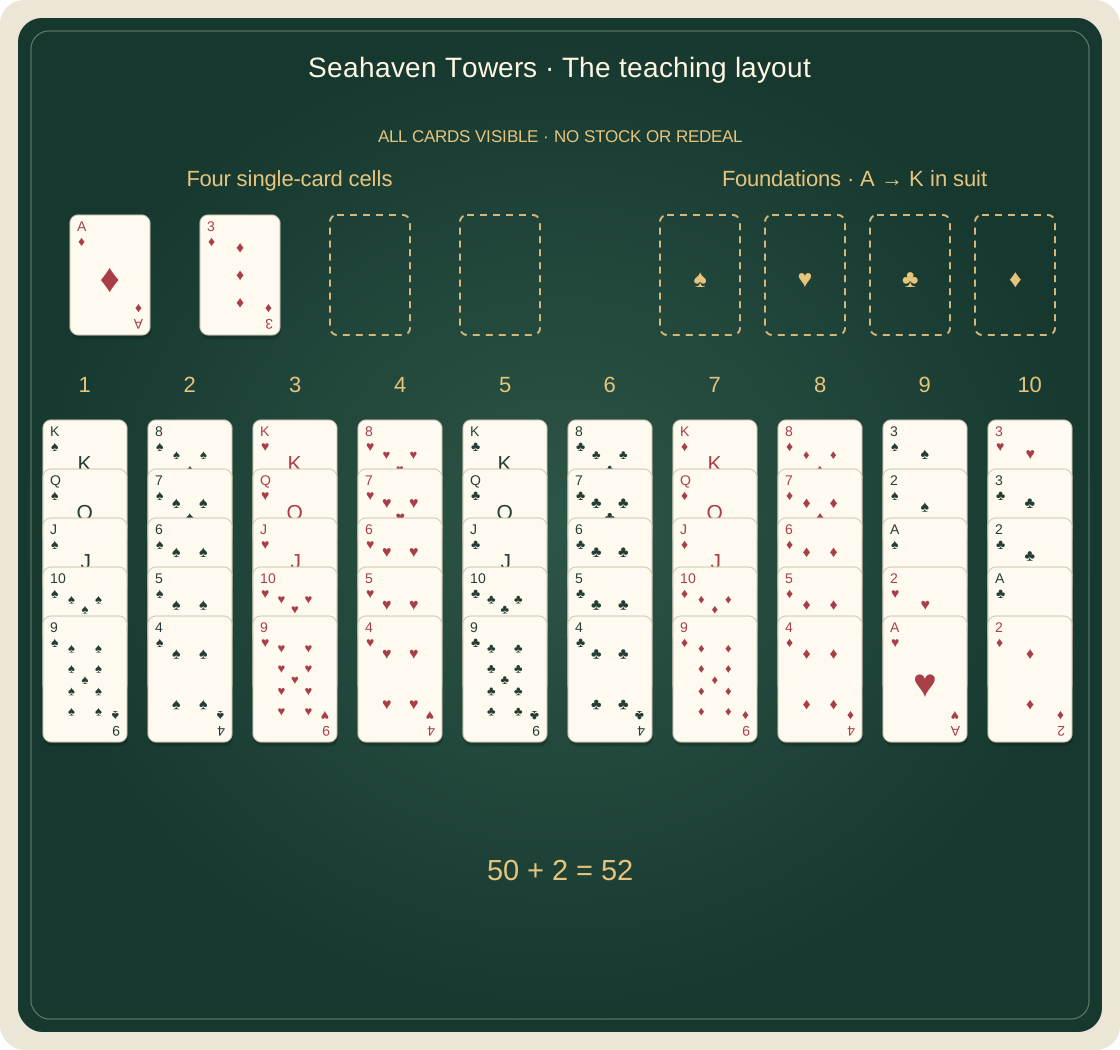
Deal 50 cards face up into ten columns of five. Put the other two face up into two of four cells; two cells start empty. Four foundations start empty. Use one 52-card pack without jokers. No card is dealt later: the full puzzle is already visible, with 50 + 2 = 52 cards.
03 /
What happens on your turn
Move one available card to an empty cell, to its next required foundation rank in ascending order, or onto a tableau card exactly one rank higher of the same suit. Thus 9♠ can go on 10♠, not 10♥. A cell cannot contain a packet or accept a second card. Buried cards cannot be pulled out. Ace is low; no king-to-ace wrap.
04 /
Empty columns and packet capacity
An empty column accepts only a king. A correctly ordered king-led run may enter only if enough single-card staging is available. Empty columns cannot be counted as unrestricted temporary cells for ordinary low cards. With E empty cells, E + 1 ordered cards can be transferred using those cells alone; the destination must still be legal. Extra empty columns do not automatically double this capacity under king-only rules.
05 /
When the round and match end
Four foundations must each finish A through K of one suit. That accounts for all 52 cards and wins. No special total of moves or time is required. A position is blocked if no useful route remains; return to an earlier saved position or restart if treating it as a puzzle. The rules do not guarantee every random deal is solvable.
06 /
A complete worked example
The teaching deal has A♦ and 3♦ in two cells. First move 9♠ from column 1 into an empty cell, exposing 10♠, then return 9♠ onto that 10♠. This is legal because both are spades; it demonstrates the cell without pretending to improve the position. Now release low cards to foundations in ascending order. A♦ starts diamonds, 2♦ comes from column 10, and 3♦ leaves its cell. A♥ and 2♥ leave column 9, exposing the small spades.
← On a small screen, scroll the diagram horizontally. →
07 /
A five-card transfer you can prove
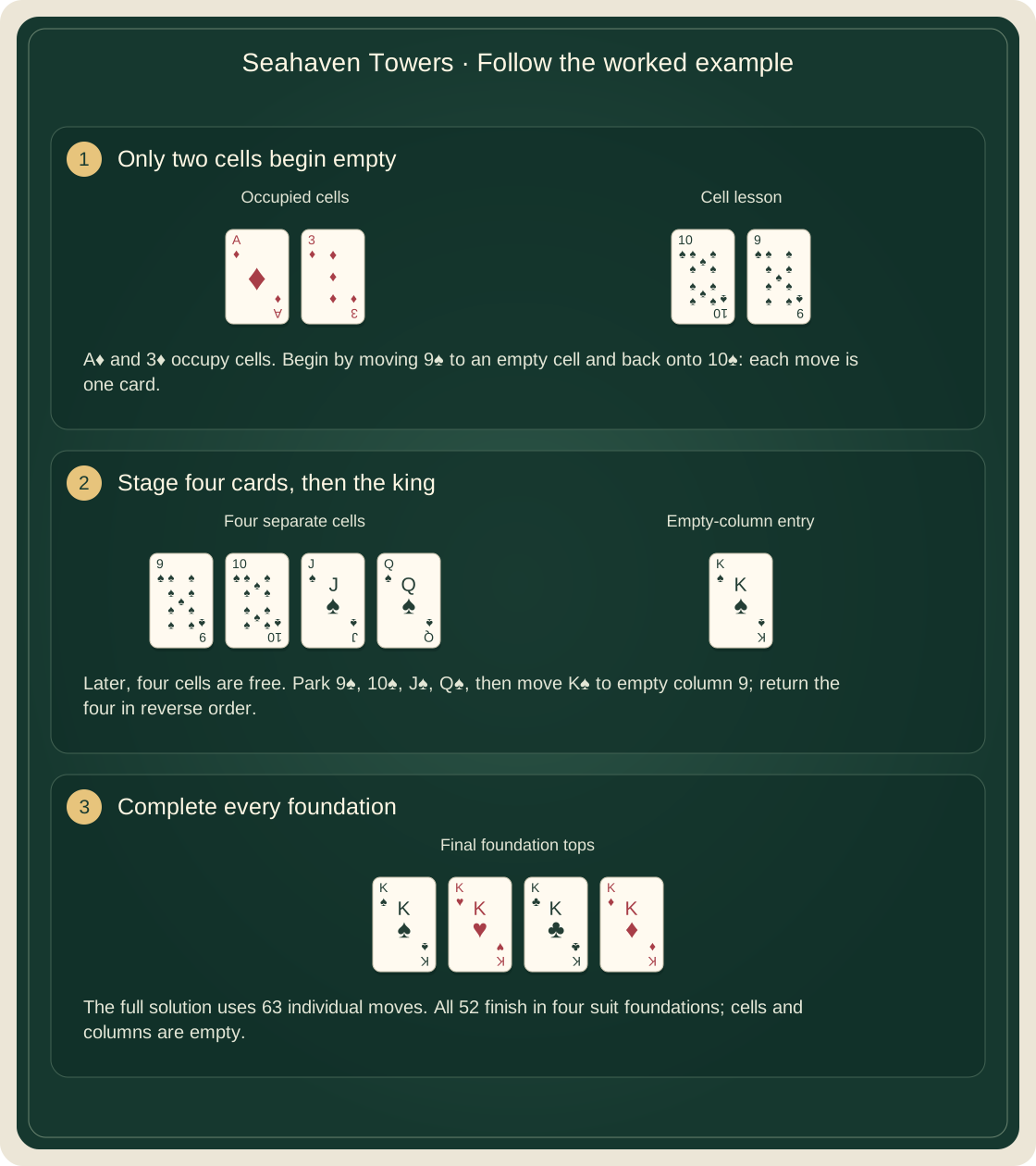
Continue each suit through eight. The low columns empty, all four cells are free, and four high columns still contain K–Q–J–10–9. To transfer the spade run from column 1 to empty column 9, park 9♠, 10♠, J♠ and Q♠ in the four cells, one per cell. Move K♠ to column 9. Return Q♠, J♠, 10♠, 9♠ onto it in that order. Nine individual moves carry five cards; no empty column ever receives a non-king.
08 /
Finish every suit
After that transfer, send each suit’s exposed 9,10,J,Q,K to its foundation in order. The full record contains 63 individual moves, including the deliberately reversible cell lesson and the long transfer. It ends with four thirteen-card foundations, empty cells and empty columns. This designed teaching deal demonstrates legality; it is not a claim about ordinary deal difficulty.
Open the complete solution
| Move | Card | From | To |
|---|---|---|---|
| 1 | 9♠ | Column 1 | Cell 3 |
| 2 | 9♠ | Cell 3 | Column 1 |
| 3 | A♦ | Cell 1 | ♦ |
| 4 | A♥ | Column 9 | ♥ |
| 5 | 2♦ | Column 10 | ♦ |
| 6 | 3♦ | Cell 2 | ♦ |
| 7 | 4♦ | Column 8 | ♦ |
| 8 | 2♥ | Column 9 | ♥ |
| 9 | A♣ | Column 10 | ♣ |
| 10 | 5♦ | Column 8 | ♦ |
| 11 | A♠ | Column 9 | ♠ |
| 12 | 2♣ | Column 10 | ♣ |
| 13 | 6♦ | Column 8 | ♦ |
| 14 | 2♠ | Column 9 | ♠ |
| 15 | 3♣ | Column 10 | ♣ |
| 16 | 4♣ | Column 6 | ♣ |
| 17 | 7♦ | Column 8 | ♦ |
| 18 | 3♠ | Column 9 | ♠ |
| 19 | 3♥ | Column 10 | ♥ |
| 20 | 4♠ | Column 2 | ♠ |
| 21 | 4♥ | Column 4 | ♥ |
| 22 | 5♣ | Column 6 | ♣ |
| 23 | 8♦ | Column 8 | ♦ |
| 24 | 5♠ | Column 2 | ♠ |
| 25 | 5♥ | Column 4 | ♥ |
| 26 | 6♣ | Column 6 | ♣ |
| 27 | 6♠ | Column 2 | ♠ |
| 28 | 6♥ | Column 4 | ♥ |
| 29 | 7♣ | Column 6 | ♣ |
| 30 | 7♠ | Column 2 | ♠ |
| 31 | 7♥ | Column 4 | ♥ |
| 32 | 8♣ | Column 6 | ♣ |
| 33 | 8♠ | Column 2 | ♠ |
| 34 | 8♥ | Column 4 | ♥ |
| 35 | 9♠ | Column 1 | Cell 1 |
| 36 | 10♠ | Column 1 | Cell 2 |
| 37 | J♠ | Column 1 | Cell 3 |
| 38 | Q♠ | Column 1 | Cell 4 |
| 39 | K♠ | Column 1 | Column 9 |
| 40 | Q♠ | Cell 4 | Column 9 |
| 41 | J♠ | Cell 3 | Column 9 |
| 42 | 10♠ | Cell 2 | Column 9 |
| 43 | 9♠ | Cell 1 | Column 9 |
| 44 | 9♥ | Column 3 | ♥ |
| 45 | 9♣ | Column 5 | ♣ |
| 46 | 9♦ | Column 7 | ♦ |
| 47 | 9♠ | Column 9 | ♠ |
| 48 | 10♥ | Column 3 | ♥ |
| 49 | 10♣ | Column 5 | ♣ |
| 50 | 10♦ | Column 7 | ♦ |
| 51 | 10♠ | Column 9 | ♠ |
| 52 | J♥ | Column 3 | ♥ |
| 53 | J♣ | Column 5 | ♣ |
| 54 | J♦ | Column 7 | ♦ |
| 55 | J♠ | Column 9 | ♠ |
| 56 | Q♥ | Column 3 | ♥ |
| 57 | Q♣ | Column 5 | ♣ |
| 58 | Q♦ | Column 7 | ♦ |
| 59 | Q♠ | Column 9 | ♠ |
| 60 | K♥ | Column 3 | ♥ |
| 61 | K♣ | Column 5 | ♣ |
| 62 | K♦ | Column 7 | ♦ |
| 63 | K♠ | Column 9 | ♠ |
09 /
Check your understanding
Can red and black alternate on the tableau?
Reveal the answer
No. Build down within one suit.
Can a free cell hold a complete run?
Reveal the answer
No. It holds exactly one card.
10 /
History and other versions
The game belongs to the FreeCell family. Art Cabral’s Macintosh version helped establish the Seahaven name, while Semicolon publishes a version as The Towers. Its account expressly says Cabral did not invent the underlying game. Same-suit building and king-only empty columns distinguish this profile from FreeCell and from relaxed Towers variants.
Common questions
Is there a stock?+
No. All cards begin in columns or cells.
Can any card fill an empty column?+
Only a king in this standard profile.
Is a group shortcut always legal?+
Only if the same result can be achieved through legal individual moves.