← On a small screen, scroll the diagram horizontally. →
01 /
Your first round
Look for a face-up card that can land on the next higher card of the same suit. Move it with every card below it. If this exposes a face-down card, turn that card up. Continue opening buried cards and assembling suits. No drawing into a hand, no waste pile, and no alternating-colour building.
02 /
Cards, seats and the deal
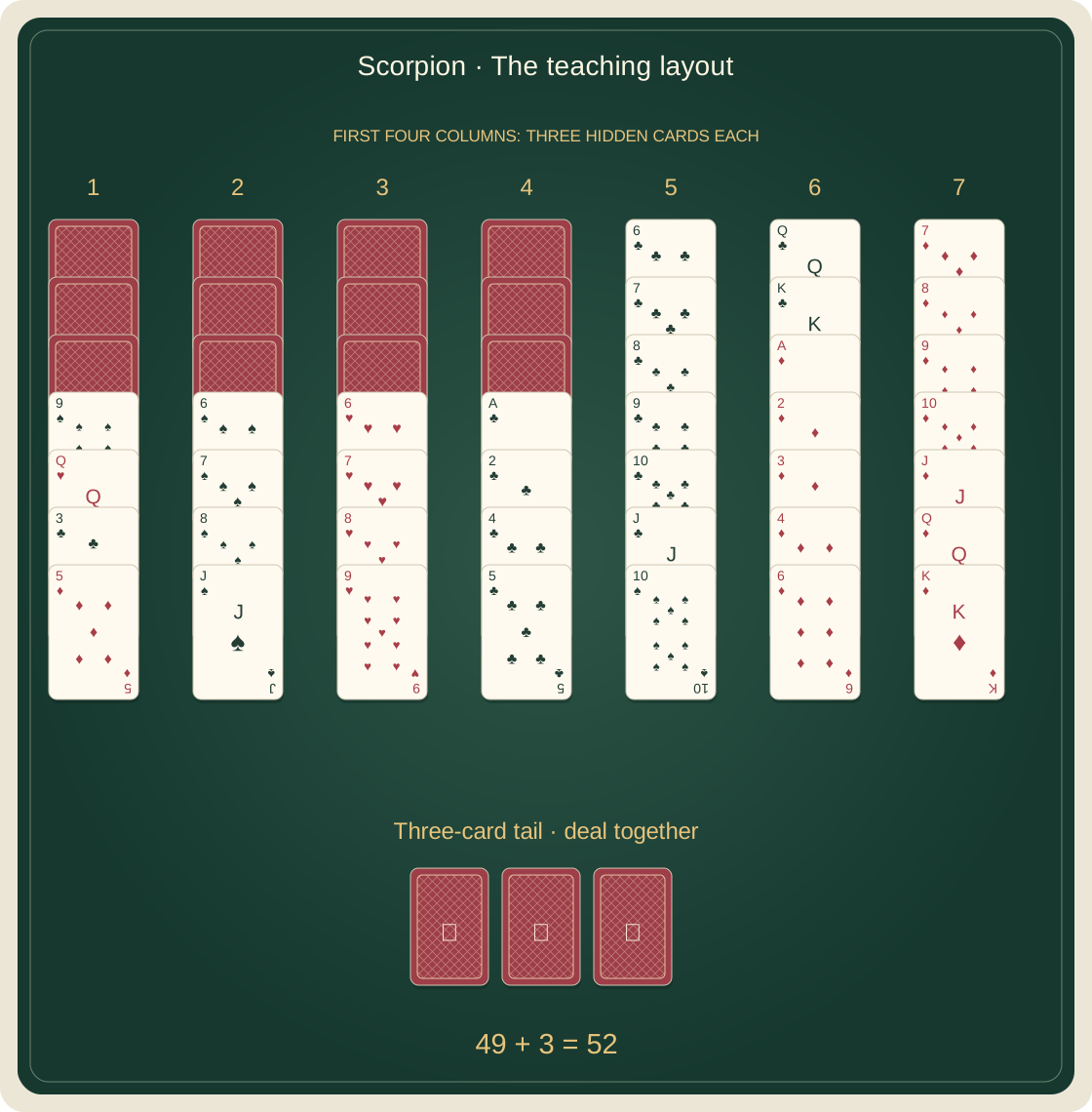
Use 52 ordinary cards without jokers. Deal 49 into seven columns, seven each, fanned so exposed ranks remain visible. In columns 1–4, the first three cards are face down and the last four face up. Columns 5–7 are entirely face up. Set the remaining three face down as the tail. Thus 12 cards are hidden and 37 are exposed in the tableau; the tail adds three more hidden cards.
03 /
What happens on your turn
You may select any face-up card, not only the exposed end card. Its full trailing packet must travel together. On a nonempty destination the selected leading card must be exactly one rank lower and the same suit as the destination’s exposed end. The trailing cards need not match one another. You cannot pull a middle card out while leaving the cards below behind.
04 /
Empty columns and turning cards
Only a king, alone or leading its whole packet, may enter an empty column. Any face-down card newly exposed at the end is turned face up immediately. A king buried inside a packet does not make that packet eligible for an empty space: the leading card must be king. Empty spaces do not serve as unrestricted FreeCell reserves.
05 /
Using the three-card tail
When useful tableau progress has run out, deal the entire tail face up: one card onto each of columns 1, 2 and 3. It is one operation, not three optional draws, and the cards are not chosen or rearranged. There is no redeal. They can unlock a buried connection or cover a useful destination, so inspect those columns before spending the tail.
06 /
When the round and match end
Win when all 52 cards form four complete descending runs, each K–Q–J–10–9–8–7–6–5–4–3–2–A in one suit. An ace is low; there is no wraparound. A run still buried under unrelated cards must be freed to satisfy the final arrangement. If no productive continuation remains after the tail, the attempt is blocked; you may restart or use agreed puzzle undo, not secretly reshuffle the existing position.
07 /
Two legal opening moves
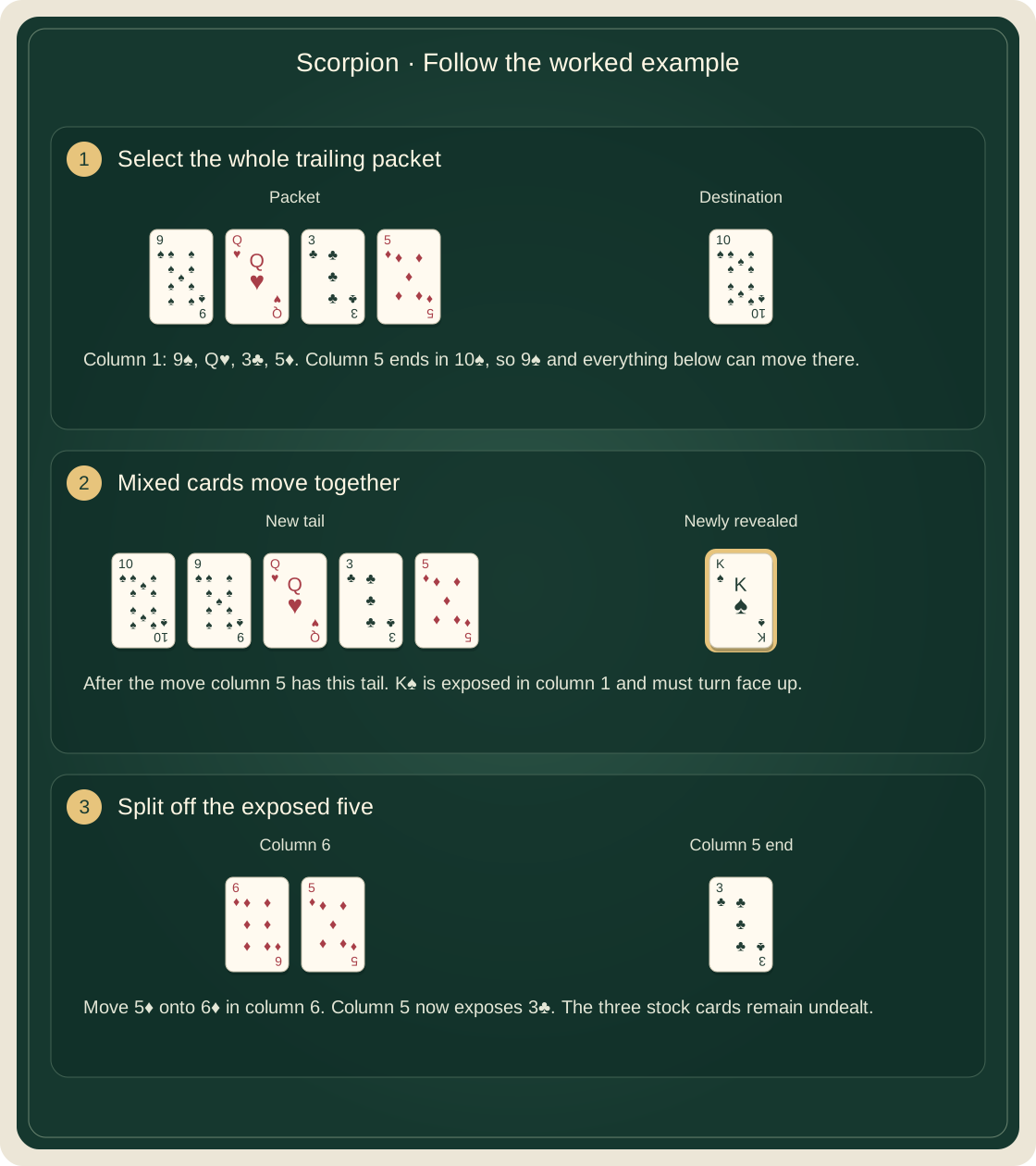
In the diagram column 1 ends with 9♠, Q♥, 3♣, 5♦. Column 5 ends with 10♠. Move that whole four-card packet onto 10♠: the mixed trailing suits do not matter. This uncovers K♠ at the end of column 1, which must be turned up. Column 6 ends with 6♦. Now move only the exposed 5♦ onto 6♦, leaving 3♣ exposed in column 5.
← On a small screen, scroll the diagram horizontally. →
08 /
Check the changed position
The two moves leave column lengths 3, 7, 7, 7, 10, 8, 7, still 49 tableau cards plus three in the tail. Hidden tableau cards drop from 12 to 11. This is an opening lesson, not a completed solution or a claim that the position is guaranteed winnable. It demonstrates why exposing one card can matter more than making a tidy-looking packet.
09 /
Check your understanding
Must every moved card be in sequence?
Reveal the answer
No. Only its leading card must fit; everything after it travels with it.
Can a queen fill an empty column?
Reveal the answer
No in Scorpion. A leading king is required; Wasp changes that rule.
10 /
History and other versions
Solitaire collections place Scorpion between the Spider and Yukon families: same-suit complete runs, with Yukon-style freedom to move unordered packets. This describes its mechanics, not a proven inventor. Wasp relaxes empty-column filling; Russian Solitaire uses a different deal and objective. Reported win rates depend on rules and undo habits, so none is promised here.
Common questions
Are there four ace foundations?+
No. Assemble complete descending suit runs instead.
Can I deal the tail again?+
No. It is a single three-card deal without recycling.
Can I move a face-down card?+
Not until exposed and turned face up.