← On a small screen, scroll the diagram horizontally. →
01 /
Your first round
Win card points, not merely tricks. The declaring side needs 61 of 120; defenders win with 60. In Sauspiel the called ace’s holder joins the declarer against the other two. In Wenz and Solo the declarer faces all three. A fresh contract can create different teams on the next deal.
02 /
Cards, seats and the deal
Dealer shuffles, right neighbour cuts leaving at least three in each packet. Deal two packets of four clockwise, starting left: eight each, no stock. That left-hand player is forehand and leads the first trick whoever declares. Dealer moves left next deal. No cards may be exchanged after the deal.
03 /
Choosing the contract
Speak clockwise from forehand: pass or offer to play. Priority rises Sauspiel → Wenz → Solo → Wenz Tout → Solo Tout → Sie. A later bidder must beat an earlier bidder’s contract; an earlier bidder may hold an equal level. Clarify competing levels without revealing unnecessary cards, then the winner names the final contract. Four passes score nothing and the next dealer redeals.
04 /
Trumps, plain suits and values
In Sauspiel trumps descend Q♣ Q♠ Q♥ Q♦ J♣ J♠ J♥ J♦ A♥ 10♥ K♥ 9♥ 8♥ 7♥. Queens and jacks are always trumps here, never members of their printed suits. Each plain suit ranks A,10,K,9,8,7. Card values are A 11, ten 10, king 4, queen 3, jack 2, others 0: total 120. The symbols are the teaching substitute described in equipment.
05 /
Calling a partner
For Sauspiel call a non-heart ace you do not hold, in a suit where you hold at least one plain card: a queen or jack does not qualify. The holder becomes your partner without announcing it. The called ace must follow the first lead of that suit even if trumped. Its holder may lead the ace, but cannot discard it off-suit before the suit is opened, except as the final card.
06 /
The running-away exception
Exception: a called-ace holder with at least three other plain cards in that suit may lead a lower one before the suit has been led. This is davonlaufen, running away. It reveals the partnership and frees the ace for later off-suit discarding when void. Merely following with a low card does not qualify and would violate the called-ace rule.
07 /
What happens on your turn
Forehand leads; follow the effective suit, including the single combined trump suit, if able. If void play anything allowed by the called-ace restriction: no forced trump or overtrump. Highest trump wins, otherwise highest led-suit card. Winner stores the trick and leads next. After eight tricks combine team points. A point-free trick still prevents Schwarz if taken by the losing side.
08 /
Wenz, Solo, Tout and Sie
Wenz: only J♣ J♠ J♥ J♦ are trumps; queens return to suits between K and 9. Solo: choose a suit in which you hold a plain card; all queens and jacks remain top trumps, then that suit’s A,10,K,9,8,7. Both are one against three. Tout commits to every trick and must be announced before play; one defender trick defeats it. Sie is all four queens and four jacks in the dealt hand, exposed for an immediate win.
09 /
Scoring and settlement
Use paper base 1 for Sauspiel and 5 for Wenz or Solo. Add 1 for Schneider: declarants reach 91 or defenders reach 90. Schwarz, all tricks, adds 2 instead of the Schneider addition. Add one per consecutive top trump held by either side initially, starting at the very highest: at least three runners in Sauspiel/Solo, two in Wenz. With fewer, add none. Tout doubles base plus runners, no Schneider/Schwarz; Sie quadruples solo base plus eight runners.
10 /
Transfers and doubles
In Sauspiel each loser transfers the game value to one winner, so each winner gains that value. In solo play the declarer gains it from each defender or pays it to each if losing. A defender may call Stoss before the second card of the first trick; the declarer may immediately answer Retour: multiply all transfers by two or four respectively. Play an agreed dealer circuit, highest net units wins; equal leaders share.
11 /
A complete worked example
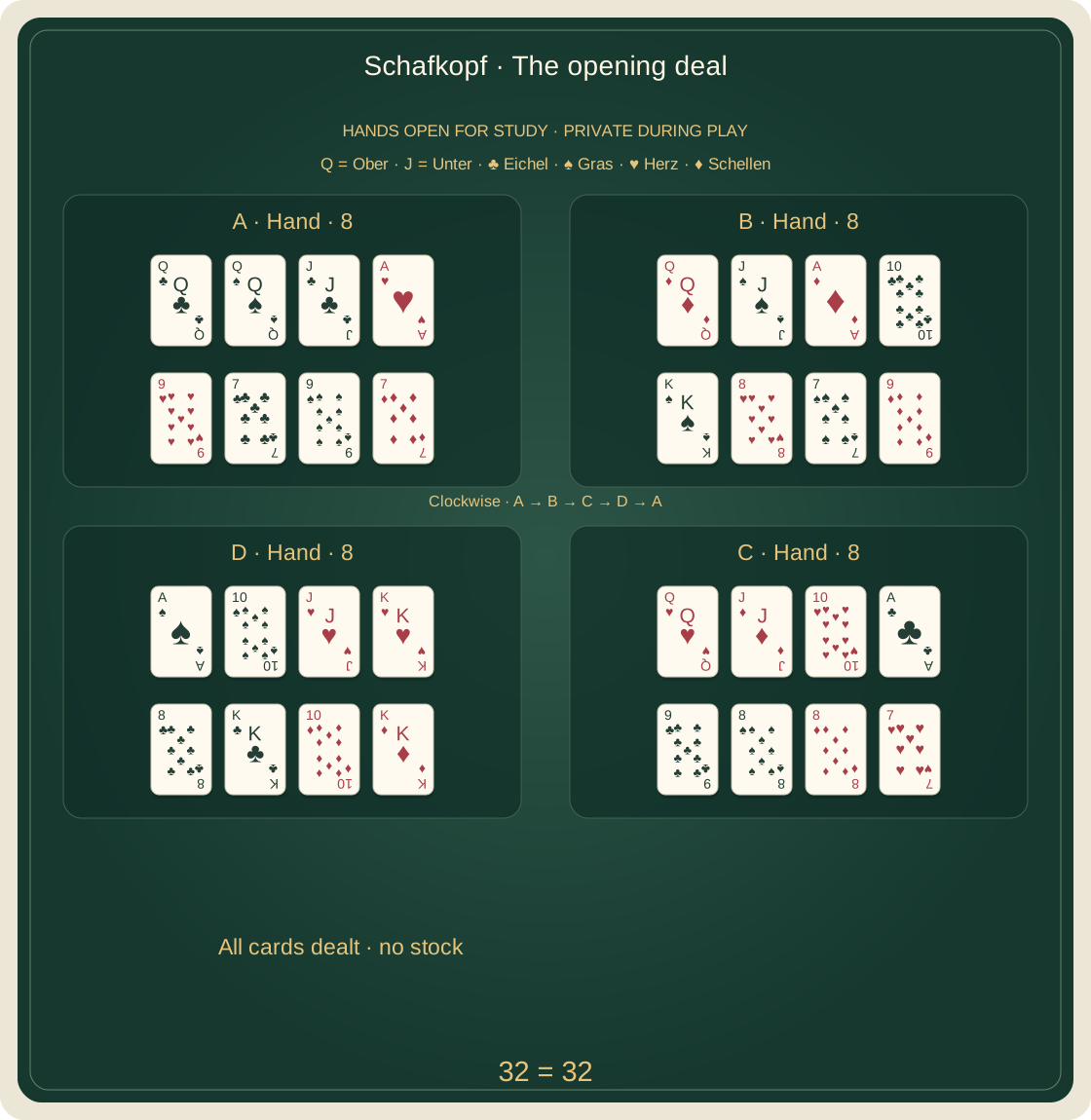
A wins Sauspiel and calls A♣; C holds it. A has 7♣, so the call is legal. A leads the top trumps, then hearts; note how off-suit high cards can be lost to trumps. On the club lead C must play A♣. The complete eight-trick record follows the illustrated hands and keeps the clockwise order after every change of leader.
| Trick | Play order | Cards | Winner |
|---|---|---|---|
| 1 | A → B → C → D | Q♣ Q♦ Q♥ J♥ | A |
| 2 | A → B → C → D | Q♠ J♠ J♦ K♥ | A |
| 3 | A → B → C → D | J♣ 8♥ 10♥ A♠ | A |
| 4 | A → B → C → D | A♥ A♦ 7♥ 10♠ | A |
| 5 | A → B → C → D | 9♥ 10♣ 9♣ 8♣ | A |
| 6 | A → B → C → D | 7♣ K♠ A♣ K♣ | C |
| 7 | C → D → A → B | 8♠ 10♦ 9♠ 7♠ | A |
| 8 | A → B → C → D | 7♦ 9♦ 8♦ K♦ | D |
← On a small screen, scroll the diagram horizontally. →
12 /
A complete settlement
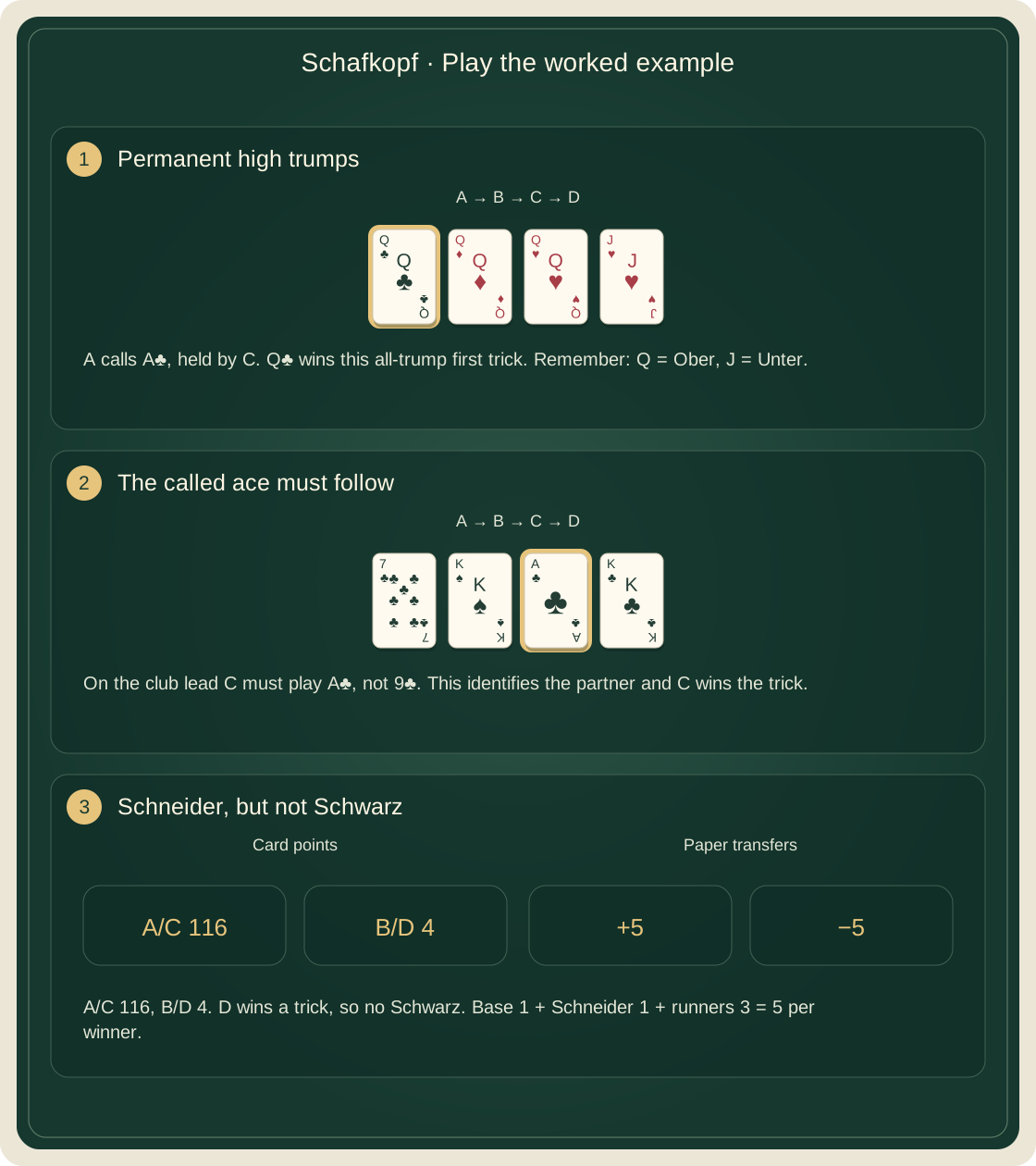
A/C take 116 card points and B/D 4. A/C held the three top queens together, so three runners apply. Seven tricks is not Schwarz: D took the last trick. The value is 1 base + 1 Schneider + 3 runners = 5. Without Stoss or Retour the net record is A +5, B −5, C +5, D −5; it balances to zero.
13 /
Check your understanding
Is Q♠ a spade in Sauspiel?
Reveal the answer
No. It is a trump. With a plain spade held, follow that instead.
Does taking every card point mean Schwarz?
Reveal the answer
No. Schwarz requires every trick, including tricks worth no points.
14 /
History and other versions
Bavarian Schafkopf developed from an older German Schafkopf family. The school relates its pure rules to a printed Amberg account from 1895 and its later revision. This is not the same as fixed-partner Deutscher Schafkopf or every pub variant. Short packs and extra solo contracts are living alternatives, so agree the exact ladder and tariff before playing.
Common questions
Can hearts be the called suit?+
No in Sauspiel: hearts are trumps. Call a qualifying plain-suit ace.
Must I trump when void?+
No. Follow suit when possible; otherwise play freely within the called-ace restriction.
Does a tie in card points favour declarer?+
No. Defenders win the tied card-point result.