← On a small screen, scroll the diagram horizontally. →
01 /
Your first round
Move available cards to shared foundations or houses, or load them onto the opponent. A turn can contain many moves. A card from your closed draw pile that you choose not to play goes to your waste and ends the turn. Emptying your reserve, draw pile and waste wins immediately; shared tableau cards are not part of your remaining burden.
02 /
Cards, seats and the deal
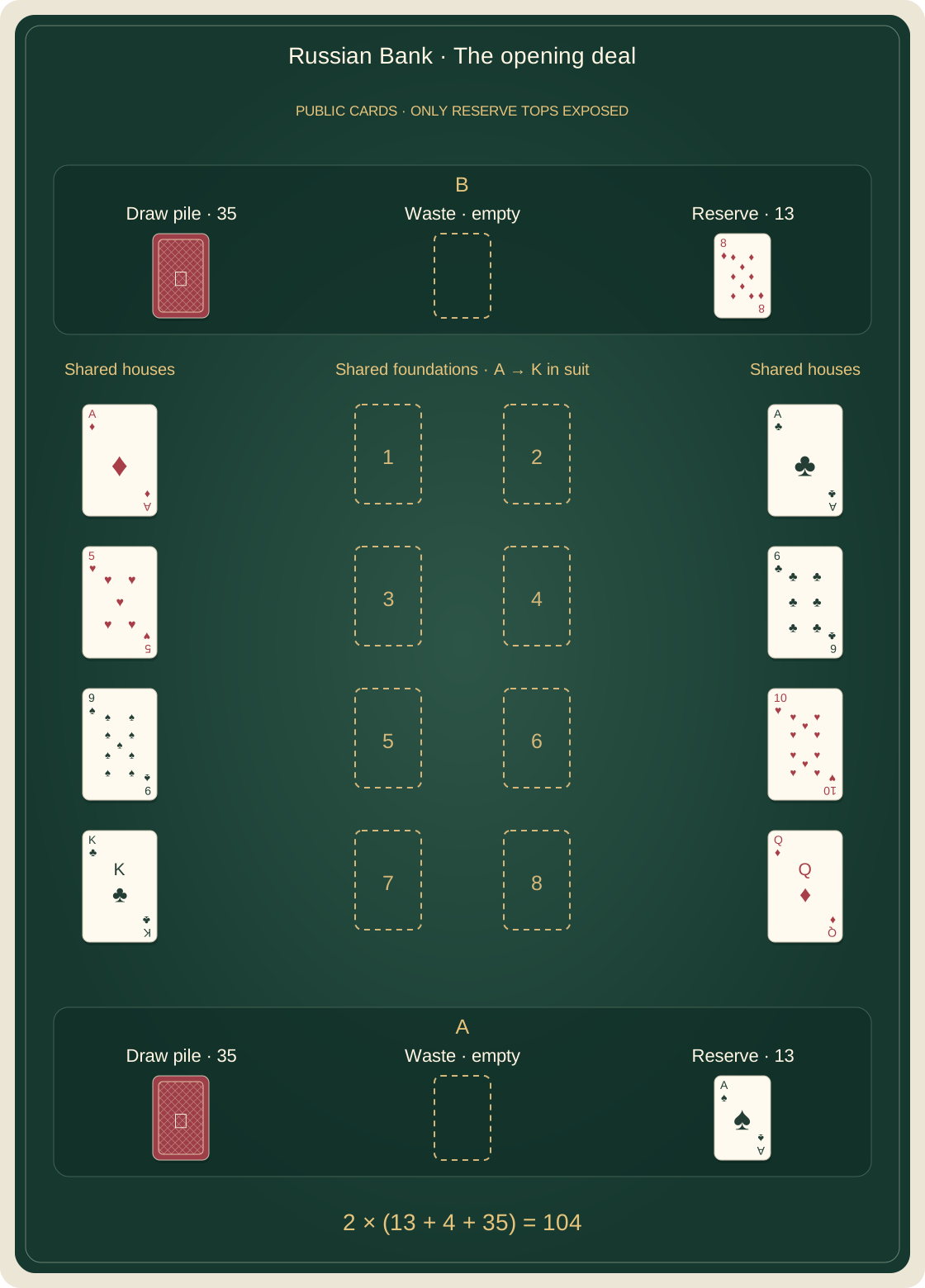
Each shuffles the other’s pack, then deals from their own: 12 face-down reserve cards plus one face up, four separate face-up houses, and 35 cards in a closed draw pile. Arrange the eight houses in two columns of four with eight foundation spaces between them. Leave one waste space per player. Lower reserve top starts, ace low; ties compare the adjacent house and then the next houses.
03 /
Which cards are available?
You may move your reserve top, the outermost exposed card of any house, and the draw card once turned up. After playing a reserve card, reveal the next immediately. Neither waste, the opponent’s reserve or draw pile, nor any foundation may supply a card. Move singly: a sequence transfer is valid only if it can be executed as legal individual moves using spare houses.
04 /
Three building rules
Foundations start with aces and ascend in the same suit to kings. Houses descend with alternating red and black; any available card can fill an empty house. Load an opponent’s nonempty reserve or waste with a card of the same suit, one rank higher or lower. There is no king-to-ace wrap. You may never add to your own reserve, and your own waste accepts only a draw card ending the turn.
05 /
Compulsory moves, in order
Priority 1: your reserve top must go to a foundation before any other move if it fits. Priority 2: every other available foundation move must precede a voluntary move or draw. Priority 3: before turning a draw card, fill empty houses from your reserve while it remains nonempty. Check priorities again after every move. An empty house does not override an available foundation.
06 /
What happens on your turn
Once obligations are satisfied, continue voluntary moves or turn your draw top. Playing that card lets you continue and eventually turn another. If you decline an optional play, put the draw card on your waste and stop. When the draw pile is empty at the moment a new card is needed, turn the waste over unshuffled. An unplayable last draw card ends the turn first; recycling waits for your next turn.
07 /
What “Stop” means
The opponent may call Stop and identify an illegal move or missed obligation. Undo an illegal placement and hand over the turn. For a missed compulsory move, undo the attempted alternative, make the required move, then hand over. Do not use Stop just because you prefer a different legal choice. Before an opponent starts, a wrongly discarded foundation card can be forced onto its foundation.
08 /
A complete worked example
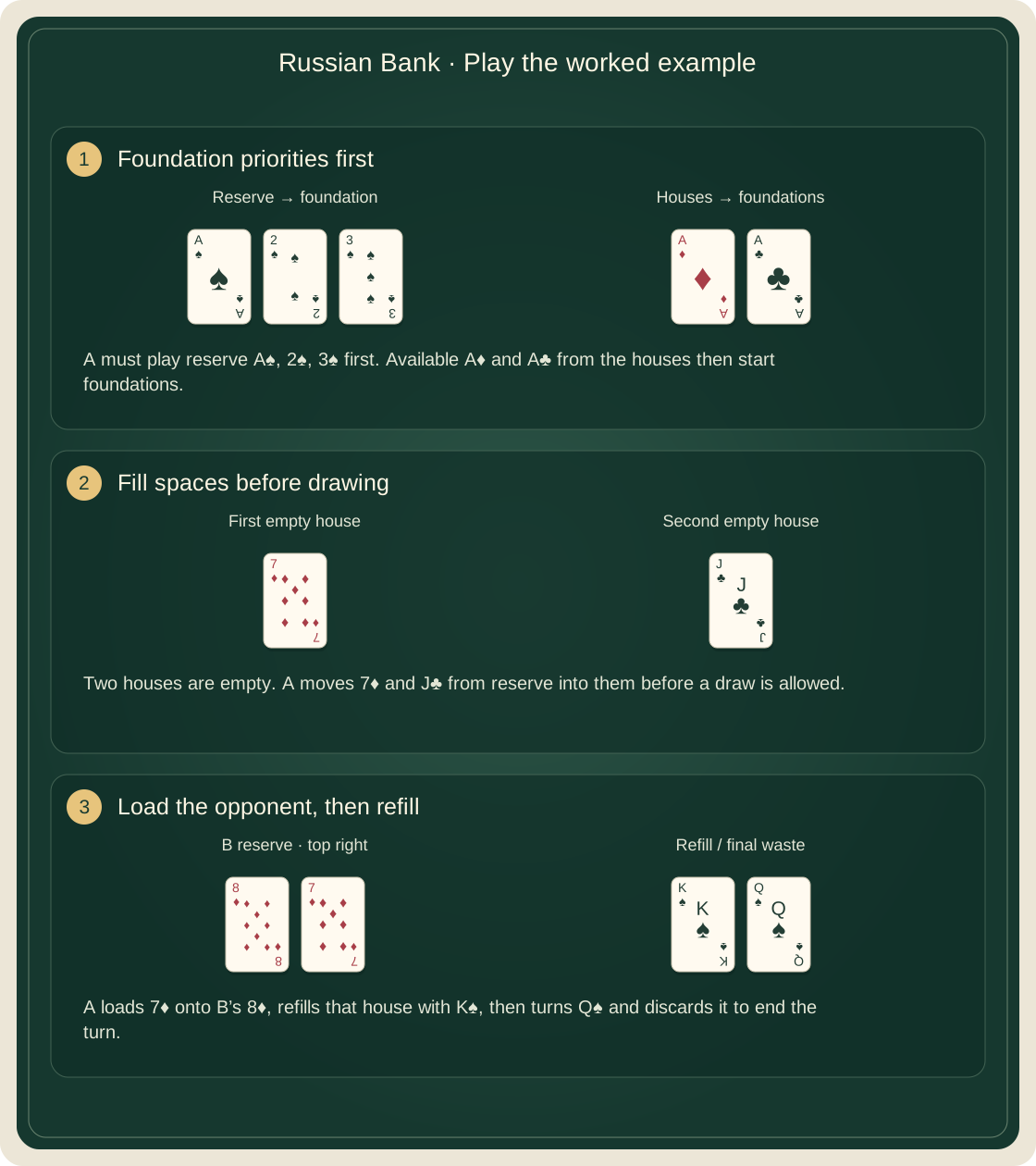
A’s reserve starts A♠, then 2♠, 3♠, 7♦, J♣, K♠; B shows 8♦. A starts and must put the first three spades on a foundation. The available A♦ and A♣ from the houses must then start foundations. Two houses are empty: before drawing, A fills them with 7♦ and J♣. Now A voluntarily loads 7♦ onto B’s 8♦, making that reserve longer. The emptied house must receive K♠ before A turns Q♠ from the draw pile and discards it to end the turn.
← On a small screen, scroll the diagram horizontally. →
09 /
Scoring and settlement
After this turn A has 7 reserve cards and 34 draw cards; B has 14 reserve and 35 draw cards. Add 8 house cards, 5 foundation cards and one waste card: 104 remain. A future clear would score 30 plus the opponent’s draw and waste count plus twice their reserve count. At a genuine mutual stalemate, lower burden scores only the difference. Play to an agreed 300; equal burdens score neither side.
10 /
Check your understanding
Can I draw while a reserve ace fits?
Reveal the answer
No. The reserve-to-foundation move has first priority.
May I play my own waste top next turn?
Reveal the answer
Not here. It returns only through unshuffled recycling when the draw pile is exhausted.
11 /
History and other versions
The game is recorded as Zank-Patience in a German patience collection published in 1884/85. Crapette is its familiar French name; Russian Bank is common in English. The name alone does not establish a Russian inventor. Waste availability and the strictness of compulsory transfers vary considerably between published and family versions.
12 /
Mistakes to avoid
Name each zone before starting: reserve and draw pile are different. Do not treat alternating colours as the loading rule; opponent piles require the same suit. Never shuffle during recycling or mistake shared houses for cards you must clear to win.
Common questions
Is this simultaneous speed solitaire?+
No. Players take alternating turns, each possibly containing several moves.
Must I load the opponent whenever possible?+
Not under these three priorities. Some stricter variants add that obligation.
Do different backs restrict a foundation?+
No. Both packs may mix freely during legal play.