← On a small screen, scroll the diagram horizontally. →
01 /
Your first round
Partners sit opposite. Deal, bid, let the highest bidder exchange with the nest and name trump, then eldest hand leads. Play nine tricks, preserving suit except for the bird’s privilege. The last trick wins the nest as well. Count captured points by partnership, compare the declaring side with its bid and update running scores.
02 /
The rules used here
Colour replaces suit; numerals rank normally from 14 down to 5. Team A/C opposes B/D. We use minimum bid 70, increments of 5 up to 120, and a stated all-pass convention: dealer must accept 70. No coaching or coded signals between partners. Alternate dealer clockwise; after four deals one pair changes seats as in the booklet. Other Rook versions may keep ones or change the bird, so identify the profile before playing.
03 /
Cards, seats and the deal
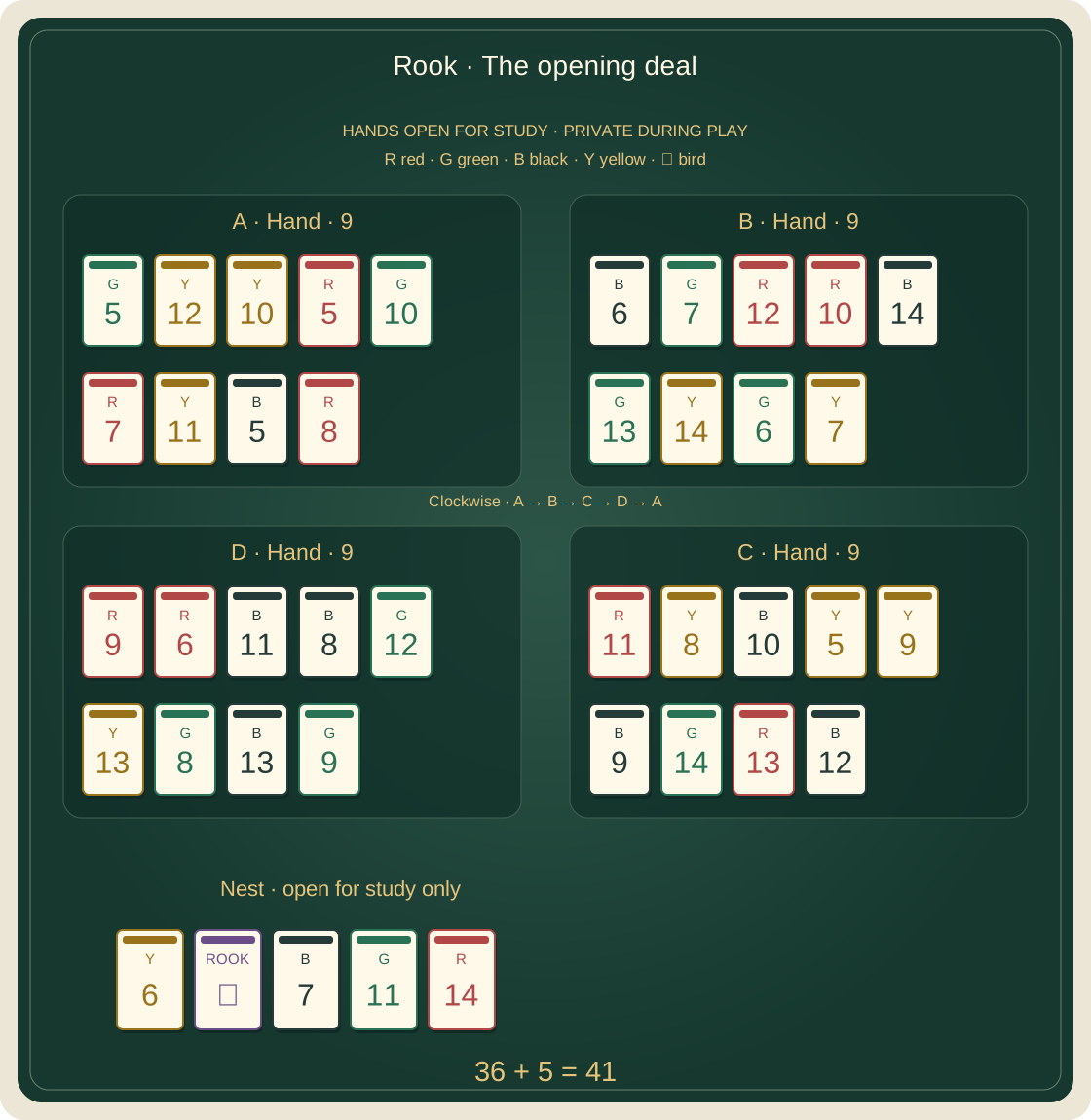
Shuffle the active pack, cut at dealer’s right and deal singly from the left. After one card to every player, place one hidden in the nest; repeat until five nest cards exist, then finish dealing to players. Each has nine. Nobody sees the nest during bidding. The high bidder privately takes it, discards exactly five back face down, retaining nine, then announces one trump colour. Any cards, even point cards or bird, may be left in the nest.
04 /
Bid for your partnership
Start left of dealer and continue clockwise. Bid above the current offer or pass; a passer cannot return. The last remaining bidder declares for the partnership, which must capture at least the promised points. Do not announce trump as part of an ordinary bid: choose it only after nest exchange. Winning the auction does not grant the first lead; that remains with dealer’s left neighbour.
05 /
What happens on your turn
Lead any card. Follow the led colour if able; when void, trump or discard freely. Highest trump wins, otherwise highest of the led colour; winner leads next. The bird always outranks trump and may be played at any time, even while holding the led colour. If bird is led, it demands trump. If trump is led and the bird is your only trump, you must play it. With other trump you may choose either. Do not treat the bird as an ordinary black-colour card.
06 /
Scoring and settlement
Each partnership counts its captured point cards; nest points go to the last trick winner. If declarers meet the bid, record all their captured points, not just the bid. If they fail, subtract the bid and ignore their captured points. Defenders always score what they captured. There is no extra score for a plain trick or the last trick itself.
| Card | Points each | Total |
|---|---|---|
| 14 | 10 | 40 |
| 10 | 10 | 40 |
| 5 | 5 | 20 |
| Bird | 20 | 20 |
07 /
When the round and match end
First partnership to reach 300 wins after settlement. If both reach it in the same deal, higher total wins; a tie needs another deal. Tournament discipline includes penalties: wrong nest count or partner coaching costs 40. A wrong-colour play may be corrected before the next trick is taken; discovered later, end that hand and set the offending side by the full bid, while the other side keeps counters already captured. An early misdeal is redealt by the next dealer; a late-discovered misdeal also penalizes dealer’s side 40.
08 /
A complete worked example
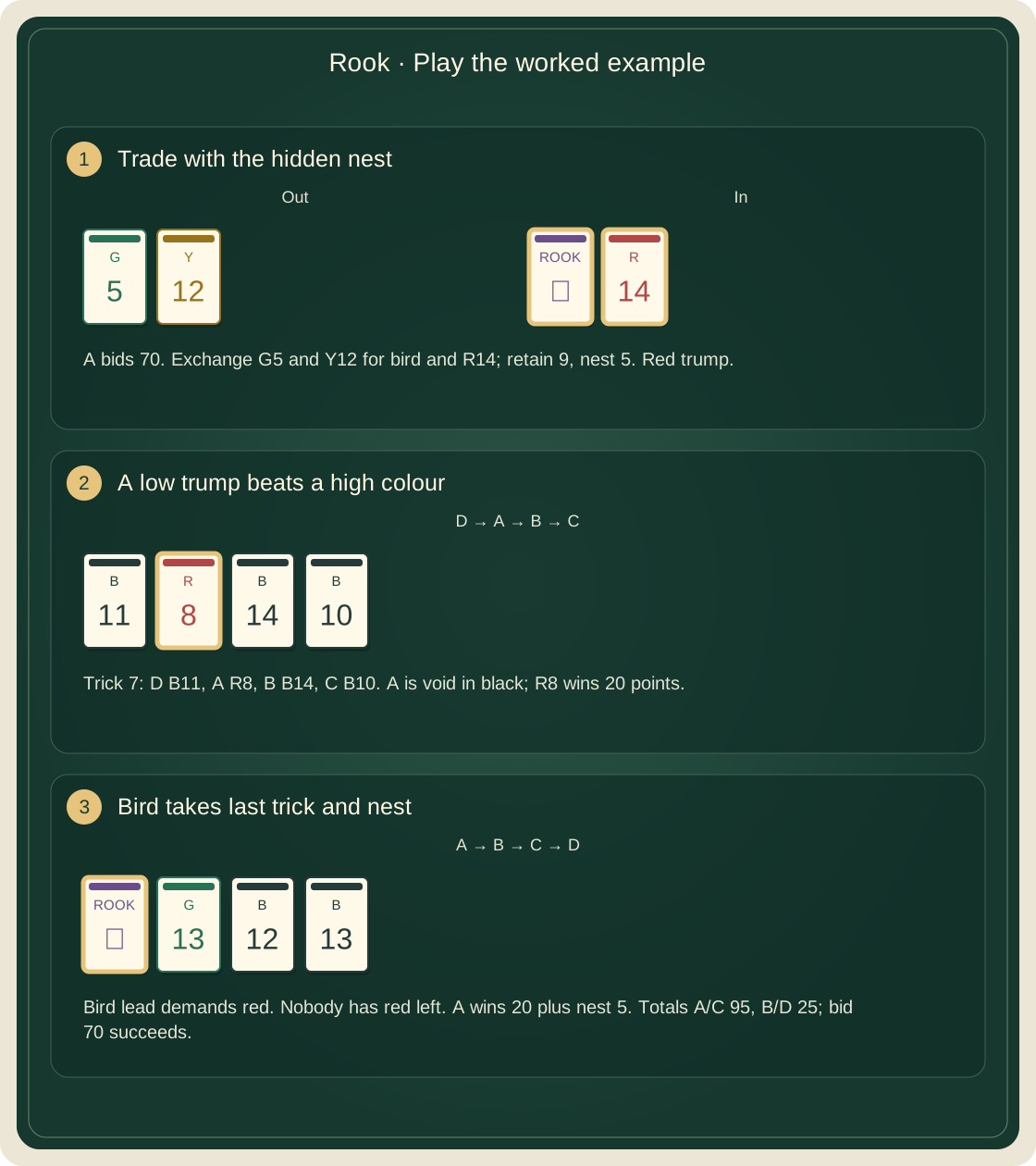
D deals; A bids 70, others pass. A replaces G5 and Y12 with the bird and R14 from the pictured nest, leaving Y6 G5 B7 G11 Y12 hidden. Red trump. First B5 B6 B9 B8 gives C the trick and 5 points. Seventh trick: A is void in black and R8 beats black fourteen, scoring 20. A then wins R14, then leads the bird to take the final trick and nest. The nine-trick table totals A/C 95 and B/D 25, including nest 5. Contract succeeds: record +95 and +25. A hypothetical bid 100 with the same captures would instead record −100 and +25.
| Trick | Order | Cards | Winner / points |
|---|---|---|---|
| 1 | A → B → C → D | B5 B6 B9 B8 | C / 5 |
| 2 | C → D → A → B | Y5 Y13 Y10 Y7 | D / 15 |
| 3 | D → A → B → C | R6 R5 R10 R11 | C / 15 |
| 4 | C → D → A → B | Y8 G8 Y11 Y14 | B / 10 |
| 5 | B → C → D → A | G6 G14 G9 G10 | C / 20 |
| 6 | C → D → A → B | Y9 R9 R7 G7 | D / 0 |
| 7 | D → A → B → C | B11 R8 B14 B10 | A / 20 |
| 8 | A → B → C → D | R14 R12 R13 G12 | A / 10 |
| 9 | A → B → C → D | ◈ G13 B12 B13 | A / 20 |
← On a small screen, scroll the diagram horizontally. →
09 /
Check your understanding
May bird be played while holding the led colour?
Reveal the answer
Yes. It is the unique exception and always the highest trump.
Does the bidder automatically keep the nest points?
Reveal the answer
No. The partnership taking the last trick captures the final nest.
10 /
History and other versions
Rook is a published numbered-colour card system with several distinct games in its own booklet. Kentucky Discard became the basis for the tournament profile shown here, with the bird included even though earlier Kentucky play could omit it. Full-pack games, ones-high games and local bird rankings are alternatives, not errors to blend into this reduced-pack deal. The drawings use original plain numeral cards rather than copied branded artwork.
11 /
Mistakes to avoid
Count retained hand and nest before naming trump. Do not award nest points at the exchange. Distinguish a high numeral from a point card: many ranks win tricks but score nothing. A failed contract loses its bid, not the difference from the bid. Preserve the bird’s exceptional right without giving that privilege to any other trump.
Common questions
How many active cards?+
41: four colours of ten ranks plus one bird, with nine each and five in the nest.
Who leads first?+
Dealer’s left neighbour, even if another player won the auction.
Is the bird black suit?+
No. It is the special highest trump regardless of its printed artwork.