← On a small screen, scroll the diagram horizontally. →
01 /
Your first round
Deal all cards. Eldest hand leads a suit, and the others try to follow clockwise. If everybody follows, throw the completed trick into a separate waste and let its highest card lead again. If somebody cannot follow, stop immediately: that player picks up only cards already played, without first discarding a different suit, and leads a fresh trick.
02 /
The rules used here
This is a race to the first empty hand, not a contest for captured points. We stop on the first legal last card even if someone later would have been void. Do not continue to determine a loser or score honours. For a longer session play a full dealer circuit and award one win per deal; most wins takes the session, ties shared. These session scores are an optional teaching convention.
03 /
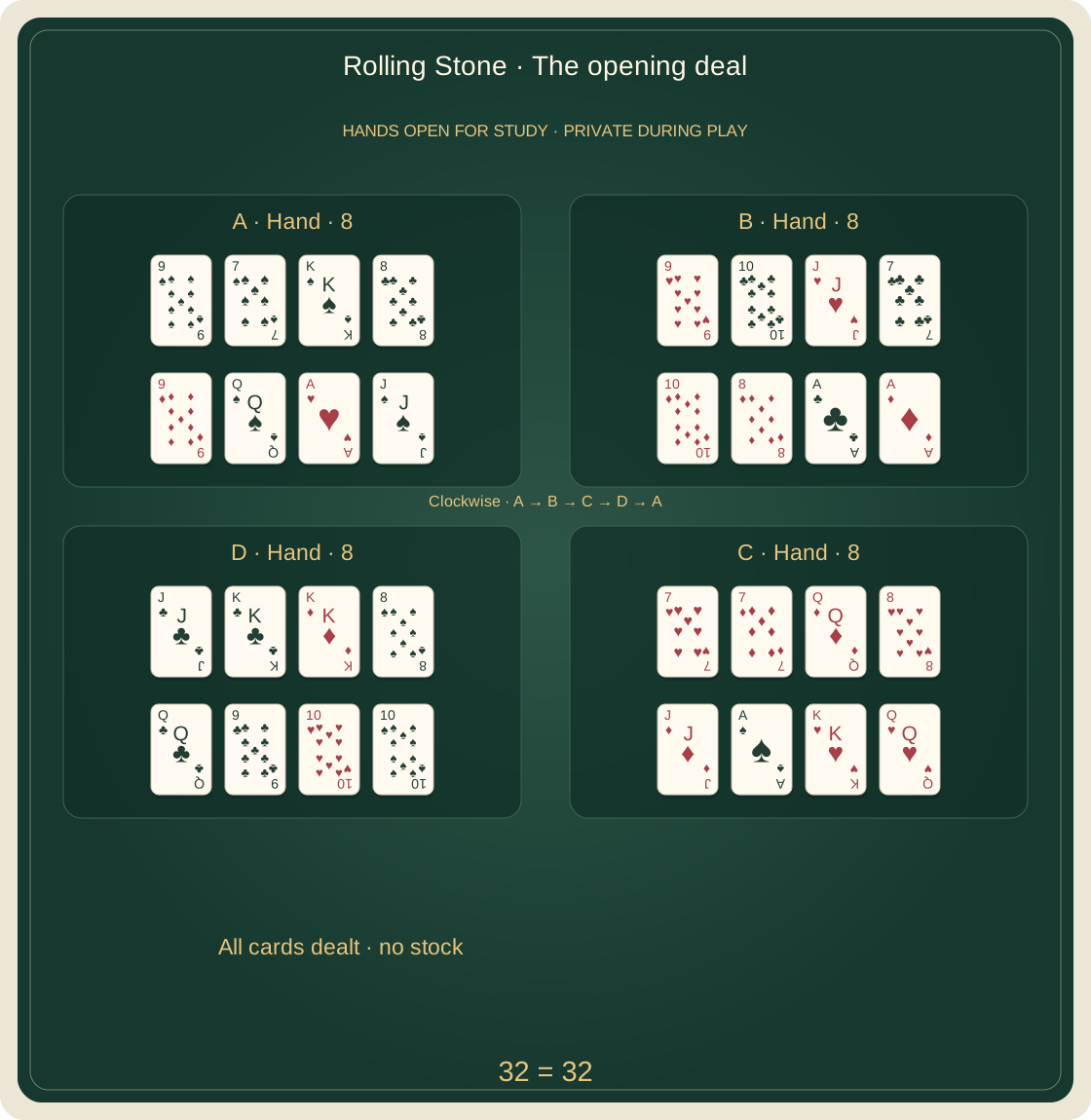
Cards, seats and the deal
Remove low cards before shuffling. Choose a dealer, shuffle and cut, then deal singly clockwise from the left until everyone has eight. The centre begins empty. Keep an obvious separate waste area: cards there must never be confused with an interrupted trick awaiting pickup. The player to dealer’s left leads any held card; the next dealer is to the left too.
04 /
What happens on your turn
A suit in hand must be followed even if you prefer to pick up. Within that suit choose any rank; overtaking is optional. Aces beat kings, then queens, jacks, tens, nines, eights and sevens. There are no trumps: an off-suit card is not a legal answer. Only after every player has contributed does a completed trick enter the waste. Its winner selects the next suit by leading, not by naming it separately.
05 /
An interrupted trick
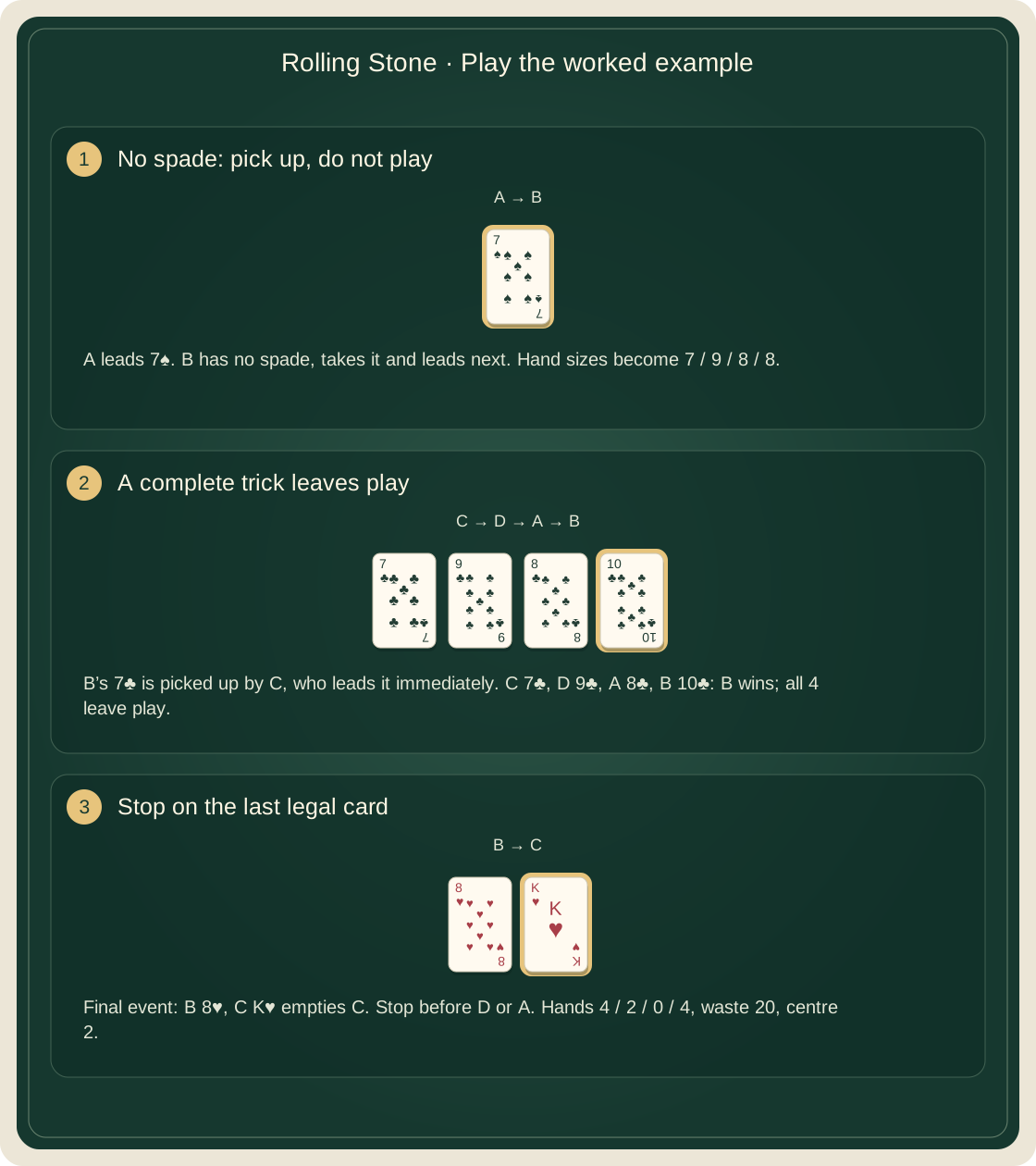
At the first void seat, the current trick ends without a winner. The void player adds its already played cards to the existing hand; players who had not yet acted keep all their cards. The collector then leads immediately, so they can lead a card just picked up. Nothing is drawn and no card is discarded as a penalty. Repeated short pickups can therefore move the same card among several hands before it finally leaves in a complete trick.
06 /
When the round and match end
Check for an empty hand immediately after each legal play, before asking the next player to act. That player wins now, even as leader of an unfinished trick. The final centre cards have not been awarded or discarded; leave them visible while confirming the result. If house rules instead wait until the trick ends, agree that before dealing because it can change the winner.
07 /
A complete worked example
A leads 7♠. B has no spade and takes that single card: sizes 7, 9, 8, 8. B now leads 7♣; C has no club and picks it up. C immediately leads that same 7♣; D 9♣, A 8♣, B 10♣ complete the trick, so B leads and those four cards leave play. Continue the complete table. At its final event B leads 8♥ and C plays K♥, emptying C’s hand. Stop without asking D or A. Remaining hands A 4, B 2, C 0, D 4; waste 20 and unfinished centre 2 account for all 32. C wins.
| Event | Order | Cards | Result |
|---|---|---|---|
| Pickup | A | 7♠ | B |
| Pickup | B | 7♣ | C |
| Discard complete trick | C → D → A → B | 7♣ 9♣ 8♣ 10♣ | B |
| Discard complete trick | B → C → D → A | 7♠ A♠ 8♠ 9♠ | C |
| Discard complete trick | C → D → A → B | 7♦ K♦ 9♦ 8♦ | D |
| Discard complete trick | D → A → B → C | 10♥ A♥ 9♥ 7♥ | A |
| Pickup | A | J♠ | B |
| Pickup | B → C | 10♦ J♦ | D |
| Pickup | D | 10♦ | A |
| Discard complete trick | A → B → C → D | 10♦ A♦ Q♦ J♦ | B |
| Pickup | B → C | J♥ 8♥ | D |
| Pickup | D | 8♥ | A |
| Pickup | A | 8♥ | B |
| Pickup | B → C → D | 8♥ Q♥ J♥ | A |
| Pickup | A | 8♥ | B |
| Immediate win | B → C | 8♥ K♥ | C |
← On a small screen, scroll the diagram horizontally. →
08 /
Check your understanding
No led suit: should you play a different suit before taking?
Reveal the answer
No. Pick up only the cards already played, then make a new lead.
Where do cards of a completed trick go?
Reveal the answer
Out of play, never into the winner’s hand.
09 /
History and other versions
Rolling Stone is also associated with the names Enflé and Schweller in the European shedding family. Modern accounts disagree on deck sizes and when an empty hand is safe. The publisher profile is especially clear for four players, which is why this guide does not mix its eight-card deal with an unexplained full pack or automatically extend it to a larger table.
10 /
Mistakes to avoid
Being short in a suit is dangerous, not permission to throw away another suit. Track which opponents have shown a void. A high card can be useful because it chooses the next lead, but taking a complete trick gives no points. Keep centre and waste apart and count every physical card after a pickup; that catches most learning errors.
Common questions
Is there trump?+
No. Only the led suit may be played into a trick.
Can a picked-up card be led immediately?+
Yes. It is part of your hand before you choose the new lead.
Does highest card always win the deal?+
No. The first empty hand wins, regardless of the value of its last card.