← On a small screen, scroll the diagram horizontally. →
01 /
Your first round
Deal thirteen cards each, hold an ascending auction, then announce trump and any called card. The dealer’s left neighbour leads regardless of who bid. Play thirteen tricks following suit. A Rik alliance needs at least eight; solo contracts use their named target, misère needs none, piek exactly one. Settle only after counting both partners’ tricks together.
02 /
The rules used here
Ordinary pack, A high down to 2, no jokers. Keep each player’s running net units, not permanent team scores. This profile does not shuffle between deals: gather cards, offer a cut to the dealer’s right, then deal clockwise in packets six and seven. Pass the deal left. Use one full dealer circuit as a teaching session; highest net total wins, ties shared. No money or central pool is needed.
03 /
Cards, seats and the deal
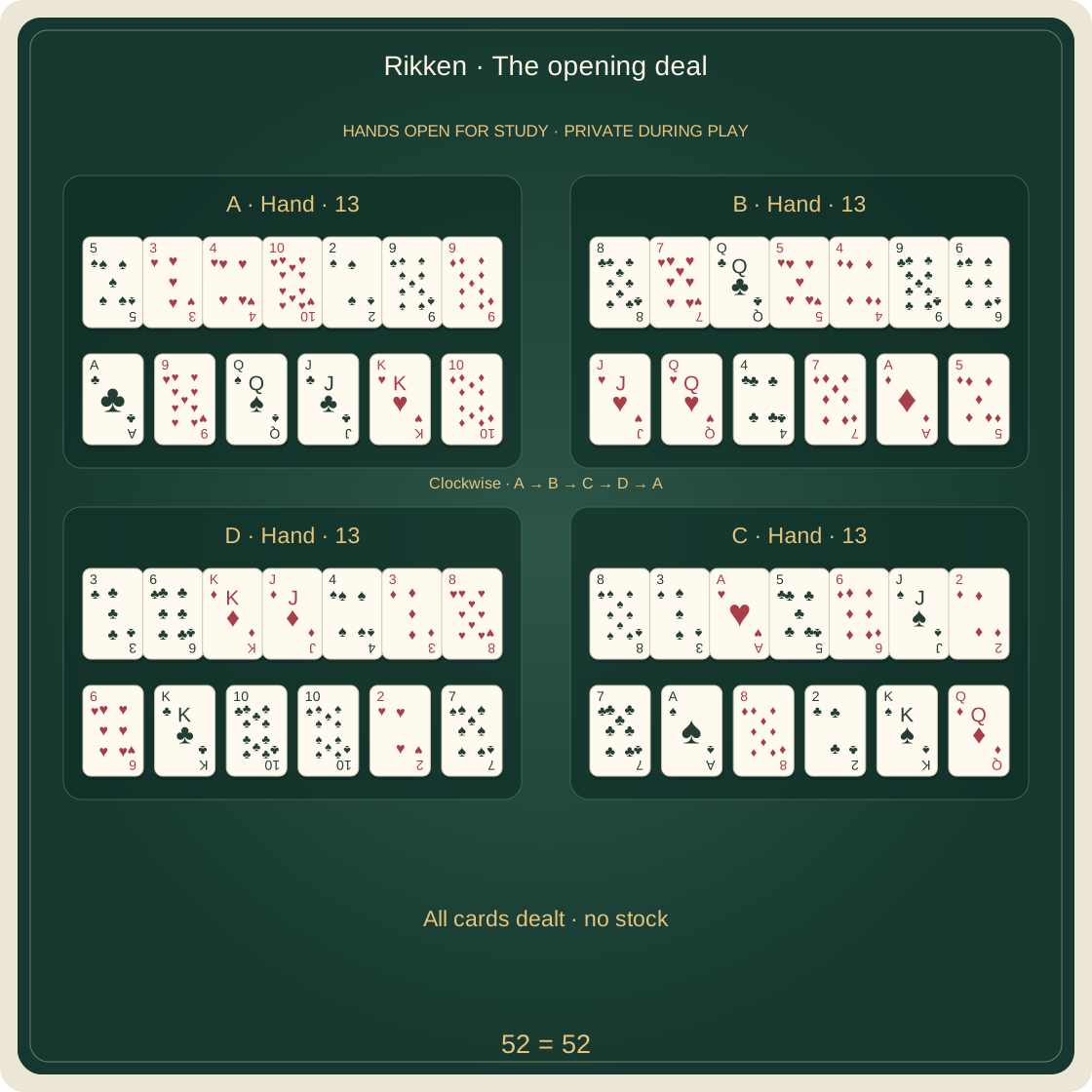
All cards are dealt; there is no stock, discard, exchange or passing phase. Hands remain private. Before the first auction turn, count your aces: exactly three requires troela or a higher contract at your first opportunity unless a higher contract was already bid. Troela is not simply a bonus added after a Rik auction. A player with four aces is not forced into that three-ace rule.
04 /
How the auction closes
Start left of dealer. Pass permanently out of this auction or bid above the current level; no suit is named yet except that Rik beter promises hearts. Continue until only the highest bidder remains. If all pass, collect and let the next dealer deal. Misère and piek at the same level can coexist: when all remaining bidders have reached that equal level, close the auction and play their contracts simultaneously. The same applies to their matching open forms.
05 /
Contracts in ascending order
The table rises from top to bottom. Alleen means alone, without a partner. Open exposes the declarer after the first trick; met een praatje exposes every hand after that trick and permits opponents to discuss play. Misère and piek have no trump. Troela needs the fourth-ace partner and a target of eight; that partner names a trump different from the missing ace’s suit.
| Contract | Trick target | Base units |
|---|---|---|
| Rik | ≥8 | 1 |
| Rik beter · ♥ | ≥8 | 1 |
| 8 alleen | ≥8 | 1 |
| Misère / Piek | 0 / 1 | 5 |
| 9 alleen | ≥9 | 1 |
| 10 alleen | ≥10 | 1 |
| 11 alleen | ≥11 | 1 |
| 12 alleen | ≥12 | 1 |
| Open misère / Open piek | 0 / 1 | 10 |
| Troela | ≥8 | 2 |
| Open misère / piek met een praatje | 0 / 1 | 15 |
| 13 alleen | 13 | 15 |
| Open 13 alleen | 13 | 20 |
06 /
Call and reveal a partner
For Rik, declarer chooses trump and calls an ace not held, outside trump. Prefer a suit in which declarer holds a card. Only when every held non-trump suit already includes its ace may a void-suit ace be called blind, announced explicitly. Four aces allow a king instead, using the same rules. Partner stays silent. When the called suit is led by another player, its ace must be played even if already ruffed. The partner may itself lead another card of that suit, thereby revealing the alliance.
07 /
What happens on your turn
Eldest hand leads; follow suit if possible. When void, trumping is optional and any card may be discarded. No compulsory overtaking. Highest trump wins, otherwise highest of the led suit; winner leads next. For a blind call, once before the called ace appears, declarer may lead a hidden card to demand the called suit; others follow that suit and the ace is compulsory. Reveal the hidden card after the trick and apply trump precedence. This special lead is not available to an ordinary non-blind call.
08 /
Scoring and settlement
Rik success: each ally receives 1 plus one per overtrick; each defender pays that amount. Failure: each ally pays 1 plus one per trick short, each defender receives it. Troela starts at 2 instead. Solo eight through twelve uses 1 plus overtricks on success or 1 plus undertricks on failure, paid by or to each opponent. Any partnered contract or solo up to twelve earns an extra unit for all thirteen tricks. Misère/piek pay 5, open forms 10, discussion forms 15, solo thirteen 15 and open thirteen 20, each against every opponent. Each simultaneous contract settles independently; sum the transfers.
09 /
A complete worked example
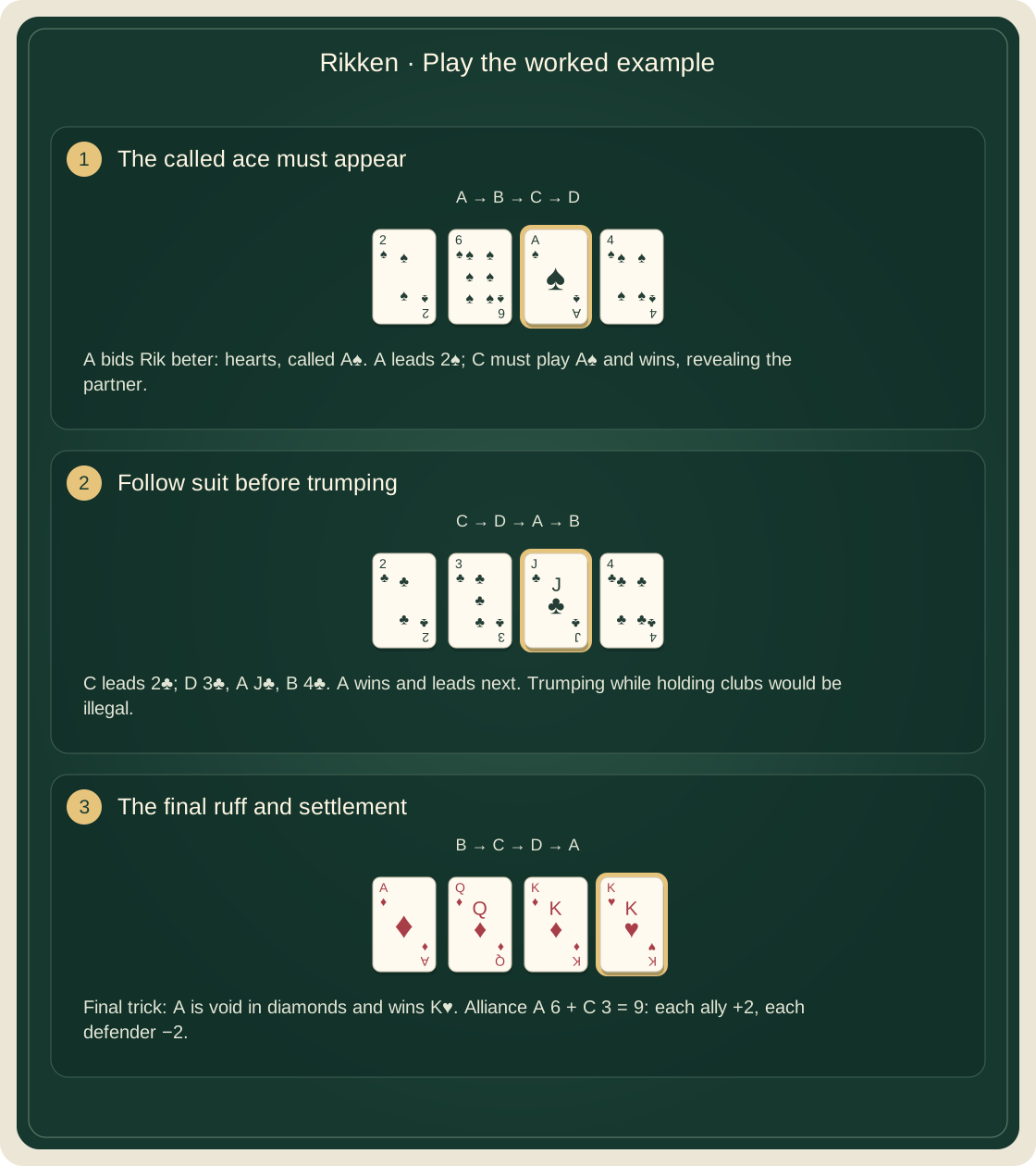
D deals. A bids Rik beter, everyone else passes; no hand contains three aces. Hearts trump, called A♠, held silently by C. A’s opening 2♠ forces C to play A♠, revealing the partner. C leads 2♣ and A wins J♣; later C takes a heart trick with A♥. The complete table follows every remaining card, including legal off-suit ruffs. On the final trick B leads A♦, but A is void and wins with K♥. Totals A 6, B 3, C 3, D 1: alliance 9, one overtrick. A and C each receive 2; B and D each pay 2. Net sum zero. The exposed hands are for study only.
| Trick | Play order | Cards | Winner |
|---|---|---|---|
| 1 | A → B → C → D | 2♠ 6♠ A♠ 4♠ | C |
| 2 | C → D → A → B | 2♣ 3♣ J♣ 4♣ | A |
| 3 | A → B → C → D | 3♥ 5♥ A♥ 2♥ | C |
| 4 | C → D → A → B | 2♦ 3♦ 9♦ 4♦ | A |
| 5 | A → B → C → D | 4♥ 7♥ 3♠ 6♥ | B |
| 6 | B → C → D → A | 5♦ 6♦ J♦ 10♦ | D |
| 7 | D → A → B → C | 6♣ A♣ 8♣ 5♣ | A |
| 8 | A → B → C → D | 5♠ 7♦ 8♠ 7♠ | C |
| 9 | C → D → A → B | 7♣ 10♣ 9♥ 9♣ | A |
| 10 | A → B → C → D | 9♠ J♥ J♠ 10♠ | B |
| 11 | B → C → D → A | Q♣ 8♦ K♣ 10♥ | A |
| 12 | A → B → C → D | Q♠ Q♥ K♠ 8♥ | B |
| 13 | B → C → D → A | A♦ Q♦ K♦ K♥ | A |
← On a small screen, scroll the diagram horizontally. →
10 /
Check your understanding
Must a void player trump?
Reveal the answer
No in this Rikken profile. Following suit is compulsory; trumping when void is optional.
Seven tricks in Rik: what does each ally pay?
Reveal the answer
2 units: base 1 plus one missing trick. Each defender receives 2, not 4.
11 /
History and other versions
Rikken is associated with Brabant and neighbouring Dutch-speaking regions. The Flemish heritage inventory identifies a historical rule booklet describing it as Brabants whist. Local practice remains diverse: museum descriptions, club play and tournaments do not share every contract order or troela rule. That living variety is why the profile above states its ladder and payments instead of presenting them as a single national law.
12 /
Mistakes to avoid
Remember the called card without asking its holder to identify themselves. Count alliance tricks, not just declarer’s tricks, in Rik. A passing player cannot re-enter the auction. Do not reveal an open hand before the first trick is finished. If joining another table, ask about troela, simultaneous piek, the better suit and all-pass treatment before bidding.
Common questions
Is a permanent partner needed?+
No. A called card creates the alliance for that deal only. Solo contracts have no partner.
Can the trump ace be called?+
No. The called ace and trump must be different suits in this profile.
Can the dealer sit out in a larger group?+
A known larger-table variant rotates a resting dealer. The worked profile always has four active hands and four-way payments.