← On a small screen, scroll the diagram horizontally. →
01 /
Your first round
One dealer manages the cards and does not compete. Players predict four cards, keep them, and then use matching ranks against a hidden pyramid. Whoever retains most cards takes the final bus challenge. Add penalties as you go; the lowest total wins this counter version after the bus ends. Matching cards and prediction cards belong to separate packs only in other variants: here the first two phases share one pack.
02 /
The rules used here
Use a standard pack, no jokers, with ace above king and 2 lowest. The dealer is additional to the listed active players. Work clockwise from the dealer’s left. Correct predictions earn no penalty and no gift points. Each bus failure adds one point; stop after three failed attempts even without success. This finite stop and the final lowest-score winner are our stated house agreements. Tied lowest totals share the win.
03 /
Cards, seats and the deal
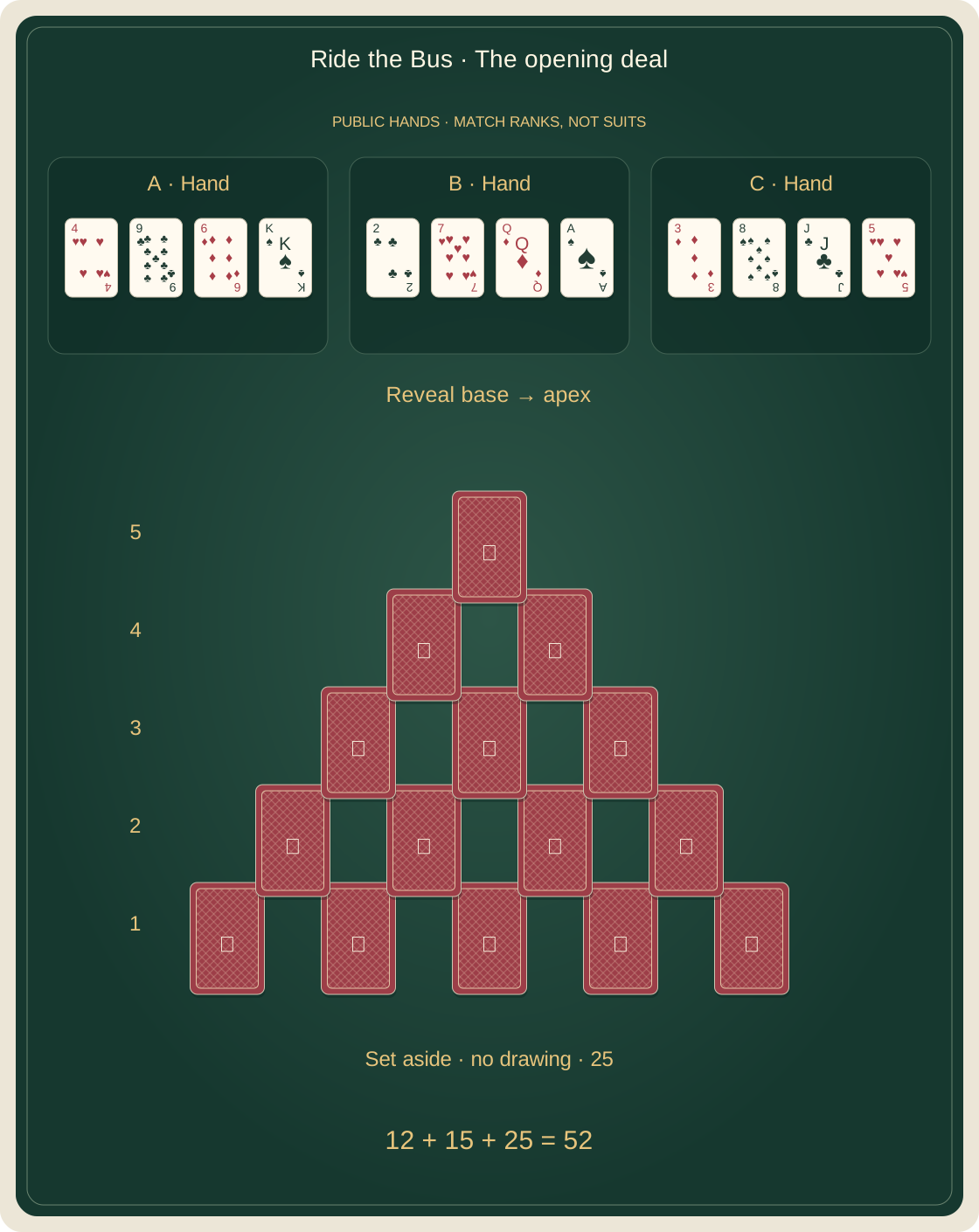
Shuffle and ask the first question of every player, dealing one visible card after each answer; repeat for the next question rounds until each has four. Leave those cards face up. From the undealt cards build fifteen hidden pyramid cards: bottom row five, then four, three, two, and one at the top. Even eight active players use only 32 + 15 = 47 cards before the bus. The rest stays aside, never drawn during the pyramid.
04 /
The four predictions
Question one: red or black? Wrong adds 1. Question two: higher or lower than the first card? Wrong adds 2; equal always wrong. Question three: strictly inside or outside the first two ranks? Wrong adds 3; matching either endpoint is wrong for both answers. With equal first ranks only outside can win. Question four: name the suit; wrong adds 4. Keep every revealed card, right or wrong. Predictions must precede the reveal.
05 /
What happens on your turn
Reveal the bottom row left to right, then climb row by row. Before the next reveal, any player may lay one or more held cards matching the revealed rank, discarding each permanently and assigning that row’s points per card to another active player. Bottom to top values are 1, 2, 3, 4, 5. Resolve offers clockwise; several players may match the same reveal. Matching is optional: saving a rank for a higher row risks retaining it. No bluff, challenge or replacement draw is used here.
06 /
Choose the rider and run the bus
Resolve the top card, then count remaining hands. Most cards rides; ties compare remaining ranks from highest down, then first tied seat clockwise from the dealer. Empty hands for everyone mean no rider. Collect and reshuffle the entire pack for the bus. Deal six hidden cards in a row. Turn left to right: 2 through 10 passes, J/Q/K/A fails immediately. On failure add one point, discard the entire six-card row, including unturned cards, and deal a fresh row from the remaining stock. Reshuffle all cards before a new row if fewer than six remain. Six consecutive passes finish; three failed rows also end this house version.
07 /
A complete worked example
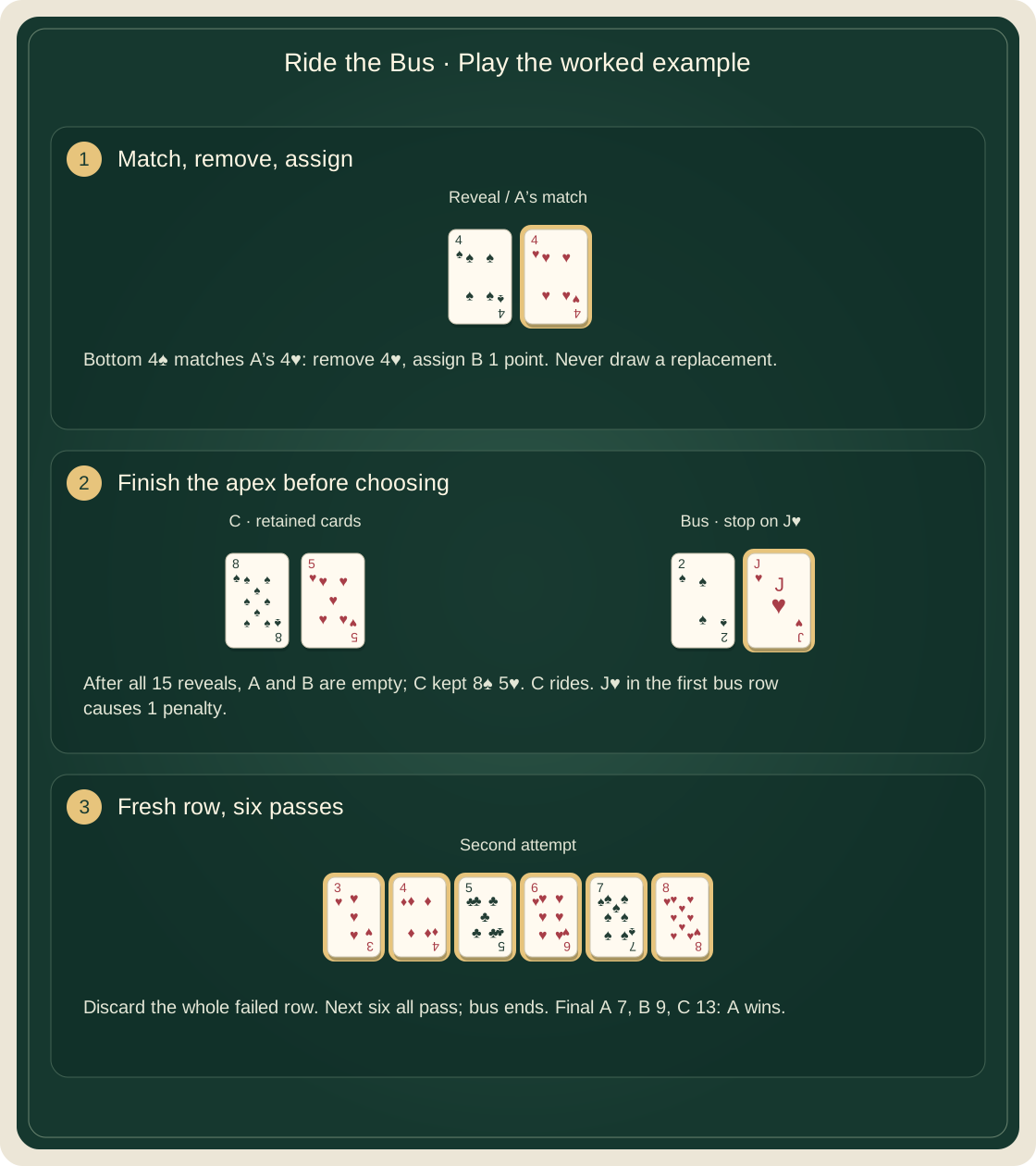
In the pictured deal, A predicts red, higher, inside, hearts for 4♥ 9♣ 6♦ K♠: only suit fails, +4. B predicts black, higher, outside, spades for 2♣ 7♥ Q♦ A♠: +0. C predicts black, higher, inside, hearts for 3♦ 8♠ J♣ 5♥: colour and inside fail, +4. In the pyramid A matches all four and gives B 1 + 2 + 3 + 3 = 9. B matches all four and gives C 1 + 2 + 2 + 3 = 8. C plays only 3♦ and J♣, giving A 1 + 2 = 3, and retains 8♠ 5♥. Resolve every remaining reveal, including the top, before naming C rider. C’s first bus row starts 2♠ J♥ and fails: +1. Next row 3♥ 4♦ 5♣ 6♥ 7♠ 8♥ passes. Final totals A 7, B 9, C 13: A wins.
← On a small screen, scroll the diagram horizontally. →
08 /
Check your understanding
Can an endpoint rank count as inside?
Reveal the answer
No. Equality loses both inside and outside predictions.
Why is C selected after scoring fewer pyramid points than B?
Reveal the answer
The rider is chosen by remaining cards, not penalty totals. C retained cards while the others emptied their hands.
09 /
History and other versions
Ride the Bus is a modern party-game tradition rather than a standardized tournament discipline. Sources disagree on whether the dealer plays, pyramid values, bluffing and even the final bus mechanism. Some repeat the four questions instead of using face-card resets. There is no securely established inventor in the sources used here. The illustrated counter adaptation fixes one playable version without claiming all households use it.
10 /
Mistakes to avoid
Do not mix a repeated-question bus with this six-card row midway through play. Never put a matched card back into your hand or draw a replacement. Announce whether you are holding a match before the next pyramid card is turned. Count the top card too; choosing the rider early can select the wrong person. The dealer records points but cannot receive assigned penalties.
Common questions
Is alcohol required?+
No. This complete version uses penalty counters and no drinking actions.
May several players match one reveal?+
Yes. Each matching card is discarded and assigns its own row-value penalty.
Does an ace pass the bus?+
No. In this row variant ace resets, as do jack, queen and king.