← On a small screen, scroll the diagram horizontally. →
01 /
Your first round
Prepare the pool, deal and exchange once. Play eleven no-trump tricks, following suit. Record honour points in won tricks and all ace or Quinola transfers separately. Unless a reversis intervenes, the lowest honour total wins the party and the highest pays it. Winning the first nine changes the objective: the same player must take the last two or pay for failure.
02 /
The rules used here
Use the named reconstruction rather than combining incompatible historical accounts. Each player starts with 100 counters; settle on paper if balances run short. A session ends after a full dealer circuit, with remaining pools shared equally. No espagnolette is announced, so everyone must always follow suit. Do not import modern Hearts passing, broken-hearts restrictions or a fixed penalty just for capturing the heart jack.
03 /
Cards, seats and the deal
Everyone contributes 5 to start the pool; each dealer adds 5 before dealing, so the first pool is 25. Deal counterclockwise in packets 4–3–4, then give the dealer a twelfth card and place one hidden offer before each other player. Dealer discards to eleven. Each other player either discards one before taking the unknown offer, or keeps the hand and merely looks at that offer. Four unused cards form the hidden talon. The lesson shows the hands after this choice; its talon is hidden during play.
04 /
What happens on your turn
The dealer’s right neighbour leads. Follow suit if able; otherwise discard anything, without trump. Highest of the led suit wins and leads again. Keep won cards by player. Each ace counts 4, king 3, queen 2, jack 1; other cards zero. Total honours across all hands and talon are 40. These card points decide the party; they are not automatically paid per captured honour.
05 /
Ace and Quinola transfers
Distinguish dumped, forced and led. Dumping an ace off-suit makes the trick winner pay its holder 1; for A♦ pay 2. An ace supplied to its own suit makes its holder pay the leader those amounts. Dumped J♥ makes the trick winner pay its holder 5. J♥ forced to a heart lead pays the leader 10 from its holder and 5 from each other opponent. Double each transfer between opposite seats, and double again in either of the final two tricks. Led aces create a claim by the eventual party winner against the leader: 1, or 2 for A♦. For led J♥, that winner claims 10 from its leader and 5 from the other opponents; exclude self-payments. Claims must be made before the next deal.
06 /
The Quinola pool
Dumping Quinola also wins the latest pool. Forcing or leading it instead makes its holder pay a supplement equal to the latest pool. The first supplement doubles the sole pool; later supplements form new separate pools. Each dealer adds 5 to the latest pool. If a dump empties every pool, rebuild with 5 from everyone and an extra 5 from the dealer. Pool supplements are not doubled for opposite seats or late tricks. Keep a ledger so a later reversis can undo transfers exactly.
07 /
Scoring and settlement
Without a reversis, least honour points wins the party and most loses. Break either tie by fewer tricks, then favour the dealer, then successive seats to the dealer’s left. The loser pays the winner 4 plus talon honour points, doubled if opposite. Use normal talon values here. A talon ace alone makes the base 4 + 4 = 8. Other side payments stand; having fewest points need not mean the largest net profit.
08 /
When everything reverses
Taking the first nine automatically starts reversis. Reverse all earlier transfers, including payments to and from pools; cancel the ordinary party. No further normal ace or Quinola transfers occur. Taking both last tricks earns 16 from each neighbour and 32 from the opposite player. If the reversis player played Quinola in the first nine, also take its pool. Failure pays 64 to the first breaker and, if Quinola was played by the attempt’s owner in those nine, a pool supplement. If Quinola itself takes the breaking trick, apply the normal forced-Quinola side payment, but no pool payment for that exception.
09 /
A complete worked example
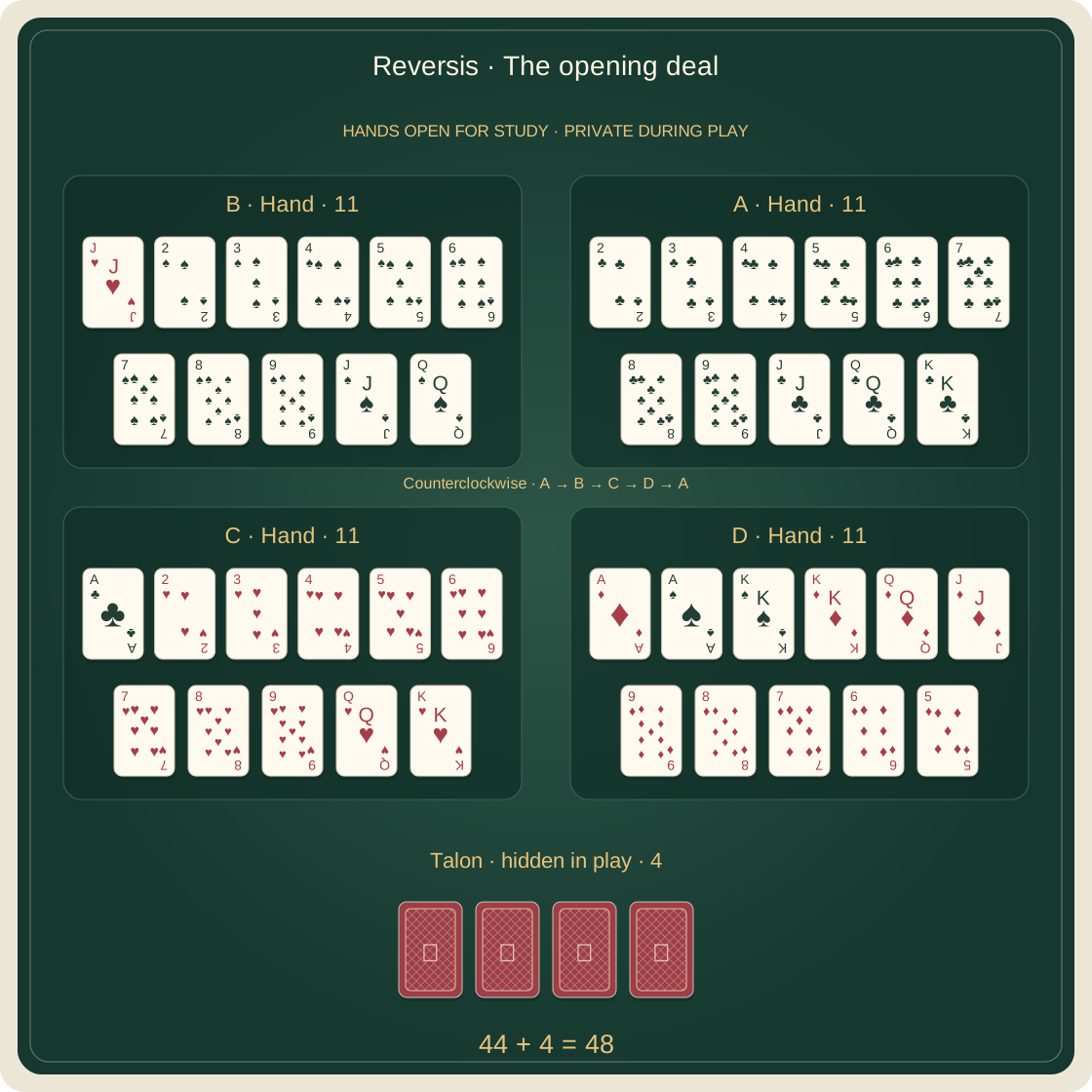
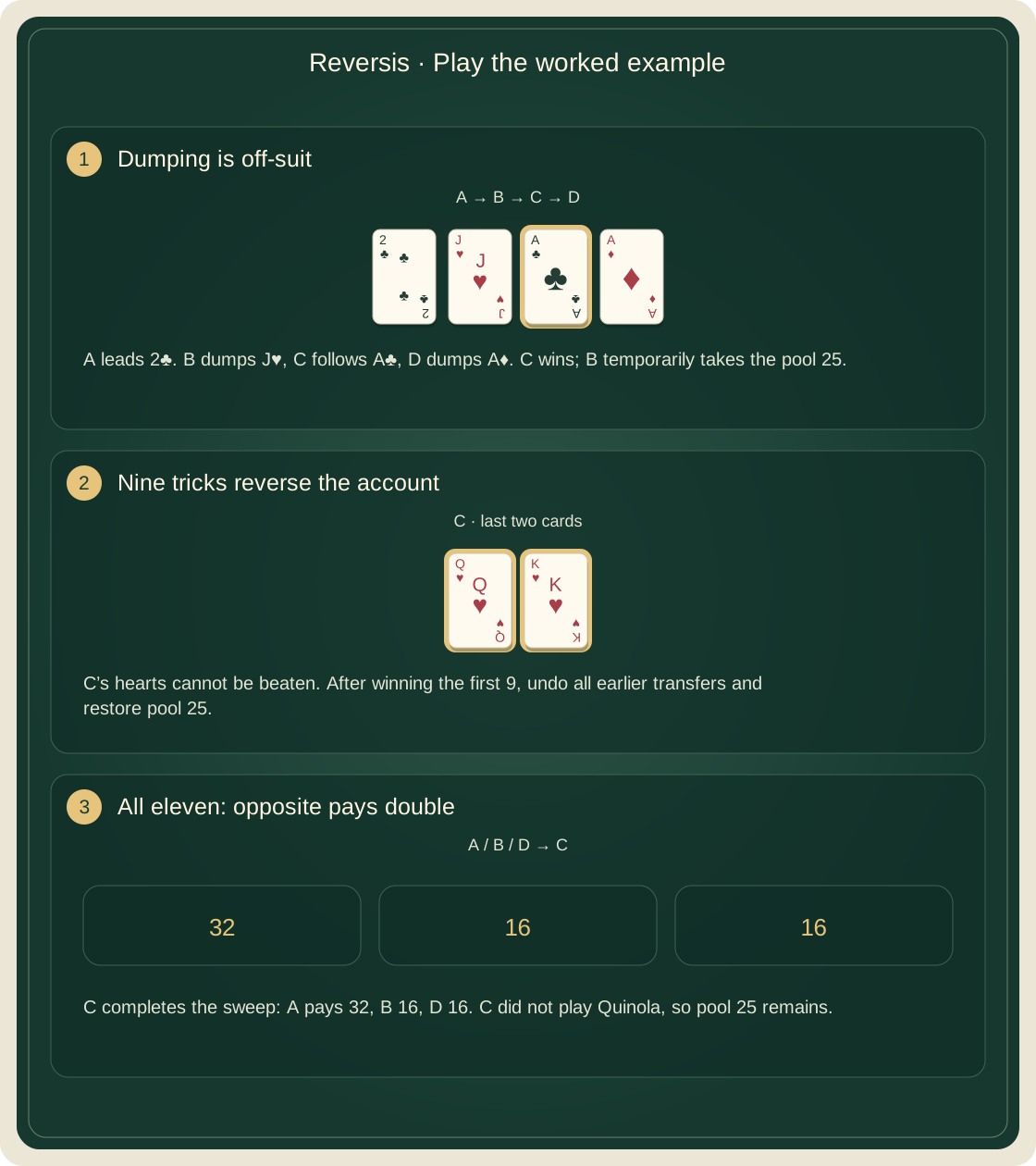
D deals; seats A → B → C → D run counterclockwise. The picture is after exchange. A leads 2♣, B dumps J♥, C follows A♣, D dumps A♦. C wins. B temporarily receives 5 from C and pool 25; C pays A 2 for its forced ace across the table and D 2 for dumped A♦. C then leads hearts throughout: every other heart is in C’s hand because J♥ has gone and A♥ is in the talon. C wins all eleven. At the ninth, undo the transfers and rebuild pool 25. Final settlement: C takes 32 from opposite A and 16 each from B and D. C did not play Quinola, so the pool stays. From initial 100 each, after contributions and settlement: A 63, B 79, C 159, D 74, pool 25, total 400.
| Trick | Play order | Cards | Winner |
|---|---|---|---|
| 1 | A → B → C → D | 2♣ J♥ A♣ A♦ | C |
| 2 | C → D → A → B | 2♥ A♠ 3♣ 2♠ | C |
| 3 | C → D → A → B | 3♥ K♠ 4♣ 3♠ | C |
| 4 | C → D → A → B | 4♥ K♦ 5♣ 4♠ | C |
| 5 | C → D → A → B | 5♥ Q♦ 6♣ 5♠ | C |
| 6 | C → D → A → B | 6♥ J♦ 7♣ 6♠ | C |
| 7 | C → D → A → B | 7♥ 9♦ 8♣ 7♠ | C |
| 8 | C → D → A → B | 8♥ 8♦ 9♣ 8♠ | C |
| 9 | C → D → A → B | 9♥ 7♦ J♣ 9♠ | C |
| 10 | C → D → A → B | Q♥ 6♦ Q♣ J♠ | C |
| 11 | C → D → A → B | K♥ 5♦ K♣ Q♠ | C |
After B empties the sole pool, rebuild it immediately as explained above; those new contributions are also reversed at the ninth trick.
← On a small screen, scroll the diagram horizontally. →
10 /
Check your understanding
Does dumping Quinola require a heart lead?
Reveal the answer
No. A dump is off-suit, legal only when void in the led suit. On a heart lead it is forced, with different payments.
Why does the sweep winner not automatically take the pool?
Reveal the answer
That bonus requires the reversis player to have played Quinola during the first nine tricks. In the example B, not C, played it.
11 /
History and other versions
Reversis was documented in early modern Europe and became an important ancestor of trick-avoidance games. Historical accounts differ: an early full pack and later reduced pack should not be collapsed into one deal. Its precise national origin is disputed. It is unrelated to the disk-flipping board game Reversi. Later espagnolette rules grant exceptional renounces and require their own full payment agreement; they are not active here.
12 /
Mistakes to avoid
Announce the event before moving counters: which card, dumped or forced, who led, who won, opposite or adjacent, early or late. Keep a reversible ledger until the ninth trick is settled. A card-point count is not the same as a transfer. Before taking an easy early trick, check whether it could leave you forced to attempt an unwanted reversis.
Common questions
Why eleven cards rather than twelve?+
Four cards stay in the talon after the exchange; only the hands are played into tricks.
Are aces low?+
No, ace is highest in each suit in this reconstruction.
Can I ignore suit for espagnolette?+
No. That optional later contract is excluded from this selected profile.