← On a small screen, scroll the diagram horizontally. →
01 /
Your first round
Place an ante before seeing any cards. The dealer exposes two cards shared by all players. Adjacent ranks return the ante; a pair has a special third-card test. Otherwise decide whether to add a raise, then reveal the third card. Strictly inside wins at the displayed odds; equal to a boundary or outside loses the total stake. Settle before the next round.
02 /
The rules used here
One or more players oppose a separate banker; the displayed player count excludes that dealer. Each player owns a separate wager even though everyone sees the same cards. This teaching table reshuffles the entire pack before each round, has no burn card and permits a raise from zero to the original ante. Agree counter limits and a stopping time beforehand. No central jackpot carries between rounds.
03 /
Cards, seats and the deal
Use 52 ordinary cards without jokers. Rank from 2 up through 10, J, Q, K, A. The ace is always above the king; there is no wrapping below the deuce. Suits never matter. After antes, deal two cards face up with space between them. Put the lower on the left for clarity. Nobody receives a private hand or exchanges a card.
04 /
Count the spread
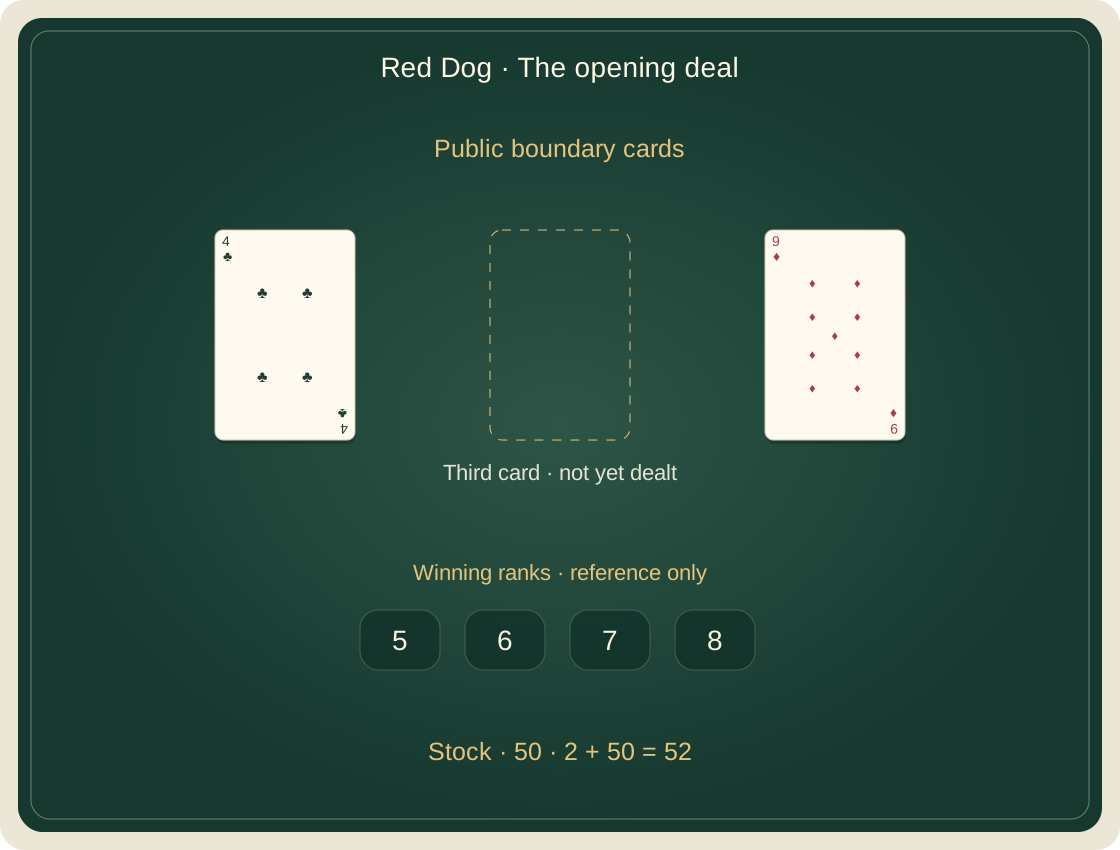
The spread counts ranks strictly between the boundaries: higher value minus lower value minus one. Between 4 and 9 lie 5, 6, 7, 8, so the spread is 4, not 5. Between Q and A only K fits: spread 1. Between K and A no rank fits: adjacent. A pair is handled separately rather than treated as a negative spread.
05 /
What happens on your turn
Adjacent cards are an immediate push: return antes, do not draw a third card and do not raise. For an opening pair, draw the third immediately with no raise allowed. A third of the same rank wins eleven times the ante in profit plus the returned ante; any other rank pushes. With a genuine gap, leave the ante or add up to one ante, then settle all wagers against the same third card. An endpoint match is simply a loss.
06 /
Scoring and settlement
Odds below mean profit, not total returned. A winning stake of 2 at 5:1 earns 10 profit and returns the 2 stake, total 12. A losing raised hand loses both ante and raise.
| Spread or event | Profit : stake |
|---|---|
| 1 | 5:1 |
| 2 | 4:1 |
| 3 | 2:1 |
| 4 or more | 1:1 |
| Three equal ranks | 11:1 |
| Adjacent / unmatched pair | Push |
07 /
A complete worked example
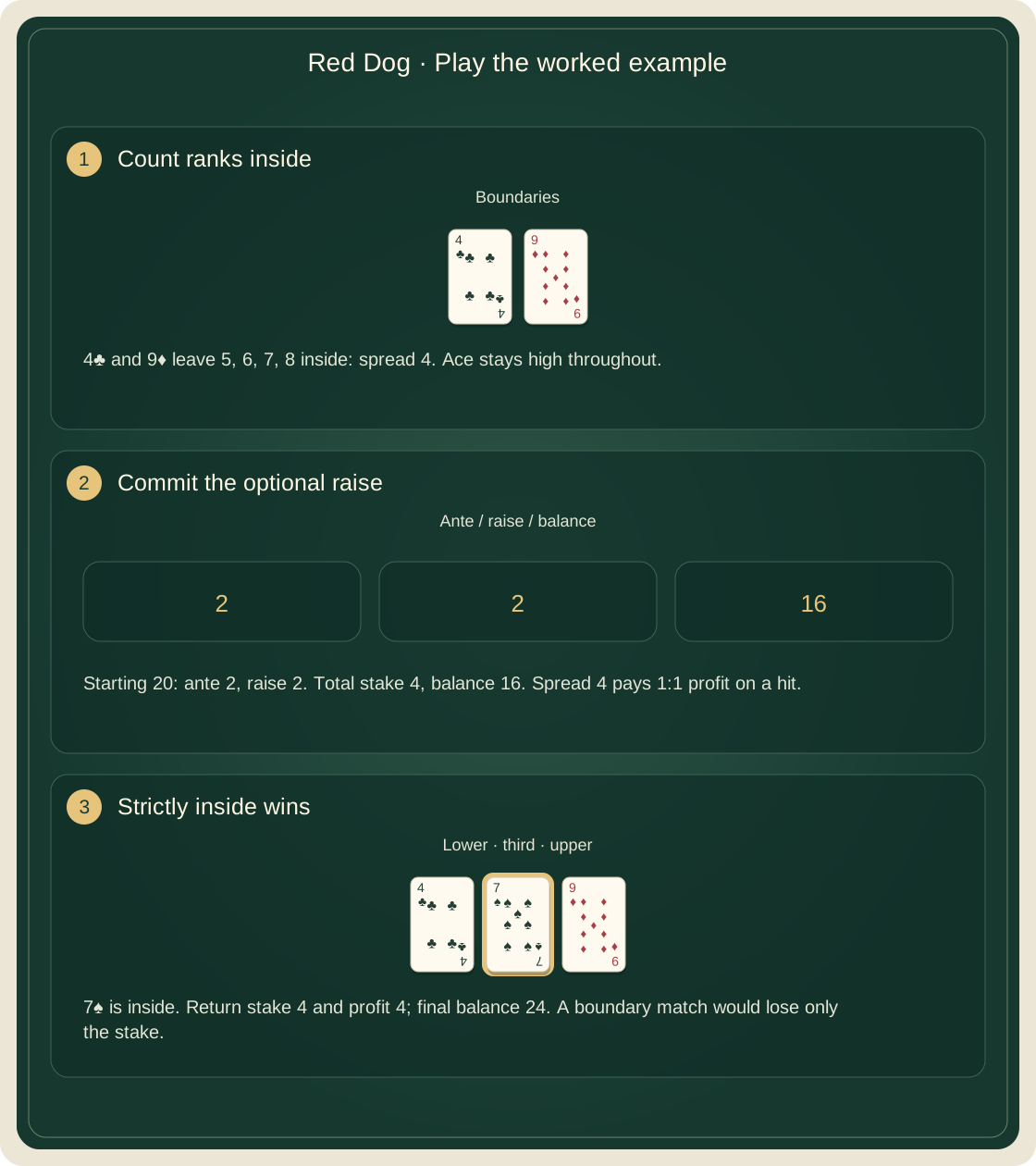
Start with 20 counters. Ante 2 leaves 18. The picture opens 4♣ and 9♦: spread 4. Add 2, leaving 16 and a total stake of 4. The third card 7♠ is inside, so profit is 4 and the stake 4 returns: finish at 24. If it were 9♣, finish at 16, not 12. Separate round: 8♣ 8♦ and 8♥ on ante 2 earn 22 profit plus 2 returned, a total return of 24. A third K♥ instead would just return 2.
← On a small screen, scroll the diagram horizontally. →
08 /
Check your understanding
Q and A: which single rank wins?
Reveal the answer
K. Ace is high, so the spread is 1 and a hit pays 5:1 profit.
Opening pair, third card different: lose or push?
Reveal the answer
Push. Return the original ante; no raise was permitted.
09 /
History and other versions
Red Dog is an ambiguous name. It can identify this casino form of In Between, but also a different high-card betting game. The shared idea of betting on an interval does not make every Acey-Deucey rule interchangeable: home pots, double endpoint penalties and flexible aces belong to other profiles. This guide uses the casino paytable rather than claiming one universal historical rulebook.
10 /
Mistakes to avoid
Do not count the boundary ranks as winning outcomes. A wider spread improves the chance of a hit but changes its payout, so it does not guarantee profit. The optional raise commits additional counters before the third card; it is not a chance to withdraw the ante. Do not copy a payout example without checking the table: spread, stake, profit and total return are different quantities.
11 /
When the round and match end
Each round ends immediately after the push or payout. Gather all cards and reshuffle for the next teaching round. Compare net counter balances only at the agreed session end; winning a single deal does not create a match winner. The banker must have enough counters to cover the displayed maximum payout before accepting antes.
Common questions
Is ace high or low?+
High throughout this casino profile. K and A are consecutive.
Can I raise after seeing the third card?+
No. Decide after the boundaries, before the third card. Pairs and adjacent cards have no raise.
Do I need proprietary cards?+
Use one ordinary 52-card pack without jokers. No special or proprietary cards are required.