← On a small screen, scroll the diagram horizontally. →
01 /
Your first round
Put counters in the middle, deal four cards and establish trump. In an optional deal one player knocks, promising two of the four tricks; each opponent decides whether to promise at least one. Exchange once, play four tricks and pay each trick its quarter of the old pool before collecting failure penalties for the next deal.
02 /
The rules used here
This table uses three active seats and clockwise play. A silent compulsory deal has no two-trick promise; eldest hand leads if nobody knocks. Set a session length in full dealer circuits. If the final pool remains, divide it equally, recording fractional paper shares. For learning, counters have no cash value. The original tradition also admits larger tables; exchange supply then needs a separate agreement.
03 /
Cards, seats and the deal
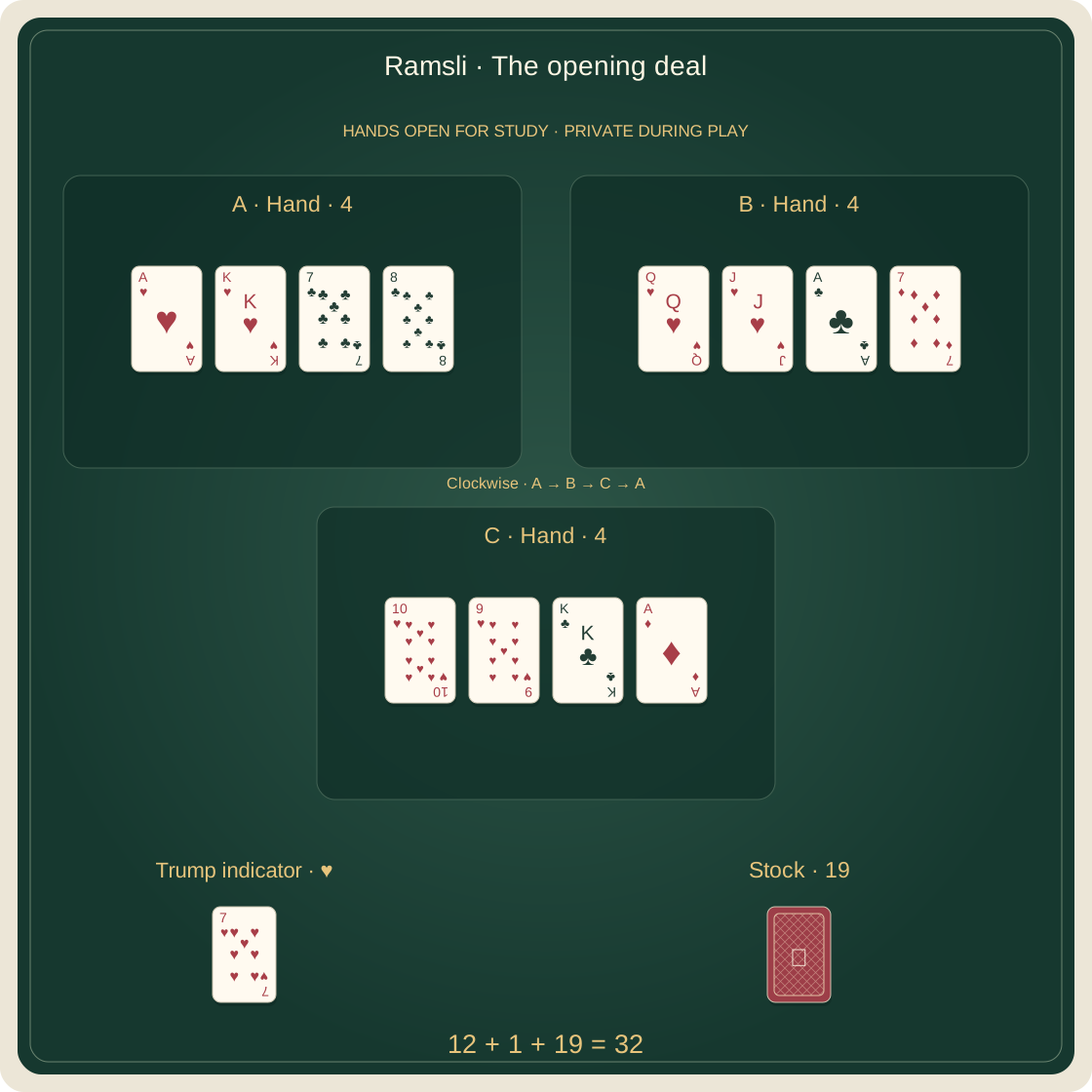
The dealer adds four counters to the carried pool, shuffles and offers a cut, then examines the bottom card privately. Deal two cards each; expose either the top remaining card or that known bottom card as trump; deal two more each. Taking the bottom option commits the dealer to knock. An exposed trump remains outside the hands until a permitted exchange. The deal passes left afterwards.
04 /
Knock, stay or pass
With more than four counters, ask clockwise from the dealer for the first knock. That player needs two tricks; others, asked from the knocker’s left, either fold unseen to the discard or stay for one trick. If nobody joins, the knocker takes the pool without play. If nobody knocks, expose another trump, skipping a previously offered suit; stop after three offered cards and carry the pool if still unclaimed. With exactly four counters it is a muss: everyone plays using the first trump. A knock is optional but binds its maker to two tricks.
05 /
Exchange before the first lead
Before looking at his hand, the dealer may knock on the indicator and take it, keeping four cards by discarding one. Otherwise the trump seven may be swapped for the indicator once. Then, starting with the knocker, each active player chooses one exchange: discard unwanted cards and draw that many; replace the whole hand with four hidden cards plus one exposed offer, choosing four; or request eins auf, one exposed offer which may replace one held card. Keep exactly four and discard rejected cards out of play. No second exchange.
06 /
What happens on your turn
The knocker leads any card. Play clockwise among active seats, following suit whenever possible. If void, you must trump if you have any trump; only if also void in trump may you discard freely. There is no obligation to overtake or overtrump. Highest trump wins; without trump, highest of the led suit wins. The winner gathers the trick and leads again. There is no drawing during the four tricks.
07 /
Scoring and settlement
Freeze the pool before play. Each trick earns one quarter of that amount. Separately, a knocker with fewer than two tricks pays twice the frozen pool; another participant with no trick pays the frozen pool. These penalties stay for the next deal: do not enlarge the current trick shares with them. Then the next dealer adds four. A non-knocking player in a muss who takes nothing has the ordinary one-pool penalty.
08 /
A complete worked example
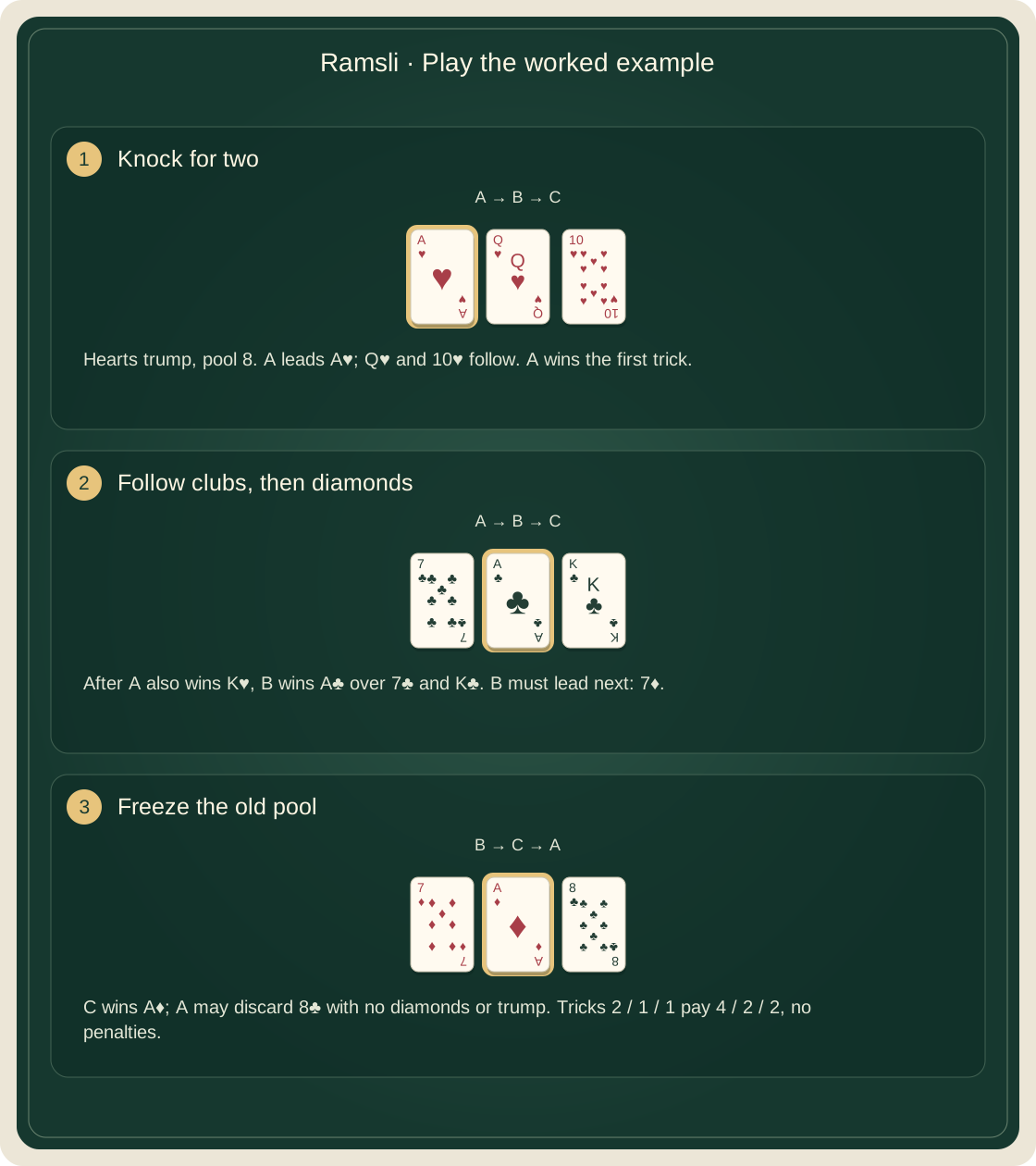
The pictured optional pool is 8, hearts trump. A knocks; B and C stay. Nobody exchanges. A takes the first two tricks with A♥ and K♥. B’s A♣ beats A’s 7♣; B then leads 7♦ and C wins with A♦. A is void in diamonds and has no trump left, so 8♣ is legal. Counts A 2, B 1, C 1 pay 4, 2, 2. No failure penalty remains. If A had taken only one trick, A would still receive 2 but would owe 16 to the next pool.
| Trick | Play order | Cards | Winner |
|---|---|---|---|
| 1 | A → B → C | A♥ Q♥ 10♥ | A |
| 2 | A → B → C | K♥ J♥ 9♥ | A |
| 3 | A → B → C | 7♣ A♣ K♣ | B |
| 4 | B → C → A | 7♦ A♦ 8♣ | C |
← On a small screen, scroll the diagram horizontally. →
09 /
Check your understanding
Void in the led suit but holding trump: may you discard?
Reveal the answer
No. Trump is compulsory, but you do not have to beat an existing trump.
Pool 8: ordinary participant takes no tricks. What happens?
Reveal the answer
No current share; pay 8 into the carried pool. The next dealer then adds 4, making 12 if no other penalties.
10 /
History and other versions
Ramsli belongs to the Rams family of small-hand trick games. The recorded Danube-Swabian version preserves knocking, a four-part pool and the Tell pack; its possible French connection does not establish a known inventor or date. Five-card Rams and other Hungarian house traditions should be compared separately, especially their rank order, forced overtaking and penalties.
11 /
Mistakes to avoid
Count trump already played before promising two tricks. A high card in a short side suit may be ruffed. Do not count honour values: this game pays for tricks, not aces or tens. Keep the current pool and next-pool penalties in separate spaces so a failed knock cannot accidentally increase the amount paid back to its maker.
Common questions
Is a special deck essential?+
Use a 32-card Tell pack, or keep A, K, Q, J, 10, 9, 8 and 7 of each suit from an ordinary pack. Q represents Ober, J Unter; suit symbols may be substituted consistently.
Must you beat a played trump?+
No. Follow suit first, then compulsory trump if void; overtaking is not required in this profile.
Does folding cost the old pool?+
No failure penalty applies to a player who legally declined an optional deal. A muss does not allow that decline.