← On a small screen, scroll the diagram horizontally. →
01 /
Cards, seats and the deal
Sit A–B–C–D counterclockwise; D deals in our example, A is eldest. Each antes 1 into a main pool. Deal all 40, 10 each, in packets 4–3–3. No drawing or exchange. Rotate dealer right. Agree a multiple of four deals; our teaching session uses four and equal paper balances. Highest final balance wins; tied leaders share, unclaimed pool is divided equally at the agreed session end.
02 /
Card order and categories
A♠ is Spadille, highest trump; A♣ is Basto, third trump, whatever suit is named. Manille, second, is trump 2 in black or trump 7 in red. These three are matadors. In red trumps A of that suit is Punto, fourth but NOT a matador. Treat black aces as trump, never as their printed plain suit. Orders below are strongest first.
| Suit | High to low |
|---|---|
| Black trump | A♠ – 2 – A♣ – K – Q – J – 7 – 6 – 5 – 4 – 3 |
| Red trump | A♠ – 7 – A♣ – A – K – Q – J – 2 – 3 – 4 – 5 – 6 |
| Plain black | K – Q – J – 7 – 6 – 5 – 4 – 3 – 2 |
| Plain red | K – Q – J – A – 2 – 3 – 4 – 5 – 6 – 7 |
03 /
Alliance, Solo or Vole
Eldest starts; pass retires from bidding. Alliance is lowest: name trumps, call partner, take at least 6 tricks together. Solo beats Alliance: at least 6 alone against three. Vole beats Solo: all 10 alone. Normally raise to a higher bid; an earlier Alliance bidder overcalled by Solo may match Solo and retain positional priority. Finish when only one bidder remains. All pass: A♠ holder must play Forced Spadille, an alliance, naming trumps themselves at our table.
04 /
Calling the hidden partner
Call a named non-trump king missing from your hand; its holder automatically allies but says nothing. Partnership becomes known when that card is played or play clearly reveals it. If all three eligible kings are held, our agreement uses a non-trump queen. Deliberately calling your own card is allowed, but then you play secretly alone and settle as a solo. Never exchange the called card: that belongs to Médiateur.
05 /
What happens on your turn
Eldest leads regardless of bidder. Follow the logical suit if held; if void, play any card, including an optional trump. No obligation to overtake or overtrump. Highest trump wins, otherwise highest of led suit, and winner leads. Black aces cannot follow a plain spade or club lead because they are trumps. Punto follows trump normally; it lacks matador protection.
06 /
When a matador may refuse trump
On a trump lead, ordinary trumps in hand force you to play a trump, though you may choose a matador. If only matadors remain, you may discard off-suit unless a higher matador was LED and forces a lower one you hold. Spadille can never be forced; Manille can force Basto. A higher matador played second or later does not force later hands. With only Basto and a plain card, an ordinary trump lead allows the plain discard; a Spadille lead forces Basto.
07 /
First six tricks and the vole
Taking the first 6 earns premiers. Soloist may stop and claim, or lead trick 7 to undertake vole automatically. In Alliance the allies agree with only “May I?” and “Yes” or “No”, no card information. An announced Vole or a later undertaking creates a SEPARATE pool: everyone pays 3, total 12. Later failed vole still preserves the already won game and premiers. Forced Spadille cannot undertake vole and has no vole bonus; our table also awards no premiers there.
08 /
Scoring and settlement
Let S be the main pool before settlement and u=S/4, excluding the vole pool. A won Solo takes S and receives the applicable bonuses below from EACH defender. A won Alliance or Forced Spadille splits S equally; each defender pays one ally the applicable matador/premiers/vole bonuses, never the Solo premium. For Solo, matadors must be originally together in caller’s hand; for Alliance they may be shared. Double matadors replaces the smaller bonus, not adds to it.
| Requirement | Payment |
|---|---|
| Solo | 4u |
| All three matadors | 1u |
| Three matadors + Punto | 2u |
| Premiers | 1u |
| Vole | 2u |
09 /
Remise, codille and responsibility
A side with exactly 5 tricks loses by remise: add S to the carried main pool, making 2S, and pay defenders the Solo premium if applicable and any matador bonus. With 4 or fewer, codille: defenders divide S, losing side replenishes 2S for next deal and pays applicable Solo, matador and undertaken-vole premiums. Soloist bears all costs. In a lost Alliance, allies split pool costs and each pays one defender; if caller took fewer than 3, caller alone pays both sides’ liabilities. That exception does not apply to Forced Spadille. Fractional paper shares avoid indivisible-chip disputes.
10 /
Two different failed voles
Successful vole also takes its separate pool. Failed late undertaking: defenders divide that pool, but caller/allies keep payment for the game already won, premiers and matadors. Failed auction Vole with at least 6 tricks: main pool carries untouched; pay only vole premium, no game or matador payments, defenders take vole pool. If the announced Vole also fails to reach 6, add a remise S to main pool and the payments for a lost Solo as well as the vole premium.
11 /
A complete worked example
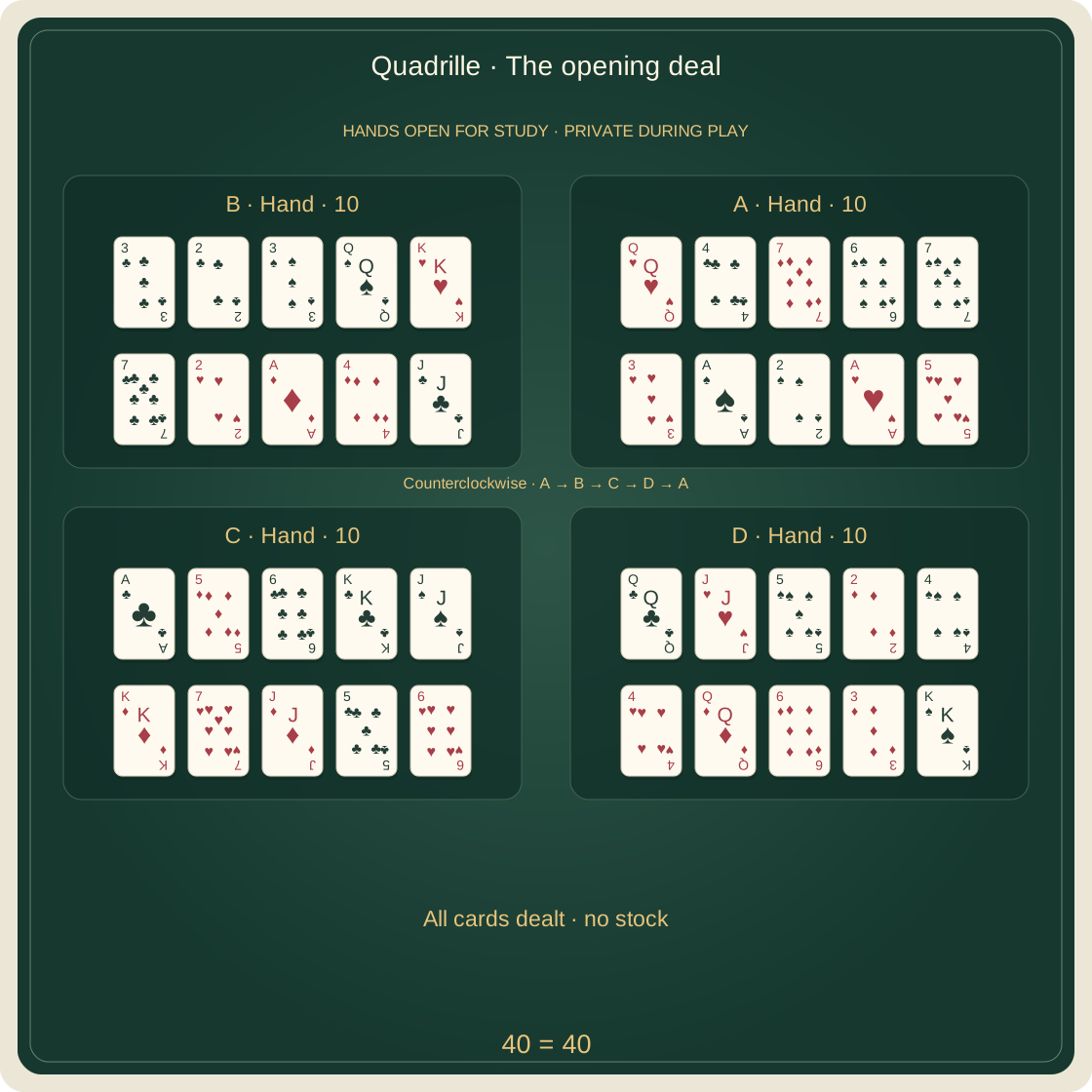
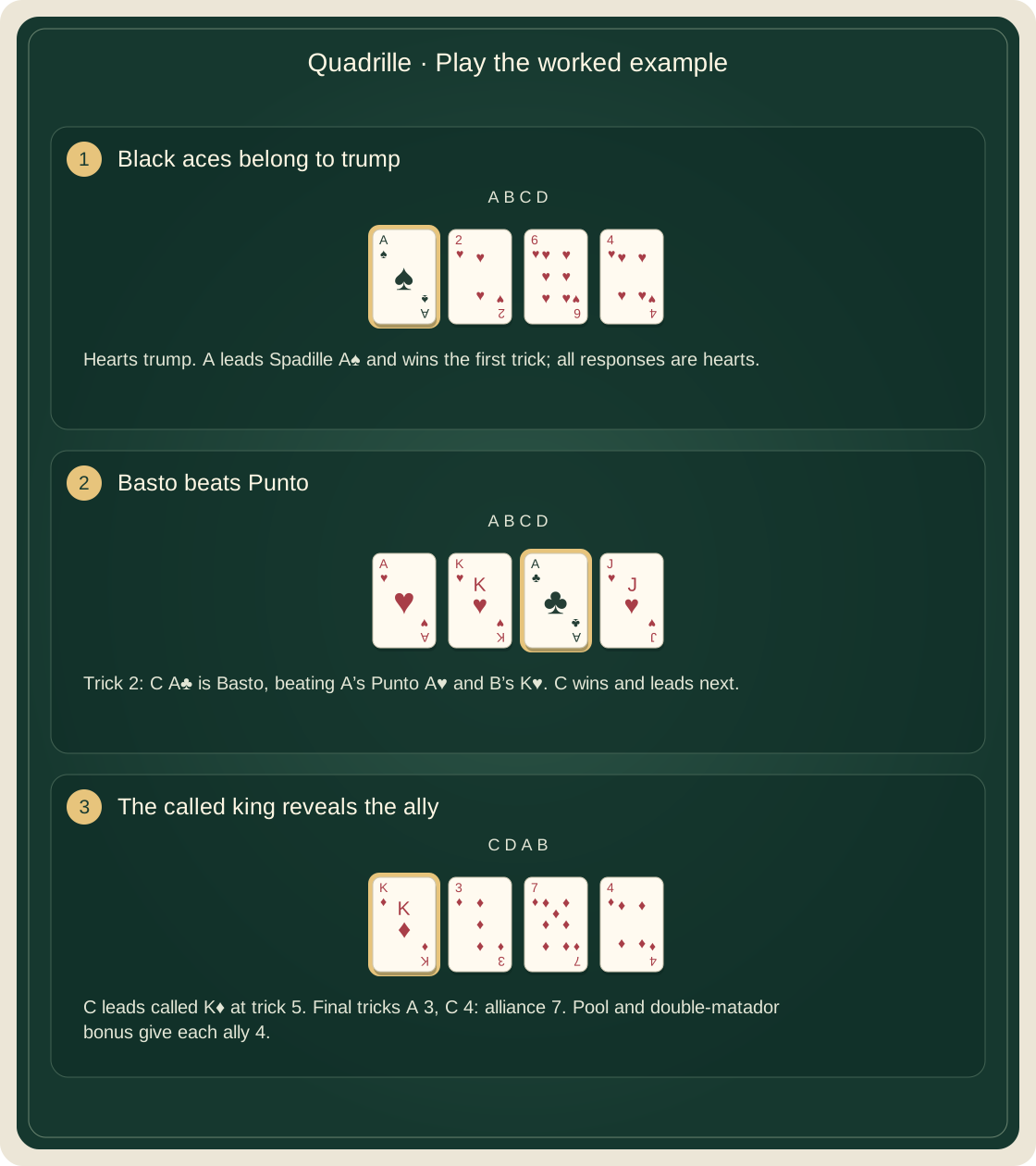
D deals; A bids Alliance, others pass. Hearts trump, A calls K♦ held by C. Hands open only for study. A–C must take 6 together; A♠, 7♥, A♣ and A♥ are shared double matadors. Columns identify seats, not chronological play: begin at the named leader and go counterclockwise.
Player A
Q♥ 4♣ 7♦ 6♠ 7♠ 3♥ A♠ 2♠ A♥ 5♥
Player B
3♣ 2♣ 3♠ Q♠ K♥ 7♣ 2♥ A♦ 4♦ J♣
Player C
A♣ 5♦ 6♣ K♣ J♠ K♦ 7♥ J♦ 5♣ 6♥
Player D
Q♣ J♥ 5♠ 2♦ 4♠ 4♥ Q♦ 6♦ 3♦ K♠
| Stage | Lead | A | B | C | D | Winner |
|---|---|---|---|---|---|---|
| 1 | A | A♠ | 2♥ | 6♥ | 4♥ | A |
| 2 | A | A♥ | K♥ | A♣ | J♥ | C |
| 3 | C | 5♥ | 2♣ | 7♥ | 6♦ | C |
| 4 | C | 4♣ | 3♣ | K♣ | Q♣ | C |
| 5 | C | 7♦ | 4♦ | K♦ | 3♦ | C |
| 6 | C | 2♠ | 3♠ | J♠ | K♠ | D |
| 7 | D | 3♥ | A♦ | 5♦ | Q♦ | A |
| 8 | A | Q♥ | 7♣ | 5♣ | 4♠ | A |
| 9 | A | 7♠ | Q♠ | 6♣ | 5♠ | B |
| 10 | B | 6♠ | J♣ | J♦ | 2♦ | B |
← On a small screen, scroll the diagram horizontally. →
12 /
Seven tricks and shared bonuses
A wins 3, C 4: alliance 7; B 2, D 1. C’s K♦ appears at trick 5, confirming partner. D wins trick 6, so no premiers and no late vole. Starting at 100 each, antes leave 99 and S=4, u=1. Allies each receive pool share 2 plus double-matador 2 from one defender. Final A 103, B 97, C 103, D 97, pool empty: total 400.
13 /
History and other versions
Quadrille adapted three-player Ombre for four in early eighteenth-century France and became a major European social game. Parlett reconstructs Quanti’s account while warning that there was no universal standard. Médiateur later adds card exchange and a longer auction; it is not silently part of this guide. Published rank summaries sometimes omit the plain red ace: it belongs after J and before 2, cross-checked against the underlying Hombre order.
14 /
Check your understanding
Is Punto a protected matador?
Reveal the answer
No. It is a fourth trump and follows normally.
Does Spadille played second force Basto?
Reveal the answer
No. The higher matador must have been the lead.
15 /
Mistakes to avoid
Do not treat black aces as plain-suit followers, rank red numerals upward as in Whist, exchange the called king or award a Solo premium to an ordinary alliance. Keep the main and vole pools distinct; calculate units from the main pool before moving any counters. A shared matador bonus in Alliance does not require all matadors to belong to one hand.
Common questions
How many active players?+
Four, all playing ten-card hands.
Are partners fixed?+
No, alliances are defined anew by the called card each deal.
Can a black ace be a plain card?+
No. Both black aces are permanent trumps in this profile.