← On a small screen, scroll the diagram horizontally. →
01 /
Your first round
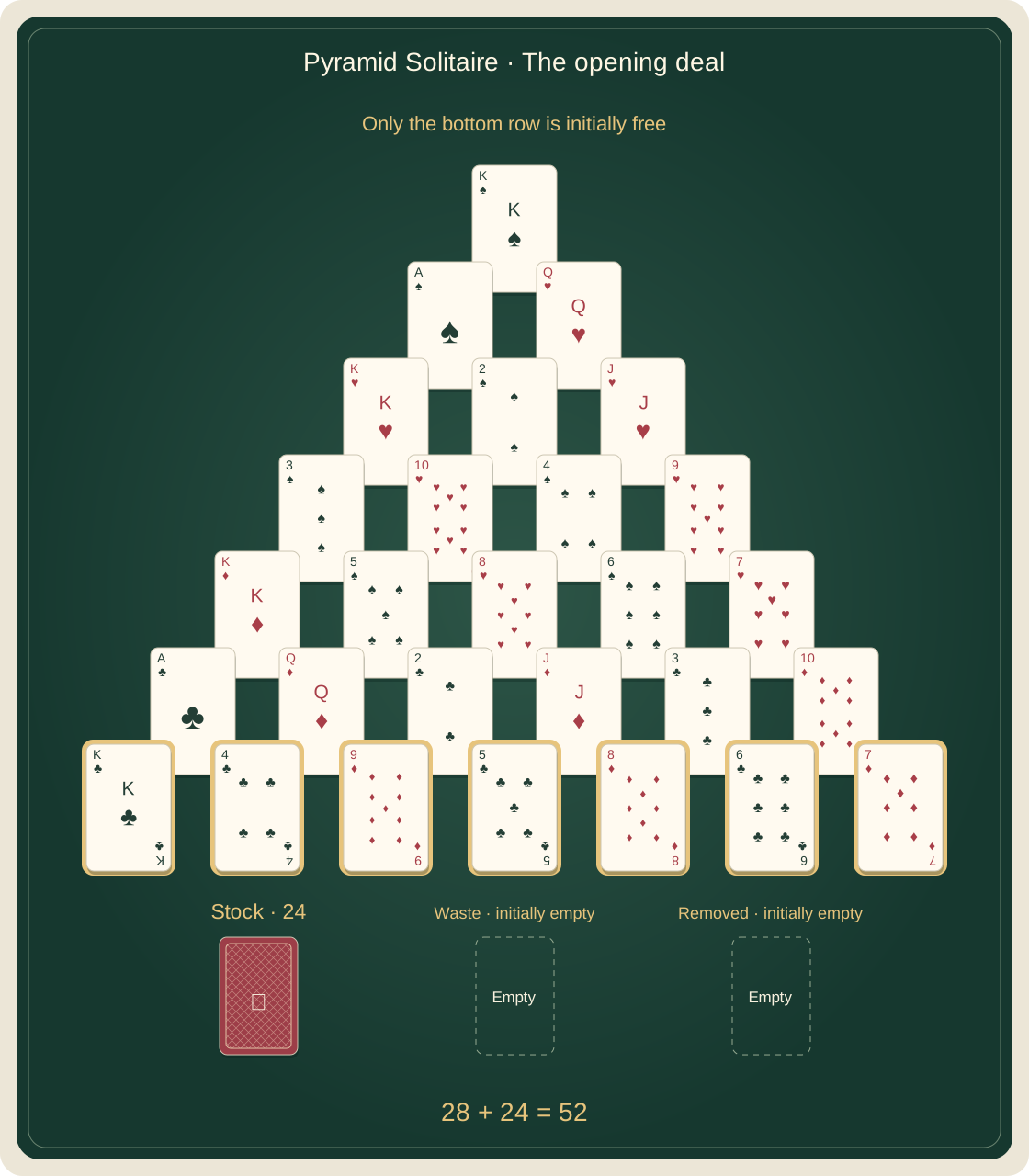
Deal 28 face up in rows 1 through 7; each card above the base is covered by two cards below. Remaining 24 form stock, with empty waste and removed piles. Remove available pairs totaling 13; an available K alone is 13. Continue until all 52 are removed, or no moves and no redeals remain.
02 /
Card values
Suits and colors never matter. A=1, J=11, Q=12, K=13; numbers keep face value. A king never needs a second card and cannot pair with another king. No joker, wild rank or matching-suit bonus. The six pair types below cover every non-king rank.
| Pair | Sum |
|---|---|
| A + Q | 1 + 12 = 13 |
| 2 + J | 2 + 11 = 13 |
| 3 + 10 | 3 + 10 = 13 |
| 4 + 9 | 4 + 9 = 13 |
| 5 + 8 | 5 + 8 = 13 |
| 6 + 7 | 6 + 7 = 13 |
03 /
Cards, seats and the deal
Shuffle 52 without jokers. Build the triangle top down, shifting each new row half a card to the left. Both lower children must be removed before their parent is free. The base starts completely free. Use distinct zones for stock, waste and permanently removed cards; empty triangle spaces are never refilled.
04 /
What happens on your turn
Choose two already free cards whose values total 13 and remove them together, or remove one free king. Do not pair a covered card with the card covering it: removing the pair does not retroactively make it legal. A card with even one child still present is blocked. Cards need not be adjacent and may come from different permitted zones.
05 /
Stock top, waste and redeals
Turn stock top face up as the active card. It and waste top may pair with each other or a free pyramid card. Before revealing the next stock card, move any unremoved active card onto waste; only its new top remains accessible. You may turn another even if a pair exists. When closed stock is empty, use available cards first. To redeal, put any active card onto waste and turn the entire waste over without shuffling. At most 2 redeals: 3 passes total. Removed cards never return.
06 /
When the round and match end
Full win means pyramid, stock and waste all empty: 52 removed. An empty pyramid with leftover stock is progress, not yet that full win. A loss occurs when no legal removals or stock turns remain and the redeal allowance is exhausted. Some initial deals are impossible; do not change the deal mid-game or use buried waste cards to force a win.
07 /
Scoring and settlement
Optional Solitaire Till Dawn par scoring is separate from the full-win condition. At the end take 50, 35 or 20 if the pyramid first cleared on pass 1, 2 or 3, or 0 if never cleared; subtract all unremoved cards. Six deals totaling 0 or more make par. Our example clears everything on pass 1: 50 − 0 = 50. No timer bonus is assumed.
08 /
A complete worked example
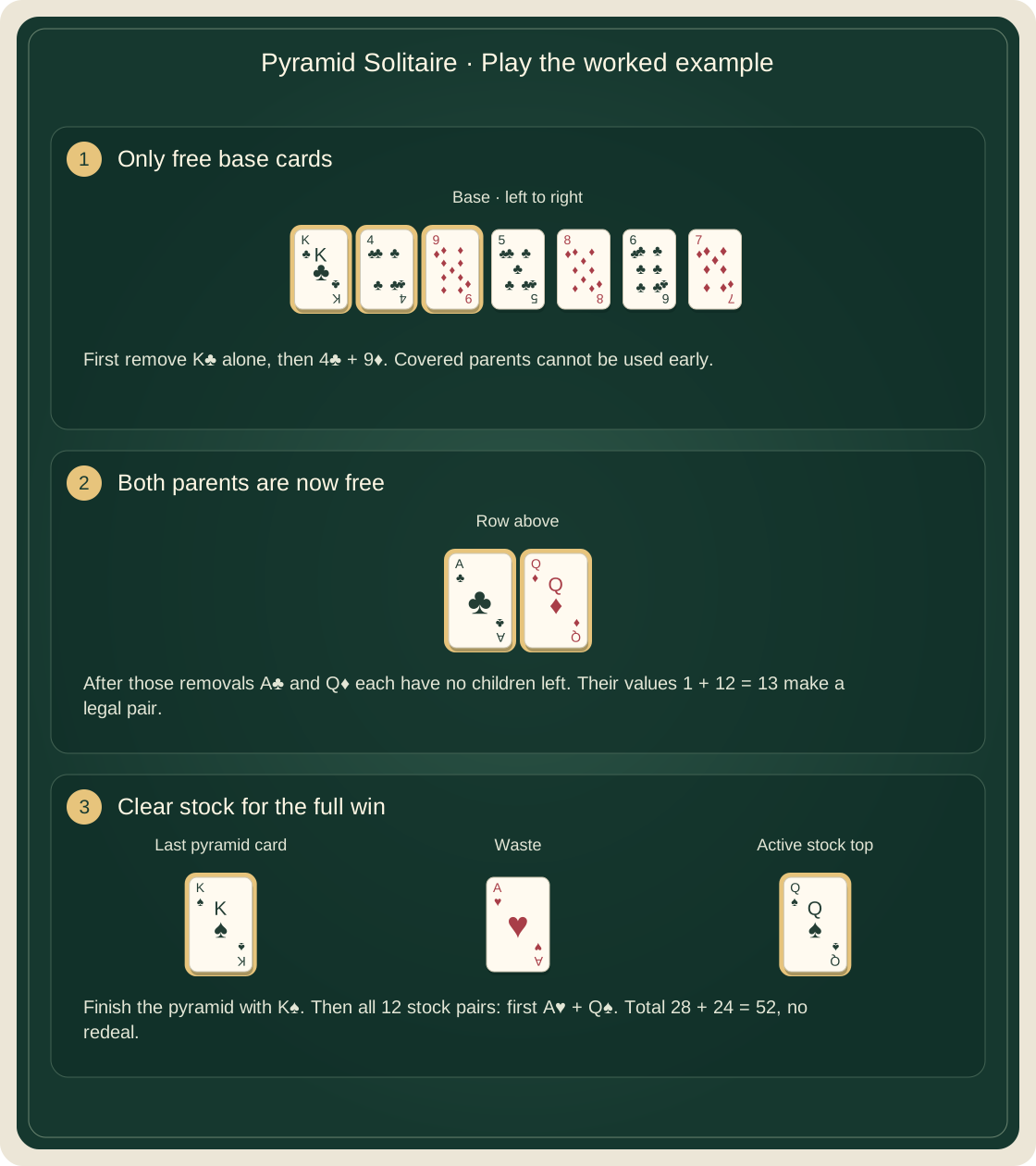
This is a constructed lesson, not a claim that random deals always solve. Rows are numbered from the top. Clear row 7: K♣ alone, 4♣+9♦, 5♣+8♦, 6♣+7♦. Only after both children vanish may the parent be used. Then follow the row-by-row removals below; every indicated card is free at its turn.
| Row | Remove left to right |
|---|---|
| 7 | K♣ 4♣ 9♦ 5♣ 8♦ 6♣ 7♦ |
| 6 | A♣ Q♦ 2♣ J♦ 3♣ 10♦ |
| 5 | K♦ 5♠ 8♥ 6♠ 7♥ |
| 4 | 3♠ 10♥ 4♠ 9♥ |
| 3 | K♥ 2♠ J♥ |
| 2 | A♠ Q♥ |
| 1 | K♠ |
← On a small screen, scroll the diagram horizontally. →
09 /
An empty triangle is not the end
After 28 pyramid cards, stock still has 24. Its teaching order consists of these consecutive pairs: A♥+Q♠, A♦+Q♣, 2♥+J♠, 2♦+J♣, 3♥+10♠, 3♦+10♣, 4♥+9♠, 4♦+9♣, 5♥+8♠, 5♦+8♣, 6♥+7♠, 6♦+7♣. For each pair, turn the first onto waste and match the next active card with it. Remove all 12 pairs: 28 + 24 = 52. No redeal needed.
10 /
History and other versions
Pyramid belongs to the addition-patience family. Its Egyptian-looking layout does not establish an Egyptian origin. Software publishers preserve different stock, redeal and victory profiles; Solitaire Till Dawn documents its par score in the nineteen-nineties. We do not claim that publication date as the game’s invention. Relaxed Pyramid changes the target to the triangle alone; other variants change stock access.
11 /
Check your understanding
Is one removed child enough?
Reveal the answer
No, both children must already be gone.
Is the empty pyramid a full win here?
Reveal the answer
Only if stock and waste are also empty.
12 /
Mistakes to avoid
Do not clear cards merely because their indices can be read, reach inside waste, reshuffle during a redeal or count a king twice. Check both children of a candidate card before pairing. Compare the possible future partners before consuming a flexible card; a legal move is not automatically the best move.
Common questions
What does ace count?+
One; pair it with a queen.
How many passes?+
Three total, including the original pass.
Can every deal be won?+
No. The lesson is constructed to demonstrate a full legal solution.