← On a small screen, scroll the diagram horizontally. →
01 /
Your first round
Deal 3 each from 52; 46 remain unused. Non-dealer leads and opponent may play ANY card. Higher rank wins, winner leads. Equal rank ties the trick and the same leader leads again. Ordinary hand victory scores 1 toward 5; an accepted put changes the reward to the whole match.
02 /
Cards, seats and the deal
Use one normal pack without jokers. Rank high to low: 3–2–A–K–Q–J–10–9–8–7–6–5–4. Every suit has the same strength. Choose dealer randomly, deal single cards alternately, then swap dealer after each hand including draws. No stock draw, discard, trump or following-suit requirement.
03 /
What happens on your turn
Play a card face up, wait for the response, then compare ranks alone. Keep the trick result visible before the next lead. A tied trick belongs to neither player: do not break it by suit or by which card was played first. Play until the hand result is decided, at latest after 3 tricks. Two wins decide it immediately.
04 /
“I put”: concede or see
Before your own card, say “I put”. Opponent must explicitly concede or see before play continues. Concession ends the hand and gives putter 1 point. Seeing makes the eventual hand winner win the whole match, regardless of current points. Already completed tricks still count. A drawn accepted put changes no score: deal again. You cannot issue a challenge after the hand has already been decided.
05 /
Scoring and settlement
Win the hand with 2 tricks, or with 1 win when the other 2 tricks tie. One win each and a tied third is a drawn hand; 3 ties also draw. A draw gives neither player a point and does not favour the first trick winner. An unchallenged win or refused put gives 1. Keep a running score; first to 5 wins unless a seen put decides it earlier.
06 /
A complete worked example
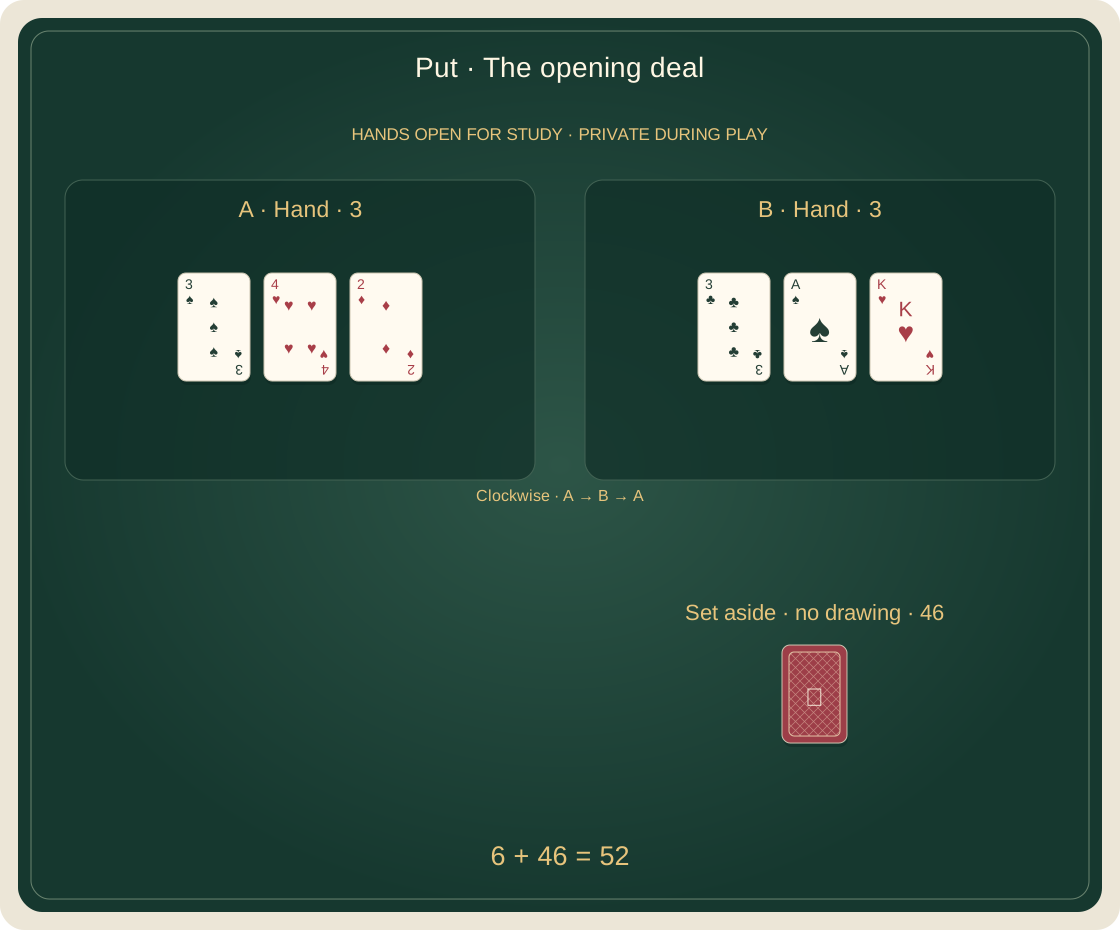
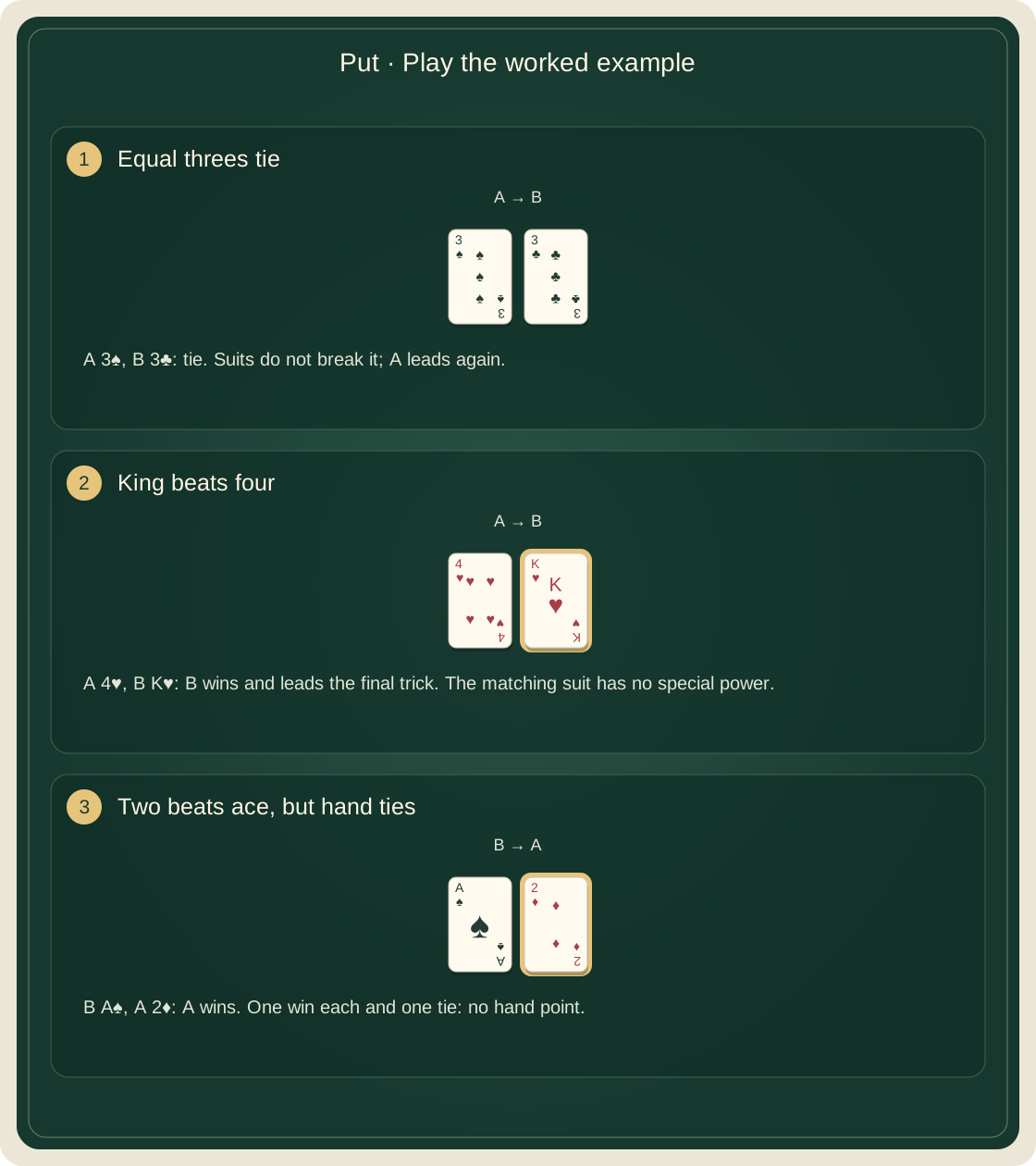
B deals, A leads; hands open for study. The first three cards tie, so A leads again. B wins the next trick and leads the last. Read the table by named leader; columns identify the players. No challenge is made in this deal.
Player A
3♠ 4♥ 2♦
Player B
3♣ A♠ K♥
| Stage | Lead | A | B | Result |
|---|---|---|---|---|
| 1 | A | 3♠ | 3♣ | Tie |
| 2 | A | 4♥ | K♥ | B |
| 3 | B | 2♦ | A♠ | A |
← On a small screen, scroll the diagram horizontally. →
07 /
One win each is not a victory
3♠ equals 3♣. K♥ beats 4♥. Then 2♦ beats A♠ despite the different suits. Each wins one, one ties: score unchanged. If A and B began at 2–3, they remain 2–3. Separate challenge case: at the same score A puts and B refuses, making 3–3; if B instead sees and A wins that hand, A wins the match immediately.
08 /
When the round and match end
Stop the match on reaching the target or winning a seen put. A drawn challenge is not a match draw; keep scores and change dealer. Before dealing again, gather all cards including the unused pack and shuffle. A player cannot concede a completed hand merely to replace an already determined match loss with a smaller penalty.
09 /
History and other versions
Put was played in England from the sixteenth century onward. Cotton’s account appeared in 1674, while Willughby’s earlier notes help clarify when a put was legal. Later nineteenth-century accounts change the challenge structure and describe partnership card passing. It is related to European Truc games, with a more distant connection to South American Truco; that does not make their scoring interchangeable.
10 /
Check your understanding
Must I follow suit?
Reveal the answer
No. Any held card is legal, and only rank matters.
What if both players win once and one trick ties?
Reveal the answer
Drawn hand, no score, even after a seen put.
11 /
Mistakes to avoid
Do not put ace above two or three, treat a same-suit reply as trump, award tied tricks to the leader or let the first trick settle every tied hand. Distinguish one hand point from a whole-match challenge. Make the response audible before playing further cards so both players know what is at stake.
Common questions
What is highest?+
Three, then two, then ace.
Does seeing a put merely double points?+
No, it puts the whole match on the hand.
Is four-player passing used?+
Not in this two-player profile.