← On a small screen, scroll the diagram horizontally. →
01 /
Your first round
Play exact ascending same-suit sequences A–2–3–4–5–6–7–8–9–10–J–Q–K. Whoever owns the next card plays it, regardless of seating order. At a stop, the last player starts the LOWEST card they hold in any chosen suit. Collect board rewards as eligible cards are played. First empty hand wins Game and residual-card payments.
02 /
Eight pools, fifteen counters
Label Ace, King, Queen, Jack, Pope, Matrimony, Intrigue and Game. Before each deal only DEALER adds: 1 each to Ace, King, Queen, Jack, Game; 6 to Pope; 2 each to Matrimony and Intrigue. Total 15. Existing contents remain underneath. Pope is always 9♦. The other card rewards refer to the suit established by the turn-up.
03 /
Cards, seats and the deal
Choose dealer randomly, rotate left; deal clockwise one card at a time to everyone AND one extra dead hand. Agree its seat before dealing. Deal all 51; unequal hands are allowed. Reveal the last dealt card to establish the reward or “trump” suit, leaving it with its actual recipient. Dead hand stays hidden even if that final card reveals one of its cards. Nobody plays the dead hand.
04 /
Turn-up rewards and actual ownership
Turning A, K, Q or J immediately pays dealer that named pool; turning 9♦ pays Pope. This does not transfer the card to dealer. Our profile continues the deal even on a Pope turn-up. A different historical variant ends it immediately; do not apply that extra ending here. A numeric turn-up such as 6♥ pays nothing.
05 /
What happens on your turn
Dealer’s left begins with their lowest card of any chosen suit. The exact successor must follow whenever held in a live hand. A king always stops; so does a missing successor in the dead hand, an already played successor or the removed 8♦. The player who made the stop restarts with their lowest remaining card of a chosen suit. No need to change suits. No captures, trumping or jumping gaps.
06 /
Scoring and settlement
Playing A, K, Q or J of the reward suit takes its pool; playing 9♦ takes Pope. One player playing J then Q of the reward suit consecutively earns Intrigue; Q then K earns Matrimony. J–Q–K from one hand earns both, plus individual pools. Merely holding the cards earns nothing. Unplayed or unclaimable pools carry and receive new dressing next deal.
07 /
When the round and match end
Stop immediately when anyone plays their last card, even midway through a sequence. Winner takes Game plus 1 per unplayed card from each opponent. Exception: an opponent still holding unplayed 9♦ pays NOTHING for remaining cards. If that card was already played, its former holder is not exempt. Dead hand never pays. Keep previous rewards. For our practice use equal 100-point counters and one deal per dealer; highest final balance wins, equal leaders tie, unclaimed pools unawarded. Paper balances may go negative.
08 /
A complete worked example
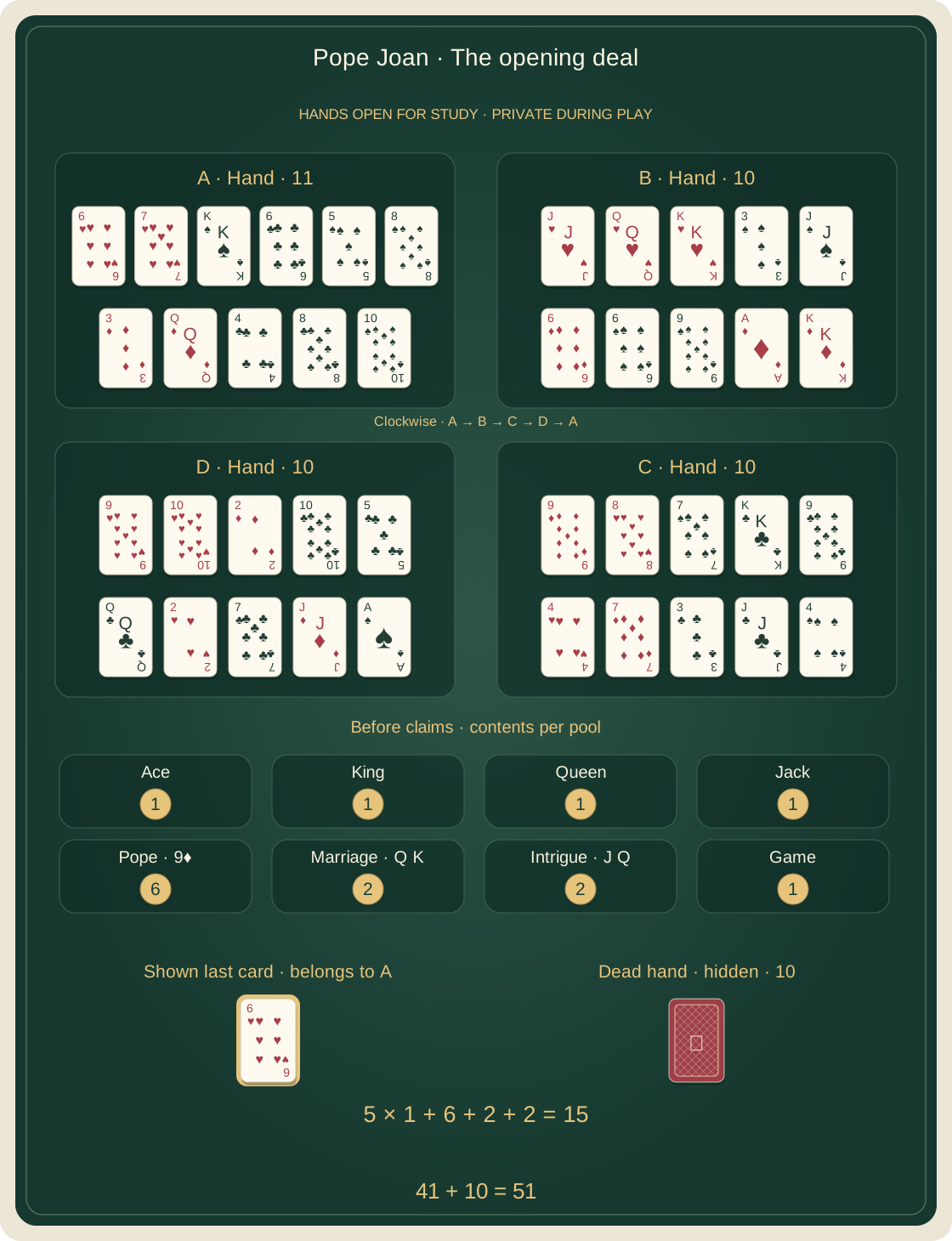
D deals in order A, B, C, D, dead hand. The final card 6♥ belongs to A: hearts reward, no immediate prize. A has 11 cards, the others 10 each, dead hand 10. D pays board 15 from 100. Hands below are exposed for study; the dead cards remain hidden in real play. A starts 6♥, the lowest heart in A’s hand.
Player A
6♥ 7♥ K♠ 6♣ 5♠ 8♠ 3♦ Q♦ 4♣ 8♣ 10♠
Player B
J♥ Q♥ K♥ 3♠ J♠ 6♦ 6♠ 9♠ A♦ K♦
Player C
9♦ 8♥ 7♠ K♣ 9♣ 4♥ 7♦ 3♣ J♣ 4♠
Player D
9♥ 10♥ 2♦ 10♣ 5♣ Q♣ 2♥ 7♣ J♦ A♠
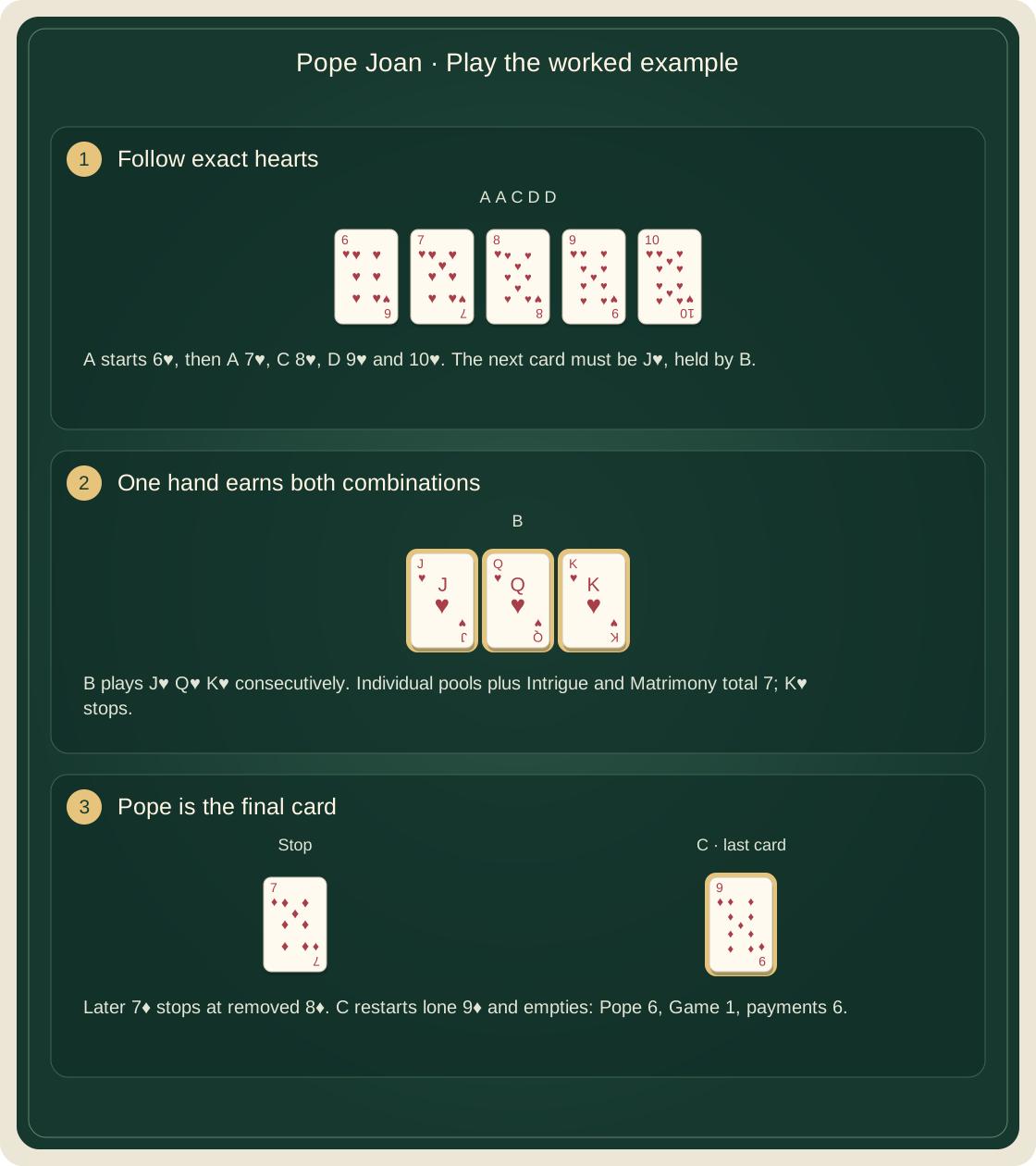
| Stage | Player and card |
|---|---|
| 1 | A 6♥ → A 7♥ → C 8♥ → D 9♥ → D 10♥ → B J♥ → B Q♥ → B K♥ |
| 2 | B A♦ → D 2♦ → A 3♦ |
| 3 | A 4♣ → D 5♣ → A 6♣ → D 7♣ → A 8♣ → C 9♣ → D 10♣ → C J♣ → D Q♣ → C K♣ |
| 4 | C 3♣ |
| 5 | C 4♥ |
| 6 | C 4♠ → A 5♠ → B 6♠ → C 7♠ → A 8♠ → B 9♠ → A 10♠ → B J♠ |
| 7 | B 3♠ |
| 8 | B 6♦ → C 7♦ |
| 9 | C 9♦ |
← On a small screen, scroll the diagram horizontally. →
09 /
Rewards, stops and settlement
B plays J♥ Q♥ K♥ consecutively: 1 + 1 + 1 + 2 + 2 = 7. A♦–2♦–3♦ stops because 4♦ is dead; C’s 7♦ later stops at removed 8♦. C finally plays lone 9♦ and empties, receiving Pope 6 and Game 1. A has 2, B 1, D 3 cards: C receives another 6. Final balances A 98, B 106, C 113, D 82; unclaimed Ace pool 1. Total 400 conserved.
10 /
History and other versions
Pope Joan was a British family game particularly associated with the Victorian period. Parlett cites an earlier reference in 1732 and appearance in Hoyle in 1826. The name refers to a legendary female pope; its exact route into the game’s title is uncertain. Older Hoyle descriptions differ over stock and turn-up endings. Our dead-hand reconstruction is deliberately identified rather than presented as a universal original.
11 /
Check your understanding
Can I restart 9♣ while holding 3♣?
Reveal the answer
No. Choose a suit, then lead its lowest card in your hand.
Who pays if Pope is still unplayed?
Reveal the answer
That holder is exempt from the final per-card payment; this does not refund the dealer’s board funding.
12 /
Mistakes to avoid
Do not use Poch’s ace-high order or freely lead a higher card above one you still hold in that suit. The turn-up stays in its dealt hand; it is not an extra fifty-second card. Owning Matrimony is insufficient unless its cards are played consecutively. Stop on the first empty hand, before rewarding cards someone might have played next.
Common questions
Which card is Pope?+
Always the nine of diamonds, regardless of reward suit.
Why remove eight of diamonds?+
It creates a permanent stop after the diamond seven.
Do trumps capture tricks?+
No: this is a sequence game; the named suit only controls rewards.