← On a small screen, scroll the diagram horizontally. →
01 /
Your first round
Play individually, with no partners. Each takes 8 cards and plays 8 tricks. Follow suit if possible; otherwise discard any card. The highest card of the led suit wins. Every captured J♥, J♦ or J♣ costs 1 penalty; J♠ costs 2. Lowest total is best.
02 /
Cards, seats and the deal
Choose first dealer randomly. Deal in packets of 2 counterclockwise until all 32 are distributed: no stock, passing or exchange. Dealer’s right leads first; dealer rotates right next deal. Name seats A–B–C–D in playing order, which here is counterclockwise. Hands stay private except in our teaching illustration.
03 /
An ace is below a jack
Write K–Q–J–A–10–9–8–7 beside the score sheet. This order determines trick winners, not penalty values. The king is highest; the ace is only fourth. In a spade trick A♠ loses to J♠. A jack discarded off-suit cannot win that trick, even though it still penalizes the eventual capturer.
04 /
What happens on your turn
Leader may choose any card, including a jack. Others must follow the led suit if held, but need not beat it. If void, any discard is legal. No trumps and no Hearts-style restriction on leading penalty cards. Collect the four cards, expose captured jacks for accounting and keep other won cards separate from the live hand. Winner leads next.
05 /
Scoring and settlement
After the whole deal count captured jacks: 2 for spades and 1 for each other suit, exactly 5 total. Other cards and number of tricks score nothing. Holding a jack at the start is not a penalty by itself. In this basic profile even taking all jacks still costs 5; it is not an automatic shoot-the-moon reversal.
06 /
When the round and match end
Complete every deal before testing the agreed threshold 20. When anyone reaches or exceeds it, end the match; the lowest accumulated score wins. Equal lowest scores share victory in our teaching agreement. Example standings 18, 17, 12, 10 become 21, 19, 12, 10 after our deal: D wins, even though C also took no penalties in that deal.
07 /
A complete worked example
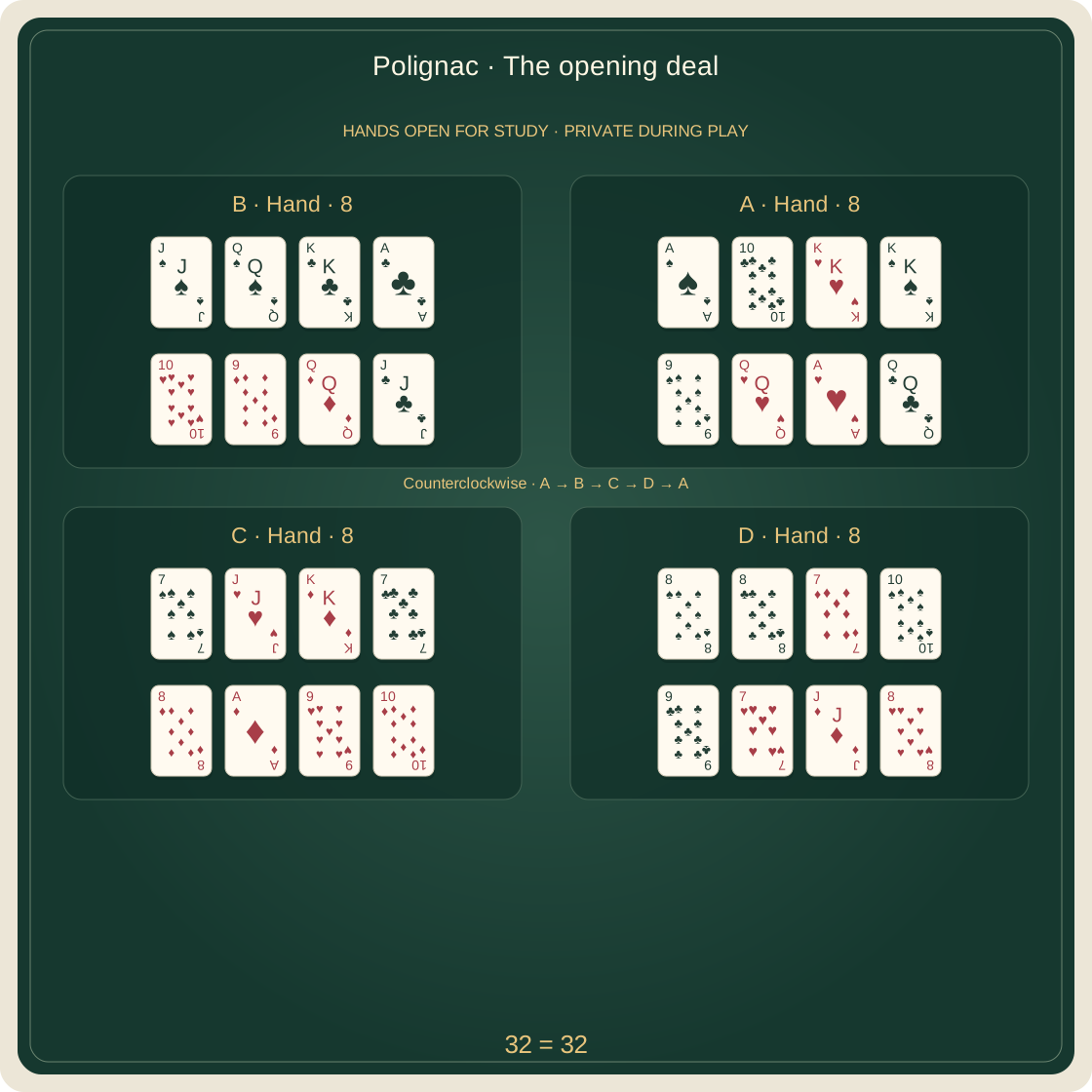
D deals, A leads at dealer’s right. Hands are open for study. Columns are fixed seats; read from the named leader in counterclockwise order. The first trick proves J♠ beats A♠; later D can throw J♦ off-suit because no spades remain in D’s hand.
Player A
A♠ 10♣ K♥ K♠ 9♠ Q♥ A♥ Q♣
Player B
J♠ Q♠ K♣ A♣ 10♥ 9♦ Q♦ J♣
Player C
7♠ J♥ K♦ 7♣ 8♦ A♦ 9♥ 10♦
Player D
8♠ 8♣ 7♦ 10♠ 9♣ 7♥ J♦ 8♥
| Stage | Lead | Player A | Player B | Player C | Player D | Winner |
|---|---|---|---|---|---|---|
| 1 | A | A♠ | J♠ | 7♠ | 8♠ | B |
| 2 | B | 9♠ | 9♦ | 8♦ | 7♦ | B |
| 3 | B | A♥ | 10♥ | 9♥ | 7♥ | A |
| 4 | A | 10♣ | A♣ | 7♣ | 8♣ | B |
| 5 | B | Q♣ | J♣ | 10♦ | 9♣ | A |
| 6 | A | Q♥ | Q♠ | J♥ | 8♥ | A |
| 7 | A | K♥ | Q♦ | A♦ | 10♠ | A |
| 8 | A | K♠ | K♣ | K♦ | J♦ | A |
← On a small screen, scroll the diagram horizontally. →
08 /
Count the jacks, not the tricks
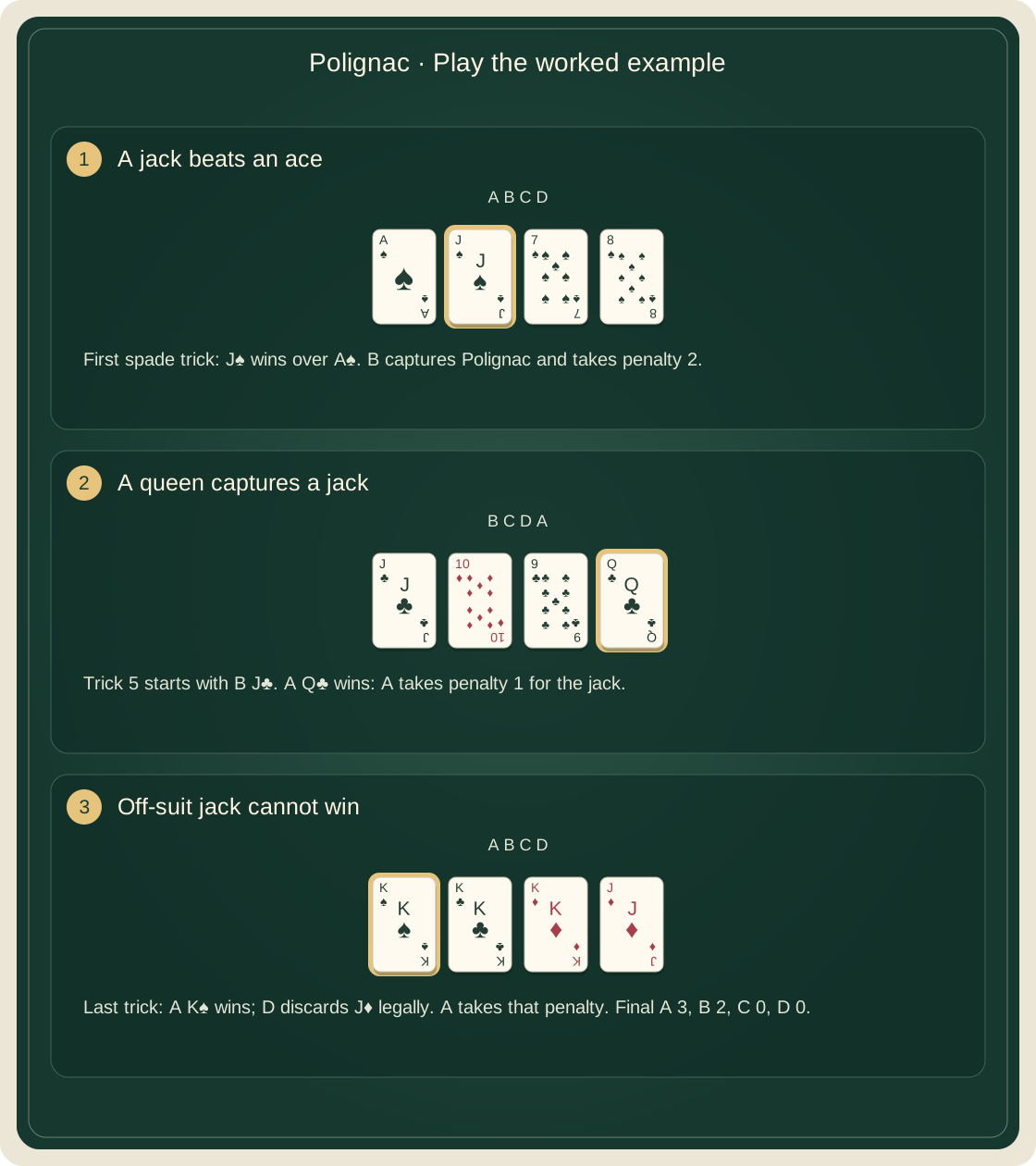
B captures J♠: 2. A captures J♣, J♥, J♦ in tricks 5, 6, 8: 3. C and D score 0. The total 3 + 2 + 0 + 0 = 5 checks the whole deal. D’s J♦ does not win the last spade trick; A’s K♠ does, and A receives the penalty.
09 /
History and other versions
The French name recalls the unpopular political figure Jules de Polignac and the nineteenth-century trick-avoidance tradition. Related games change which cards hurt or how many players take part. An optional announced générale attempts every trick and needs its own agreed settlement; it is disabled in our basic lesson, not silently triggered by collecting all jacks.
10 /
Check your understanding
Which wins: A♠ or J♠?
Reveal the answer
J♠ in this explicitly selected French ranking.
Does a discarded jack escape penalties?
Reveal the answer
It still penalizes the player who captures the trick, not its previous owner.
11 /
Mistakes to avoid
Do not import ace-high ranking from a different summary. Do not count every trick as a penalty or require beating the current card. Check for the led suit before throwing a jack: an illegal off-suit discard is a revoke, not strategy. Use the complete deal score before deciding who won the match.
Common questions
Is the ace highest?+
No: K, Q and J all beat A in this profile.
What is Polignac?+
The jack of spades, worth double the other jacks’ penalty.
Are there trumps?+
No, only the led suit can win a trick.