← On a small screen, scroll the diagram horizontally. →
01 /
Your first round
Prepare nine pools: A, K, Q, J, 10, Marriage K–Q, Sequence 7–8–9, Pocher and Centre. Each player antes 1 into EACH pool before every deal, including carried pools. First pay card awards, then settle Pochen, then play Stops. The upcard defines a pay suit, never a trick-taking trump.
02 /
Cards, seats and the deal
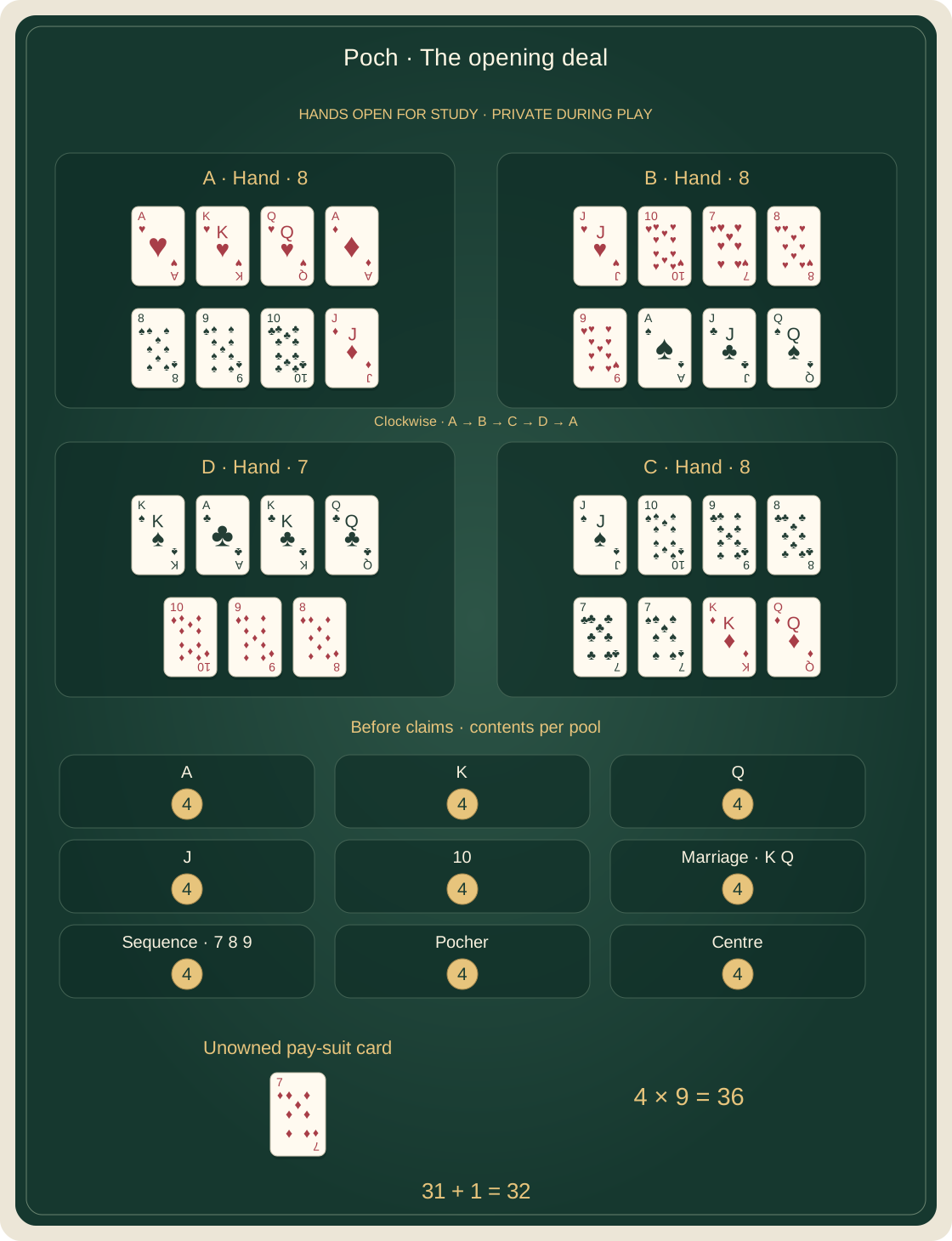
Seat 3–6 clockwise. Choose dealer randomly; rotate left. Deal single cards clockwise until only one remains. Turn that last card up: nobody owns it or plays it. Unequal hands are correct. At 4 players the hands have 8, 8, 8, 7 cards plus the upcard. Card order for sequences is 7–8–9–10–J–Q–K–A.
03 /
First: claim the card rewards
Holders of pay-suit A, K, Q, J, 10 take those pools. Holding both K and Q also earns Marriage; holding 7, 8, 9 earns Sequence. These combination rewards are additional. A turned-up reward card has no owner, so its pool carries. Unclaimed combinations also carry. Show claims, collect chips, retain every card for later stages.
04 /
Second: Pochen, not poker hands
Compare only your best matching rank: four beats three, three beats pair; within a size, A high down to 7. Equal pairs: the pair containing the pay-suit card wins. Two pairs count only their higher pair; a triple plus pair is only a triple, never a full house. With no pair you cannot enter Pochen or bluff.
05 /
How the betting closes
Start left of dealer, clockwise: pass, open at 1–3, call the current total, raise up to the agreed total cap 3, or fold. A raise adds only the difference from your previous contribution. Continue until all remaining players have matched and had a response opportunity. Best shown set takes Pocher plus bets. A lone survivor must still show a pair or better. All pass: pool carries, dealer’s left starts Stops. Folding keeps cards and returns for Stops.
06 /
What happens on your turn
Pochen winner starts Stops with ANY hand card. Whoever holds the exact next higher rank of that suit plays it; this is not turn order. Continue to A or a missing successor, including the unowned upcard or an already played card. Last person to play before a stop starts any new card. Never skip a missing rank or wrap A to 7. Empty hand ends play instantly.
07 /
When the round and match end
The first out takes Centre plus 1 from EACH opponent per card left in that opponent’s hand. Earlier card rewards remain earned. Unclaimed board pools carry into the next deal. Our four-deal session ends by comparing personal balances, highest wins; tied highest share victory. Unclaimed pools are left unawarded. Paper balances may be negative, since these are play points, with no all-in or side-pot rule.
08 /
A complete worked example
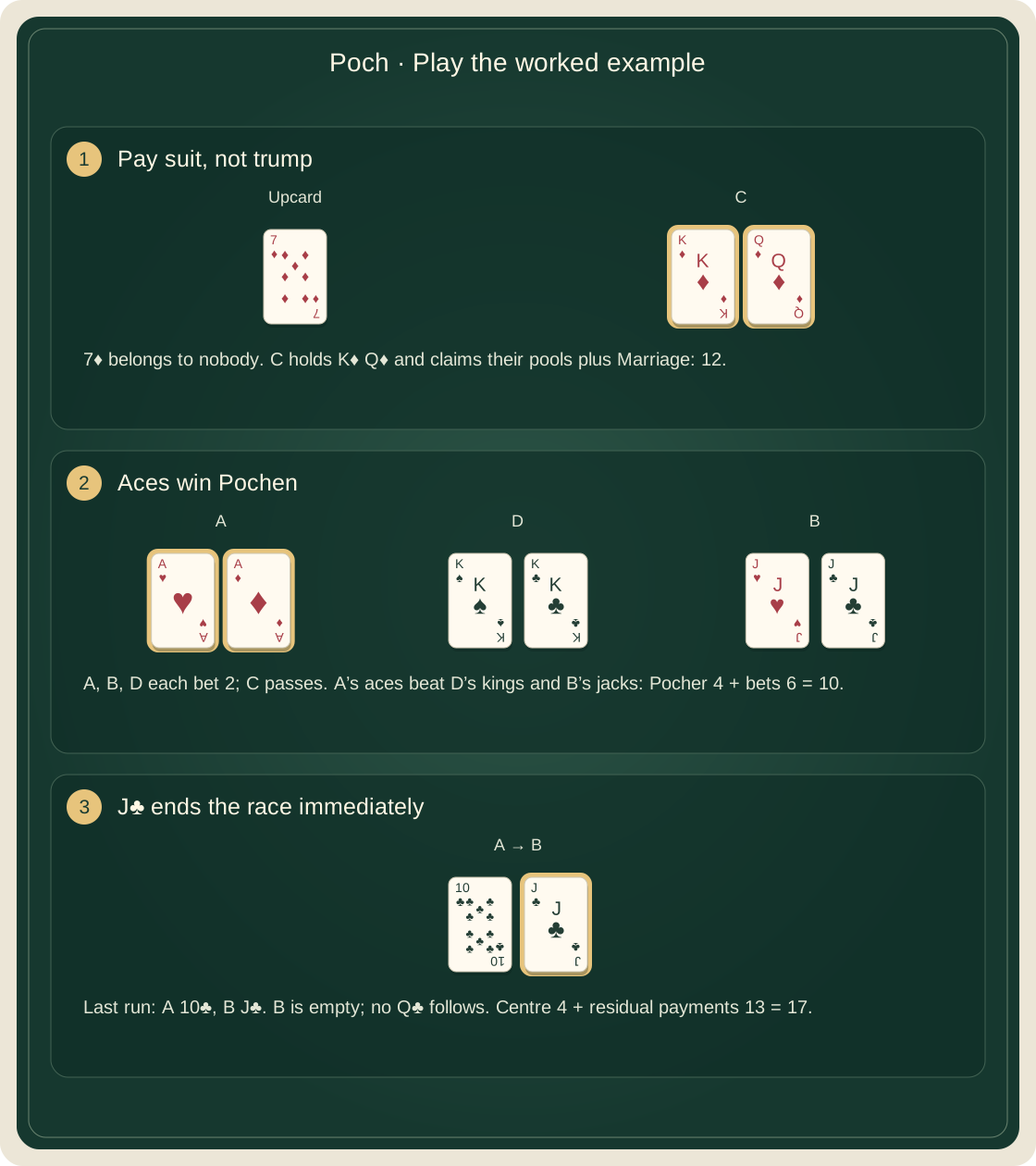
D deals; open 7♦ makes diamonds pay. Each starts with 100, antes 9, leaving 91 and 4 in each pool. A claims A♦ and J♦: 8. C claims K♦, Q♦ and Marriage: 12. D claims 10♦: 4. Sequence cannot be held because 7♦ belongs to nobody; its 4 carry. A opens Pochen 2, B calls, C passes, D calls. A’s pair of aces wins 4 + 6 = 10.
Player A
A♥ K♥ Q♥ A♦ 8♠ 9♠ 10♣ J♦
Player B
J♥ 10♥ 7♥ 8♥ 9♥ A♠ J♣ Q♠
Player C
J♠ 10♠ 9♣ 8♣ 7♣ 7♠ K♦ Q♦
Player D
K♠ A♣ K♣ Q♣ 10♦ 9♦ 8♦
| Stage | Player and card |
|---|---|
| 1 | A 8♠ → A 9♠ → C 10♠ → C J♠ → B Q♠ → D K♠ → B A♠ |
| 2 | B 7♥ → B 8♥ → B 9♥ → B 10♥ → B J♥ → A Q♥ → A K♥ → A A♥ |
| 3 | A A♦ |
| 4 | A 10♣ → B J♣ |
← On a small screen, scroll the diagram horizontally. →
09 /
Stop the sequence at the winner
A begins 8♠; B plays the final A♠ and restarts 7♥. A eventually plays A♥, then A♦, then 10♣. B follows J♣ and empties: do not continue to Q♣. Remaining cards A 1, C 6, D 6. B receives Centre 4 plus 13 = 17. Final balances A 106, B 106, C 97, D 87; board Sequence 4. Total 400 is conserved.
10 /
History and other versions
Poch has a European history reaching the fifteenth century; later German Poch and French Poque profiles differ. It belongs to the historical conversation about poker’s predecessors, but matching names do not prove a single invention chain. American board games such as Tripoli and Michigan Rummy are related, not interchangeable rulesets.
11 /
Check your understanding
May I skip a missing card in Stops?
Reveal the answer
No. Stop; the last player starts a new run.
Does a full house beat three kings?
Reveal the answer
There is no full-house category. Compare only the triple’s rank.
12 /
Mistakes to avoid
Do not discard rewarded cards before Stops, treat the upcard as belonging to dealer or distribute carried pools at will. Folding Pochen does not exclude you from the card race. Notice that Poch allows any new starting card and uses A high; those details differ from Pope Joan’s lowest-card, A-low sequences.
Common questions
Is a special board required?+
Take 7 through A in all suits: 32 ordinary cards, no jokers. Mark nine pools on paper; a commercial Poch board is optional.
Who owns the upcard?+
Nobody; it defines pay suit and cannot be played.
Does folding lose my cards?+
No. Only betting participation ends; you still play Stops.