← On a small screen, scroll the diagram horizontally. →
01 /
Your first round
Deal 5 cards each. Turn one stock card face up. On your turn, match its rank with one hand card, then discard any other hand card. The free discard becomes the next target. Suits never matter. The first empty hand wins immediately, even when the last matching play uses only one card.
02 /
Cards, seats and the deal
Use 52 ordinary cards, no jokers. Choose dealer randomly, deal one at a time clockwise, keep hands private and leave the remainder face down as stock. Reveal its top card beside it. Dealer’s left starts; turn passes left after each attempt. There are no special aces, skips or reversals.
03 /
What happens on your turn
With a matching rank in hand, play exactly one match and, if a card remains, one free discard. End your turn; do not chain another match. Without a match, turn exactly one stock card onto the pile. Now match that new rank if possible, then free-discard; otherwise pass. Never take the turned card into your hand or keep drawing until lucky.
04 /
The rules used here
For this teaching match, if stock empties, leave the upcard in place and shuffle the older discards into new stock. If a complete circuit produces no play and neither stock nor older discards are available, call the round a draw. No hand-size tiebreak is invented. Cards in hand never increase in this profile.
05 /
Scoring and settlement
Award one round win to the first player out. Draws award none. For a short match play until someone has 3 wins, rotating dealer after every round. This first-to-3 format is our session agreement, not a universal Pitty Pat scoring law. No leftover-card values or financial stakes are needed.
06 /
A complete worked example
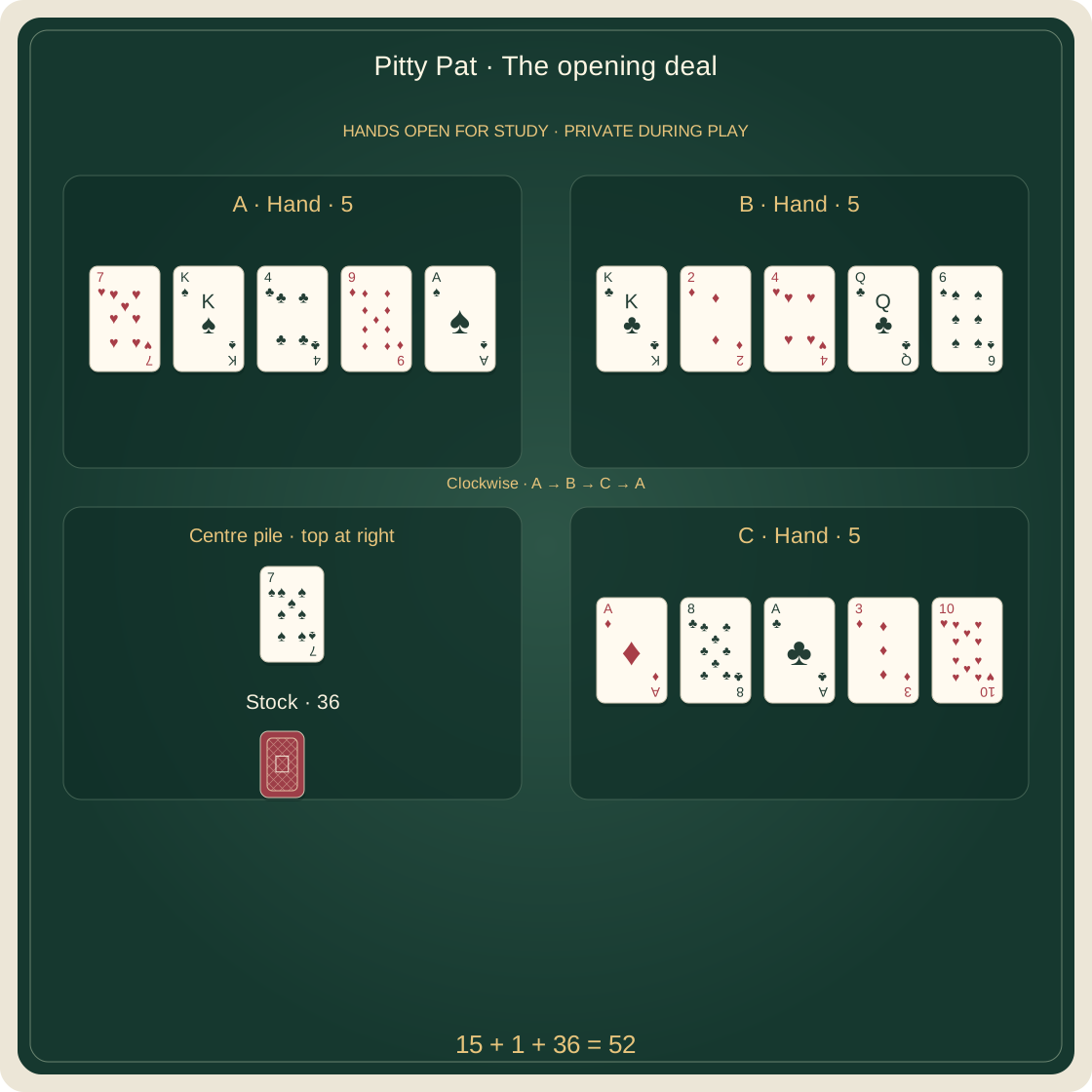
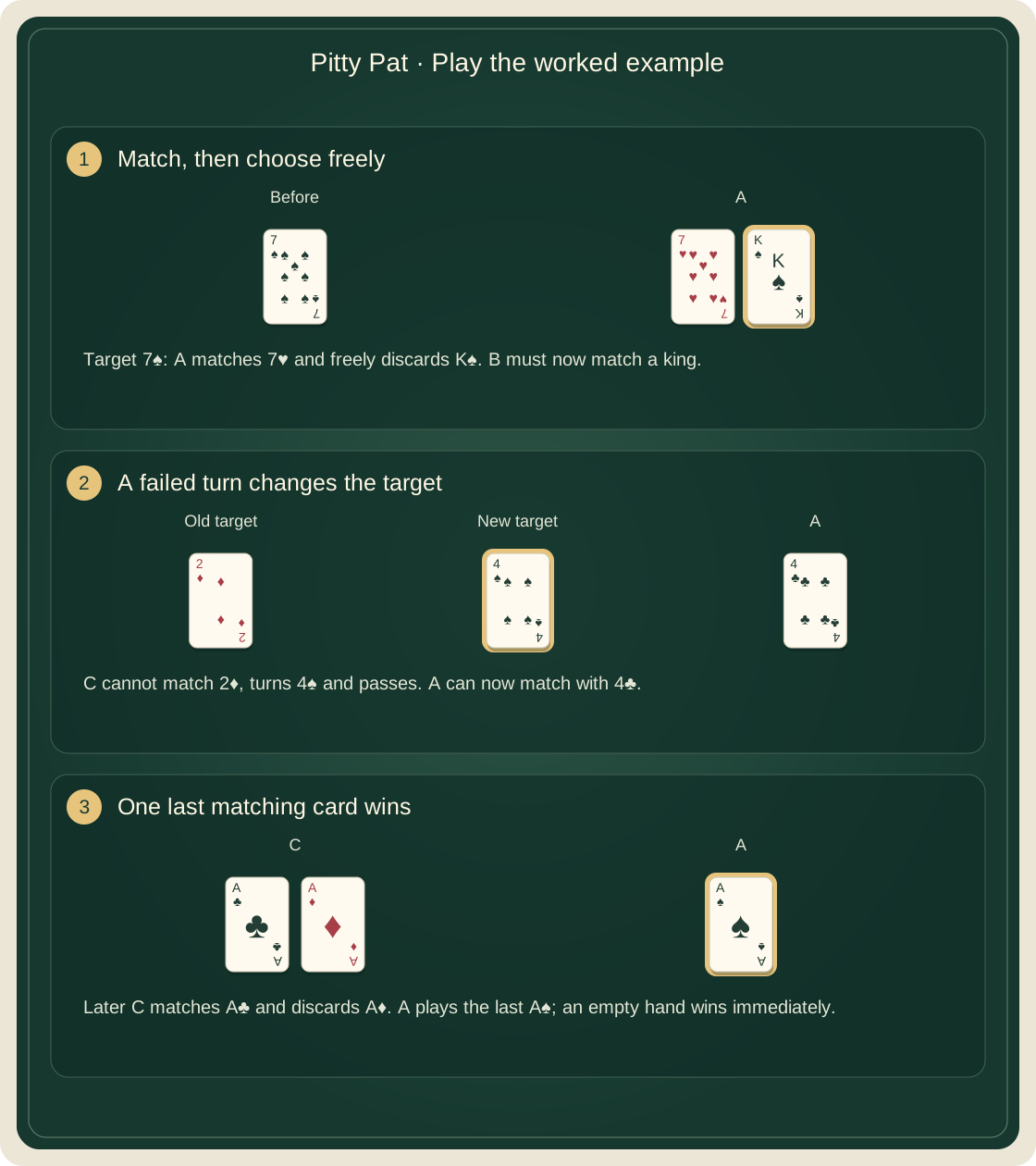
A, B, C play clockwise, C deals. Hands are exposed only for study. The upcard is 7♠; stock has 36 cards. A plays 7♥ then K♠. B matches K♣ then discards 2♦. C has no two, turns 4♠ and cannot match, so passes.
Player A
7♥ K♠ 4♣ 9♦ A♠
Player B
K♣ 2♦ 4♥ Q♣ 6♠
Player C
A♦ 8♣ A♣ 3♦ 10♥
← On a small screen, scroll the diagram horizontally. →
07 /
The stock changes the target
A now matches 4♣ and discards 9♦, retaining only A♠. B has no nine: turns 5♠ and passes. C has no five: turns A♥, matches A♣, then freely discards A♦. A matches with the last A♠ and wins; no second card is required. B still has 3 cards, C has 3, stock has 33.
08 /
When the round and match end
Stop as soon as a hand is empty, before the next turn. A player with a pair still in hand has not won under these rules: those cards must be legally discarded. Do not take a new stock card after winning. Gather every card, shuffle and start the next round with the new dealer.
09 /
History and other versions
Pitty Pat is closely associated with Belize, where it is described as a national card game. Its precise inventor and date are not established by the sources used here. Local versions may retain matching pairs until the finish; others differ over stock turns. That is why the selected empty-hand profile is stated before play.
10 /
Check your understanding
Does a turned stock card join my hand?
Reveal the answer
No. It becomes the new target on the discard pile, even if you cannot match.
Can my last matching card finish alone?
Reveal the answer
Yes. Empty hand ends the round immediately in this profile.
11 /
Mistakes to avoid
A free discard need not match either card under it. A matching suit alone is useless. Two equal cards already in your hand are not an automatic meld or win here. Keep the stock separate from the discard pile and announce a pass after an unsuccessful turn-up so the next player knows the target changed.
Common questions
Do I need special cards?+
Use one ordinary 52-card pack without jokers. No special or proprietary cards are required.
Does suit matter?+
Only rank matters for matching.
Can I play again after a free discard?+
No. Turn passes to the next player.