← On a small screen, scroll the diagram horizontally. →
01 /
Cards, seats and the deal
Partners A–C oppose B–D. Shuffle, cut to dealer’s right and deal clockwise from the left, usually in packets of 3 until each has 12. All 48 cards are dealt, no stock. Within any suit rank A > 10 > K > Q > J > 9. Suit chosen as trump beats every other suit. Identical cards are not tied in a trick: the first played beats the later copy. Dealer rotates left after the deal.
02 /
Bid, name trump, pass four
Left of dealer bids first. Bid a number only, at least 250, raising by multiples of 10, or pass permanently. Continue until only one bidder remains. If the first three pass, dealer takes 250. We omit the optional “pass with help” signal. Winner names trumps; partner passes exactly 4 face down. Bidder temporarily has 16, selects 4 to return, possibly some just received, restoring both hands to 12. Defenders do not exchange.
03 /
Meld: what can count together
| Combination | Points |
|---|---|
| Trump A 10 K Q J | 150 |
| Run + extra K or Q / both | 190 / 230 |
| Double run: two of every member | 1500 |
| Trump K Q / other-suit K Q | 40 / 20 |
| Each trump 9, deece | 10 |
| Q♠ J♦ / two of each | 40 / 300 |
| A around: one in each suit / two | 100 / 1000 |
| K around / double | 80 / 800 |
| Q around / double | 60 / 600 |
| J around / double | 40 / 400 |
Show meld after passing. A single card may serve different classes: suit combinations, Q♠–J♦ pinochle, and arounds. Do not reuse a card twice within the same class. A bare trump run already includes its K–Q marriage; do not add 40 again. In this family, a single extra K or Q raises that run to 190; both raise it to 230. Arounds need every suit in one player’s hand, not cards pooled across partners. Tens around score nothing. Return shown cards to the hand for tricks.
04 /
What happens on your turn
Declarer leads. Follow suit if possible and beat the currently winning card if you can, even partner’s. If void, trump; overtrump the current winner if able, otherwise play any trump. Without led suit and trumps discard freely. A plain card cannot beat a trump already winning, so following that plain suit no longer requires overtaking another plain card. First identical card wins; winner leads next. There are 12 tricks and no drawing.
05 /
Scoring and settlement
Each captured A, 10 or K gives 10, others 0; last trick adds 10. Exactly 250 trick points exist. A made contract adds the partnership’s meld plus trick points; failure subtracts the bid, adding neither. Defense adds tricks and saves ordinary meld only by capturing a counter or the final-trick bonus; the exception keeps deece points if those nines are the defense’s only meld. If meld plus the maximum 250 cannot make the bid, throw in before play: bidders lose the bid, defenders get their own meld only, no imaginary tricks.
06 /
When the round and match end
Add the settled deal scores to cumulative totals, which may be negative. In this family play to 1500. If both teams reach that target in the same deal, the bidding team wins regardless of the higher numerical total. Do not mix with the common divided-by-10 scale or an app using different counters, a different minimum bid or no passing. Those require a different agreed profile.
07 /
A complete worked example
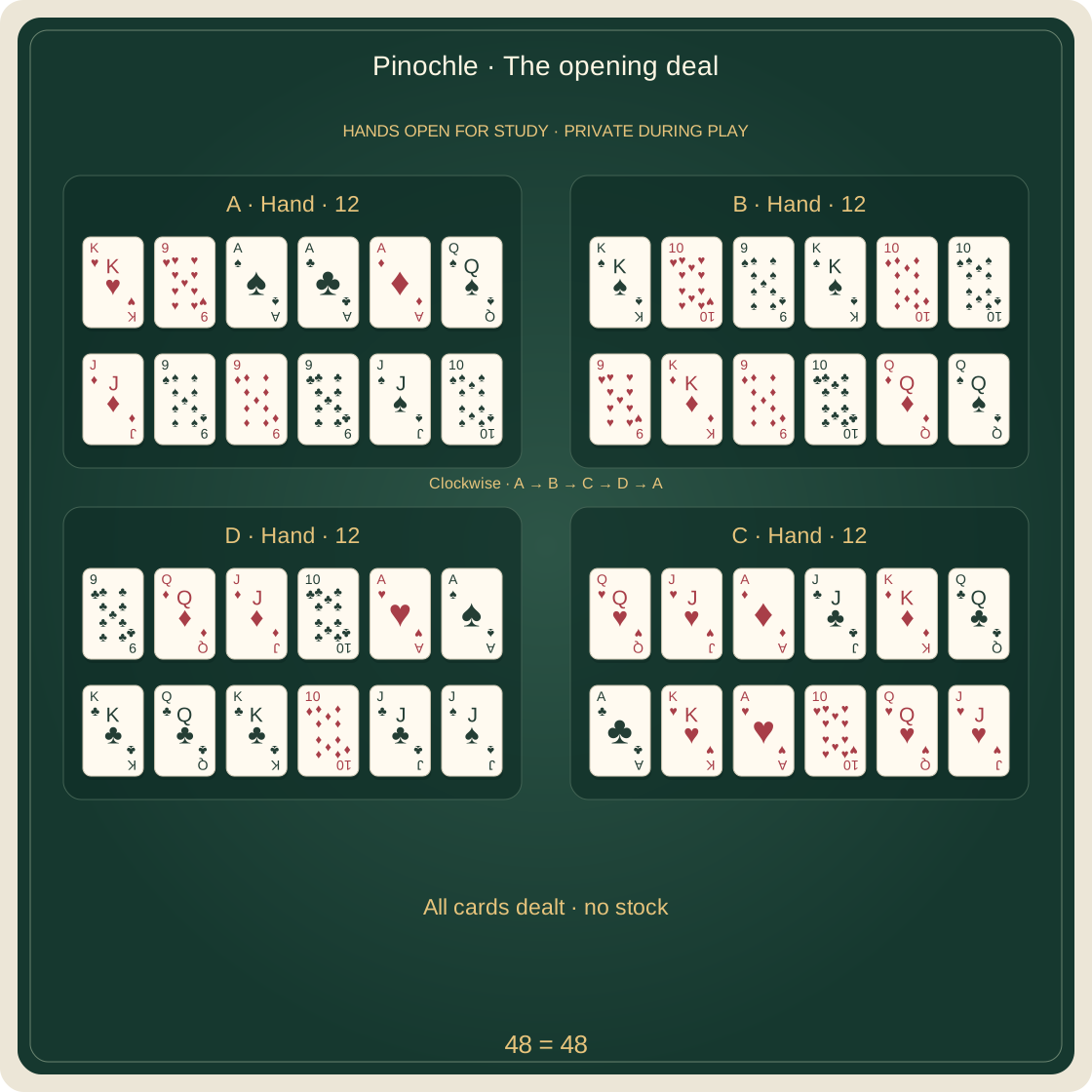
Player A
A♥ 10♥ K♥ Q♥ J♥ 9♥ A♠ A♣ A♦ Q♠ J♦ 9♠
Player B
K♠ 10♥ 9♠ K♠ 10♦ 10♠ 9♥ K♦ 9♦ 10♣ Q♦ Q♠
Player C
9♦ 9♣ J♠ 10♠ Q♥ J♥ A♦ J♣ K♦ Q♣ A♣ K♥
Player D
9♣ Q♦ J♦ 10♣ A♥ A♠ K♣ Q♣ K♣ 10♦ J♣ J♠
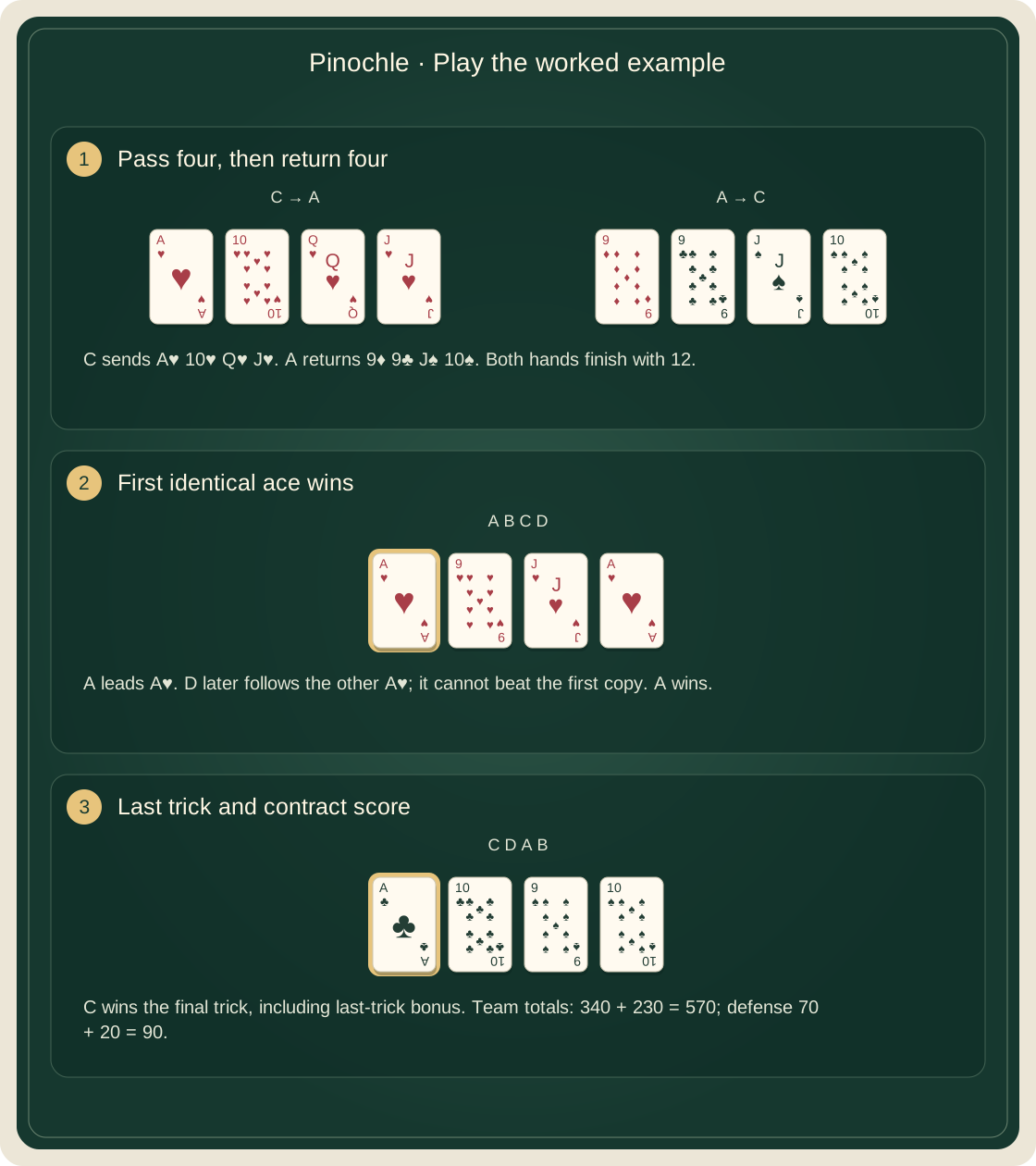
D deals; A bids 400, others pass, hearts trump. The opening diagram shows hands before exchange. C sends A♥ 10♥ Q♥ J♥; A returns 9♦ 9♣ J♠ 10♠. These printed hands are after exchange. A melds run 150, deece 10, pinochle 40 and aces around 100 = 300. C has trump marriage 40: team 340. B has deece and two plain marriages = 50; D plain marriage 20: defense 70. The following rows complete the actual deal, columns A B C D.
| Lead | Player A | Player B | Player C | Player D | Winner | Points |
|---|---|---|---|---|---|---|
| A | A♥ | 9♥ | J♥ | A♥ | A | 20 |
| A | 10♥ | 10♥ | Q♥ | 9♣ | A | 20 |
| A | K♥ | 9♠ | K♥ | J♦ | A | 20 |
| A | Q♥ | 9♦ | 9♦ | J♣ | A | 0 |
| A | J♥ | Q♦ | 9♣ | J♠ | A | 0 |
| A | 9♥ | Q♠ | J♠ | Q♦ | A | 0 |
| A | A♠ | K♠ | 10♠ | A♠ | A | 40 |
| A | A♣ | 10♣ | J♣ | Q♣ | A | 20 |
| A | A♦ | K♦ | K♦ | 10♦ | A | 40 |
| A | Q♠ | K♠ | Q♣ | K♣ | B | 20 |
| B | J♦ | 10♦ | A♦ | K♣ | C | 30 |
| C | 9♠ | 10♠ | A♣ | 10♣ | C | 40 |
← On a small screen, scroll the diagram horizontally. →
08 /
Identical aces and final settlement
In trick 1, A♥ from A beats the identical A♥ played later by D. All 12 tricks give A–C 230 and B–D 20: 250 total. A–C add meld 340: 340 + 230 = 570, enough for 400; record +570. Defense saves its 70 meld with counters and adds 20, recording +90. A failed independent bid of 600 with the same earned 570 would record −600 instead. This teaching line is legal, not a claim of optimal bidding or defense.
09 /
Check your understanding
Do two identical aces split a trick?
Reveal the answer
No. The earlier played ace wins.
Can partner’s Q♠ join my J♦ for meld?
Reveal the answer
No. Both must be held in the same player’s hand after passing.
10 /
History and other versions
Pinochle has a strong American partnership tradition and several distinct branches. “Single deck” and “double deck” refer to Pinochle compositions, not simply to the number of ordinary packs on the table. The selected account is explicitly David Dailey’s family game. Many later rulebooks relax overtaking when a plain suit is led, omit passing or use different run extras. Describing the selected family honestly is more useful than pretending all versions share one scoring table.
11 /
Mistakes to avoid
Keep rank strength separate from point value: queens can win but are not counters here. Do not count a run and its built-in marriage twice. Do not exempt a winning partner from the strict overtaking rule. A trick with no counters and not the last may be worth 0, so winning any trick is not always enough to save ordinary defensive meld.
12 /
A reminder for the table
After passing, verify every hand has twelve cards again. Separate meld classes and write the commitment before taking tricks. Count counters and the last trick, then test the contract and the defensive saving rule. A displayed meld does not remove cards from subsequent play.
Common questions
Do I need a special deck?+
Use two copies of 9, J, Q, K, 10, A in every suit: 48 cards. A Pinochle pack supplies this, or strip two ordinary decks. Here single-pack means one Pinochle pack, not one ordinary deck.
Are the two players’ meld cards pooled?+
No. Score each player’s own meld, then add the partnership totals.
May I underplay if partner is already winning?+
Not when a higher legal card can beat the current winner in this strict family profile.