← On a small screen, scroll the diagram horizontally. →
01 /
Cards, seats and the deal
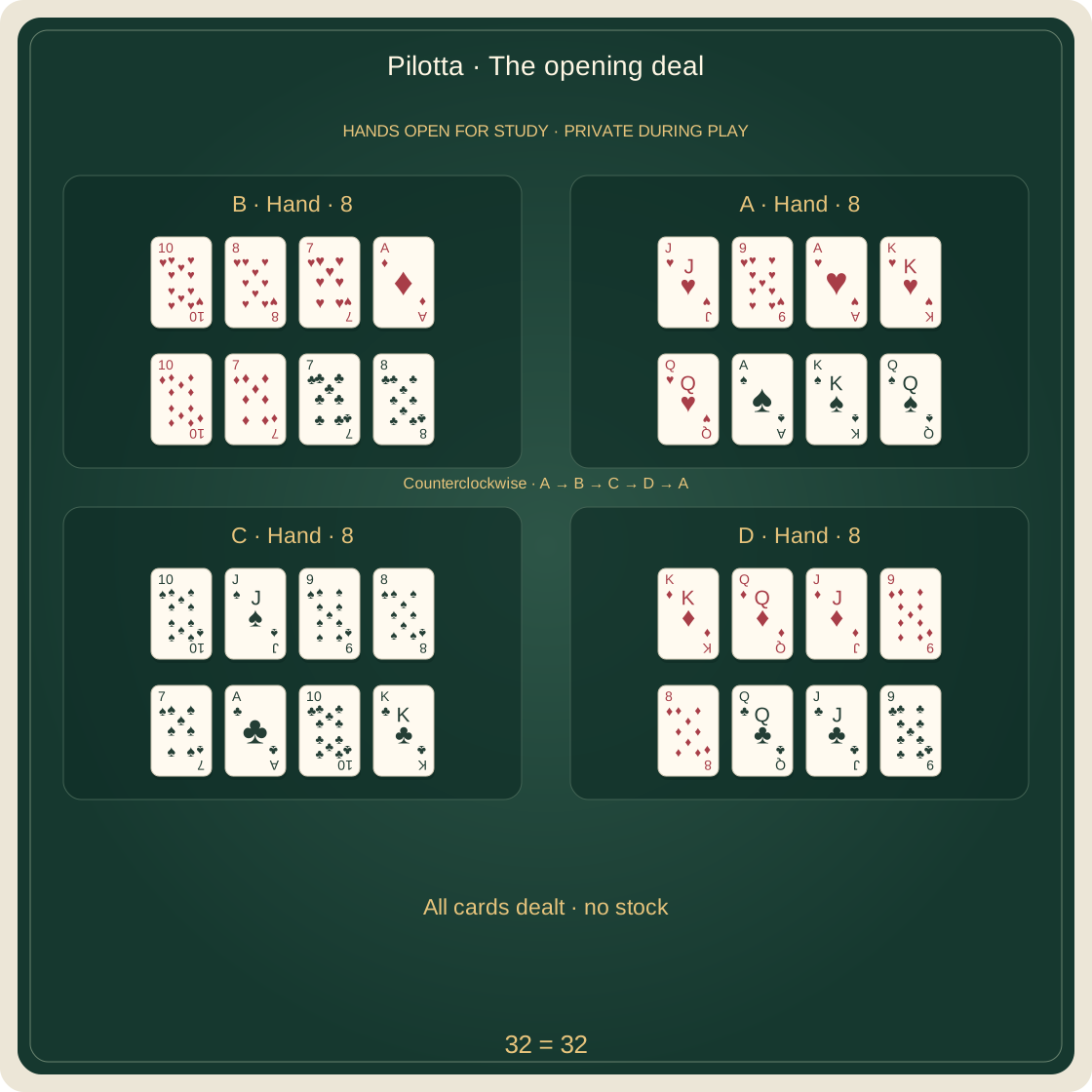
Partners sit opposite, A–C against B–D. Dealer offers a cut to the left and deals counterclockwise from the right in packets 3–2–3: 8 each, all 32 used. No stock or upcard. The right-hand neighbour also opens the auction and later leads the first trick, even if someone else wins the auction. Dealer rotates right after each deal. In our diagrams A, B, C, D are named in counterclockwise play order.
02 /
Auction and the promise
Bid a number plus a trump suit, minimum 80; every later bid must increase by at least 10. Pass if you do not raise. For this table a pass withdraws you from that auction; when only one bidder remains after the others pass, their last bid is the contract. Four initial passes mean next dealer redeals. Contract success tests the partnership’s captured-card points, last-trick bonus and awarded declarations together, before adding the bid bonus.
03 /
Card order is not declaration order
| Position | Trump | Other suits |
|---|---|---|
| 1 | J · 20 | A · 11 |
| 2 | 9 · 14 | 10 · 10 |
| 3 | A · 11 | K · 4 |
| 4 | 10 · 10 | Q · 3 |
| 5 | K · 4 | J · 2 |
| 6 | Q · 3 | 9 · 0 |
| 7 | 8 · 0 | 8 · 0 |
| 8 | 7 · 0 | 7 · 0 |
04 /
What happens on your turn
Leader plays any card. Follow suit if held. When trump is led, play above the highest trump so far if able; otherwise any trump. When void in a plain suit, trump even if partner is winning; if already trumped, overtrump if possible, otherwise play any trump. Only without both the led suit and trumps may you discard freely. There is no compulsory overtaking within a plain suit. Highest trump wins, otherwise highest led-suit card; winner leads next.
05 /
Declarations and their deadlines
Sequences use natural 7 8 9 10 J Q K A order in one suit: 3 cards 20, 4 cards 50, 5 or more 100. Four J score 200; four 9 score 150; four A, 10, K or Q score 100. No four-7 or four-8 award. Announce your highest declaration before playing in trick 1 and show scoring groups before playing in trick 2; already played cards remain identifiable from trick history. Groups cannot share a physical card, except the trump K–Q Pilotta may overlap a sequence.
06 /
Comparing declarations and Pilotta
Only the team with the best ordinary declaration scores all its nonoverlapping declarations. Our explicit comparison agreement is: points first, four-of-a-kind over an equal-point sequence, fours ordered J 9 A 10 K Q, sequences by length then natural top rank; an otherwise equal trump sequence wins. Equal non-trump sequences cancel both teams’ ordinary declarations. Pilotta is separate: the holder says Pilotta on playing the first trump K or Q and re-Pilotta on the second, for 20 irrespective of the ordinary declaration contest.
07 /
Scoring and settlement
Card points total 152; last trick adds 10, hence 162 before declarations. On success each side receives its captured points plus awarded bonuses, and bidders also add the bid. On failure bidders get 0; defenders receive the bid, all 162 card/last-trick points and all awarded bonuses. Cancelled declarations do not revive. A sweep of all 8 tricks replaces 162 by 250. These full-scale rules omit rounding; do not compare our totals directly with a scorepad divided by 10.
08 /
When the round and match end
Count only after all 8 tricks and add the deal score to running totals. Our agreed target is 1000: if either passes it, higher total wins; an exact tie continues. Other tables use targets on a divided-by-10 scale, special rounding, doubles or closed contracts. Choose one score system before dealing. The present sheet always writes 162 rather than 16, and does not switch units during the match.
09 /
A complete worked example
Player A
J♥ 9♥ A♥ K♥ Q♥ A♠ K♠ Q♠
Player B
10♥ 8♥ 7♥ A♦ 10♦ 7♦ 7♣ 8♣
Player C
10♠ J♠ 9♠ 8♠ 7♠ A♣ 10♣ K♣
Player D
K♦ Q♦ J♦ 9♦ 8♦ Q♣ J♣ 9♣
D deals; A bids 200 hearts, the others pass. A announces 20 before playing; C announces 100, D 20. C’s five spades wins the declaration contest: A’s two three-card sequences add 40, C adds 100, D’s declaration is cancelled. A’s K♥ Q♥ earns Pilotta 20 when played in tricks 5 and 6. Columns below always stay A B C D; the lead column tells where to begin. All cards are shown only for study.
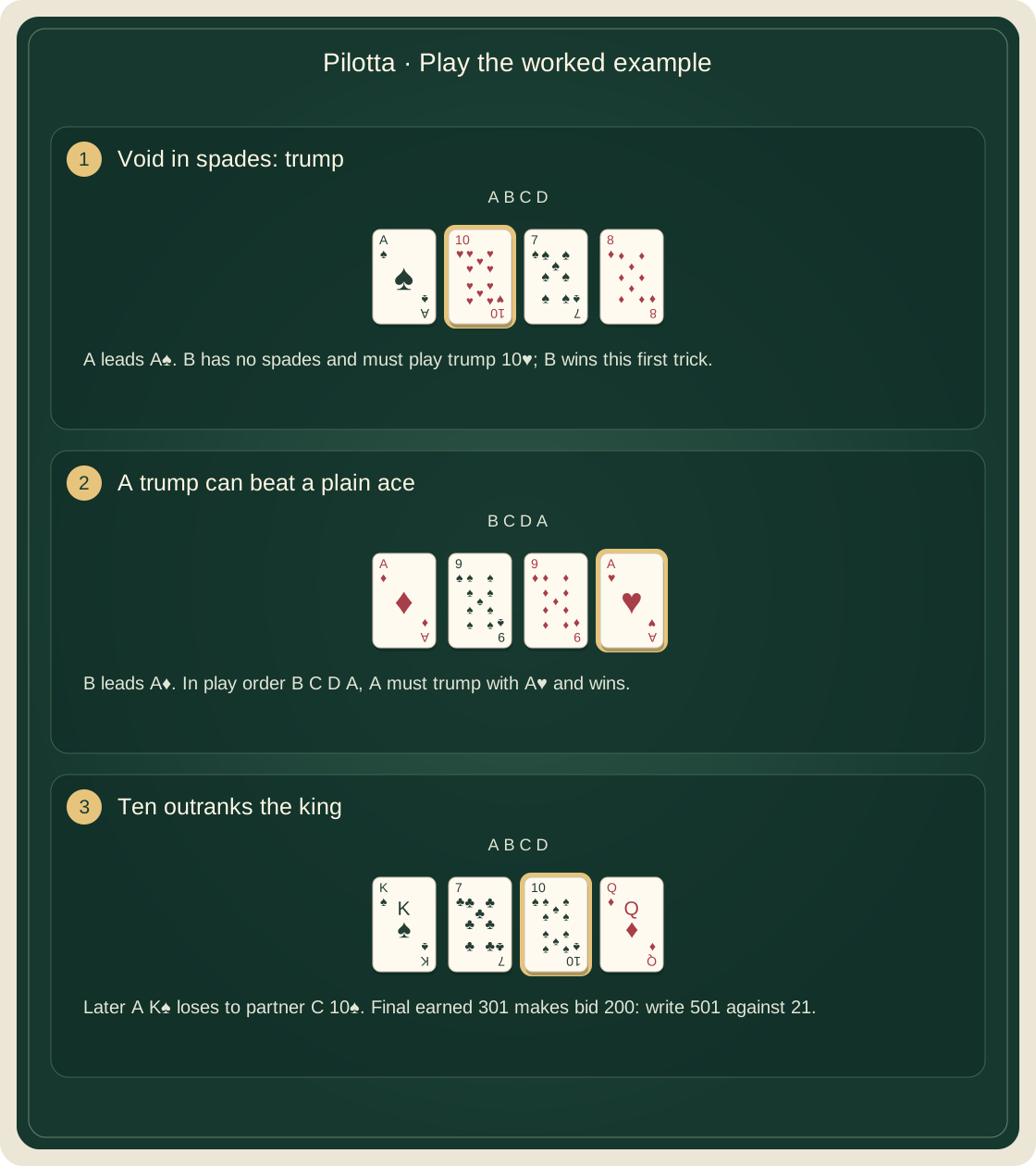
| Lead | Player A | Player B | Player C | Player D | Winner |
|---|---|---|---|---|---|
| A | A♠ | 10♥ | 7♠ | 8♦ | B |
| B | A♥ | A♦ | 9♠ | 9♦ | A |
| A | J♥ | 7♥ | 8♠ | 9♣ | A |
| A | 9♥ | 8♥ | J♠ | Q♣ | A |
| A | K♥ | 7♦ | 10♣ | J♣ | A |
| A | Q♥ | 10♦ | K♣ | J♦ | A |
| A | K♠ | 7♣ | 10♠ | Q♦ | C |
| C | Q♠ | 8♣ | A♣ | K♦ | C |
← On a small screen, scroll the diagram horizontally. →
10 /
Contract result and a failed comparison
A–C capture 141 including the last 10; B–D capture 21. Check 141 + 21 = 162. Bidders earn 141 + 140 + 20 = 301, making 200, so record 301 + 200 = 501 against 21. This is not a sweep because B won the opening trick. Independent failed example without declarations: bid 100, capture 80; bidders 0, defenders 162 + 100 = 262. The bid bonus cannot help you make your own contract.
11 /
Check your understanding
Is A–10–K a sequence declaration?
Reveal the answer
No. Use natural rank order, not trick strength.
Partner wins, but you are void and hold trump. Discard?
Reveal the answer
No in this profile. Trump and overtrump if possible.
12 /
History and other versions
Pilotta is a Greek-speaking Jass-family game particularly associated with Cyprus and related to Belote. The Palaristi bidding tradition adds contract promises to card points and declarations. Local rulebooks differ especially in scoring scale and declaration ties; a single online summary is not a universal tournament code. This article identifies its full-scale teaching agreements rather than inventing a precise origin date.
13 /
Mistakes to avoid
Use separate orders for trick-taking and sequences. Do not grant a partner-winning exemption to compulsory trump. Announcing is not enough: meet the showing deadline. Avoid counting a long sequence as several overlapping shorter ones. Add the bid only after deciding whether earned points met it; never round the earned total before testing the contract in this full-scale profile.
14 /
A reminder for the table
Before play record the bid, trump suit, first leader, declaration-tie agreement and score scale. Announce in time, follow suit and check compulsory trump before discarding. At the end distinguish earned points, successful-bid addition and the sweep replacement.
Common questions
Do I need a special deck?+
Use 7, 8, 9, 10, J, Q, K, A in every suit: 32 cards, no jokers. Remove lower ranks from an ordinary pack; no proprietary deck required.
Are all declarations scored by both teams?+
No. The best ordinary declaration selects one team; Pilotta has its separate award.
Does the auction winner always lead first?+
No here. The first leader is dealer’s right-hand neighbour.