← On a small screen, scroll the diagram horizontally. →
01 /
Cards, seats and the deal
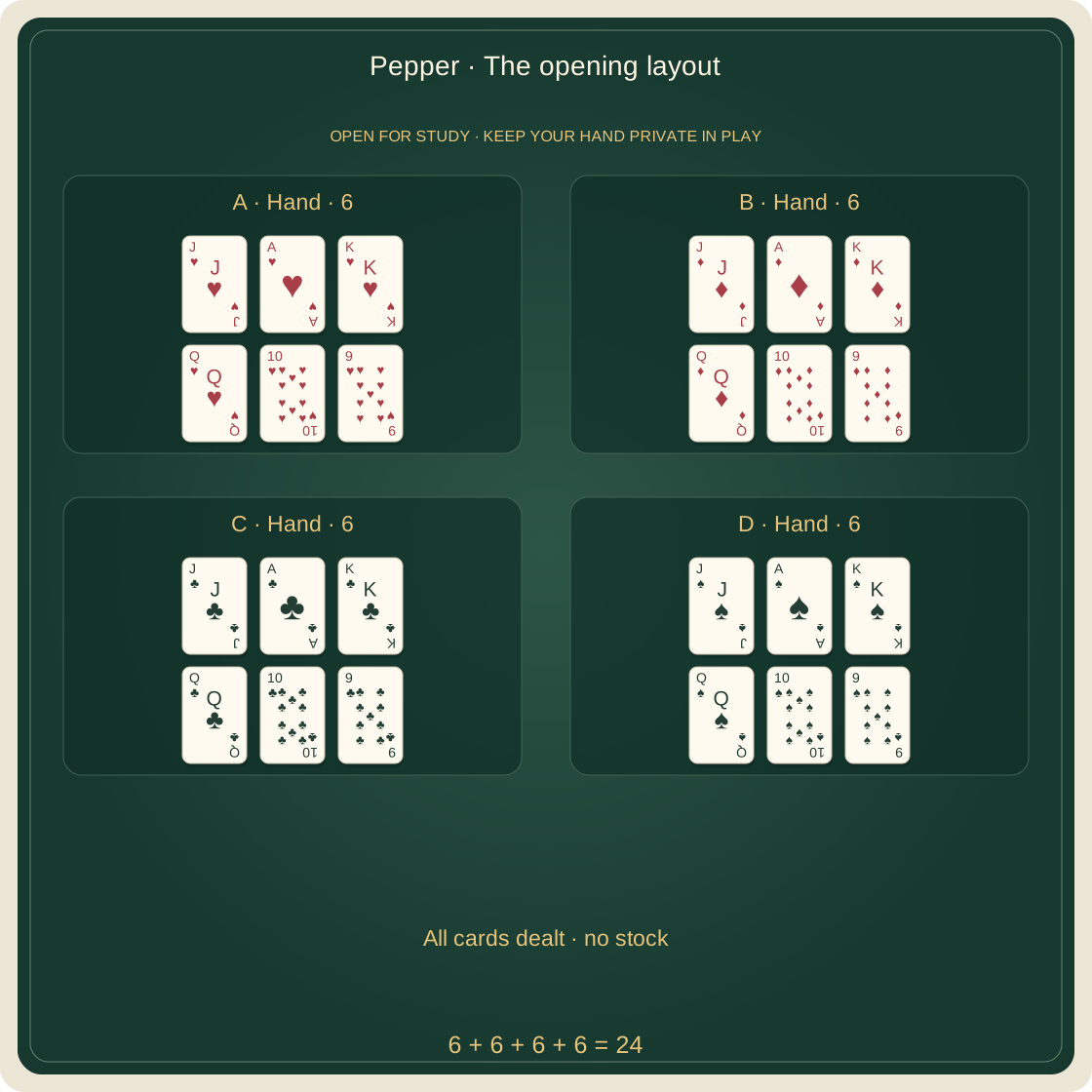
Partners sit opposite: A–C against B–D. Choose dealer and deal clockwise, starting left, in packets no larger than 3 until all hold 6. All 24 cards are used. Next dealer is leftward. In trumps the right bower, the jack of trump, is highest; the other same-colour jack is left bower and ranks next, then A K Q 10 9. The left bower belongs to trumps, not its printed suit. In no-trumps every suit ranks A K Q J 10 9.
02 /
Auction and contract choice
Each speaks once, starting left of dealer: pass or raise in the order 1, 2, 3, 4, 5, 6, little pepper, big pepper. All pass: next dealer reshuffles and redeals. Winner chooses any trump suit or no-trumps. Numeric bids promise at least that many tricks; either pepper promises all 6. Big pepper is not restricted to no-trumps in this profile. Never substitute a five-trick hand from another version.
03 /
Exchange, solo or with partner
For an ordinary bid or little pepper, bidder may exchange or play with partner. In an exchange bidder sets aside 1 unwanted card, partner independently passes 1 face down without inspecting that discard or discussing cards, and bidder takes it. Partner’s other 5 plus bidder’s discard are out of play; bidder and two defenders each retain 6. With partner, no exchange and all four play. Big pepper always excludes partner’s original 6 and allows no exchange.
04 /
What happens on your turn
Before the first lead defenders jointly choose play or surrender. They may discuss that decision, not reveal card holdings. Surrender gives the bidder the successful-contract award and defenders 0. Otherwise bidder leads any card; everyone follows effective suit if able, discarding freely when void. No compulsory trump or overtrump. Highest trump wins, otherwise highest led-suit card. Winner leads next. Count all 6 tricks, with the inactive partner omitted.
05 /
Scoring and settlement
Ordinary bids 1–6: success adds the bid, not tricks actually won; failure subtracts the bid. Defenders who take tricks add that number. Taking none costs the bid against 1–5; our stated 6-bid safety option instead gives defenders 0. Little pepper: all 6 means bidders +7, defenders −7; any defensive trick reverses those signs. Big pepper is ±14 by the same test. Surrender always leaves defenders 0. Start both teams at 0; negative scores are possible.
06 /
When the round and match end
After each deal, if either team has at least 42, the higher total wins. A tie at or above 42 requires another deal. This profile does not require the winning side to be the bidders. A short session can agree a smaller target beforehand, but do not change it to rescue a failed big pepper.
07 /
A complete worked example
Player A
J♥ A♥ K♥ Q♥ 10♥ 9♥
Player B
J♦ A♦ K♦ Q♦ 10♦ 9♦
Player C
J♣ A♣ K♣ Q♣ 10♣ 9♣
Player D
J♠ A♠ K♠ Q♠ 10♠ 9♠
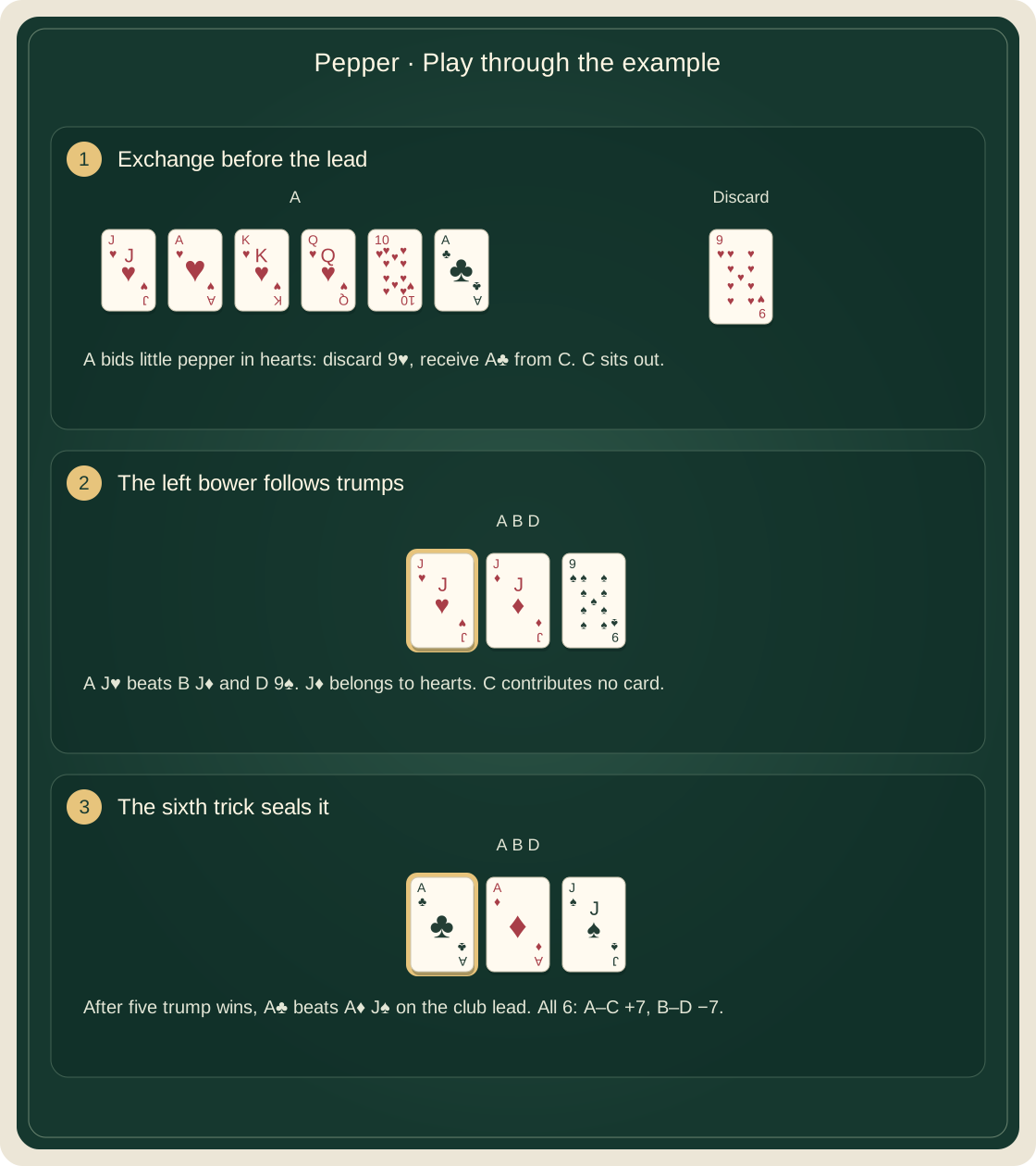
D deals. A bids little pepper, everyone else passes; A chooses hearts and exchanges 9♥ for partner C’s A♣. C’s remaining clubs and 9♥ are out. Defenders choose to play. A now leads every row in the following table; C sits out. J♦ must follow the heart lead because it is left bower. After five trump wins, A♣ wins the final club lead: neither defender has clubs or trumps. A–C record +7, B–D −7.
| Player A | Player B | Player D |
|---|---|---|
| J♥ | J♦ | 9♠ |
| A♥ | 9♦ | 10♠ |
| K♥ | 10♦ | Q♠ |
| Q♥ | Q♦ | K♠ |
| 10♥ | K♦ | A♠ |
| A♣ | A♦ | J♠ |
← On a small screen, scroll the diagram horizontally. →
08 /
Check your understanding
Partner exchanged a card. Do they play?
Reveal the answer
No. Their other cards are set aside and they sit out.
Little pepper wins 5 of 6. Success?
Reveal the answer
No. Bidders −7, defenders +7.
09 /
History and other versions
Pepper is an American bidding relative of euchre, strongly associated with Iowa. Bower ranks survive, but the auction, six-card hands and exchange transform the decisions. Local tables vary in minimum bid, forced dealer, surrender and pepper values. In particular some use little pepper 6 and big pepper 12; others keep all four players active. Those are separate profiles, not corrections to apply halfway through this one.
10 /
Mistakes to avoid
Check the left bower before declaring yourself void. Do not score actual bidder tricks in the bid-value profile. Separate the ordinary six bid from pepper contracts and from the chosen zero-trick safety option. If defenders surrender, no imaginary cards are played and they take no negative pepper penalty.
Common questions
How many tricks are played?+
6, from six-card active hands.
Can big pepper name a trump suit?+
Yes in this profile. It forbids partner help, not trump suits.
Does a special deck need to be bought?+
Keep 9, 10, J, Q, K and A in each suit: 24 cards, no jokers. An ordinary pack can be stripped; no proprietary deck is needed.