← On a small screen, scroll the diagram horizontally. →
01 /
Your first round
Move all 52 cards to 4 foundations, one suit per foundation. They build upward from the first dealt rank, wrapping K → A until each has 13. With base 7, the final order is 7 8 9 10 J Q K A 2 3 4 5 6. You win only when all four foundations are complete, not merely when the beak is freed.
02 /
Cards, seats and the deal
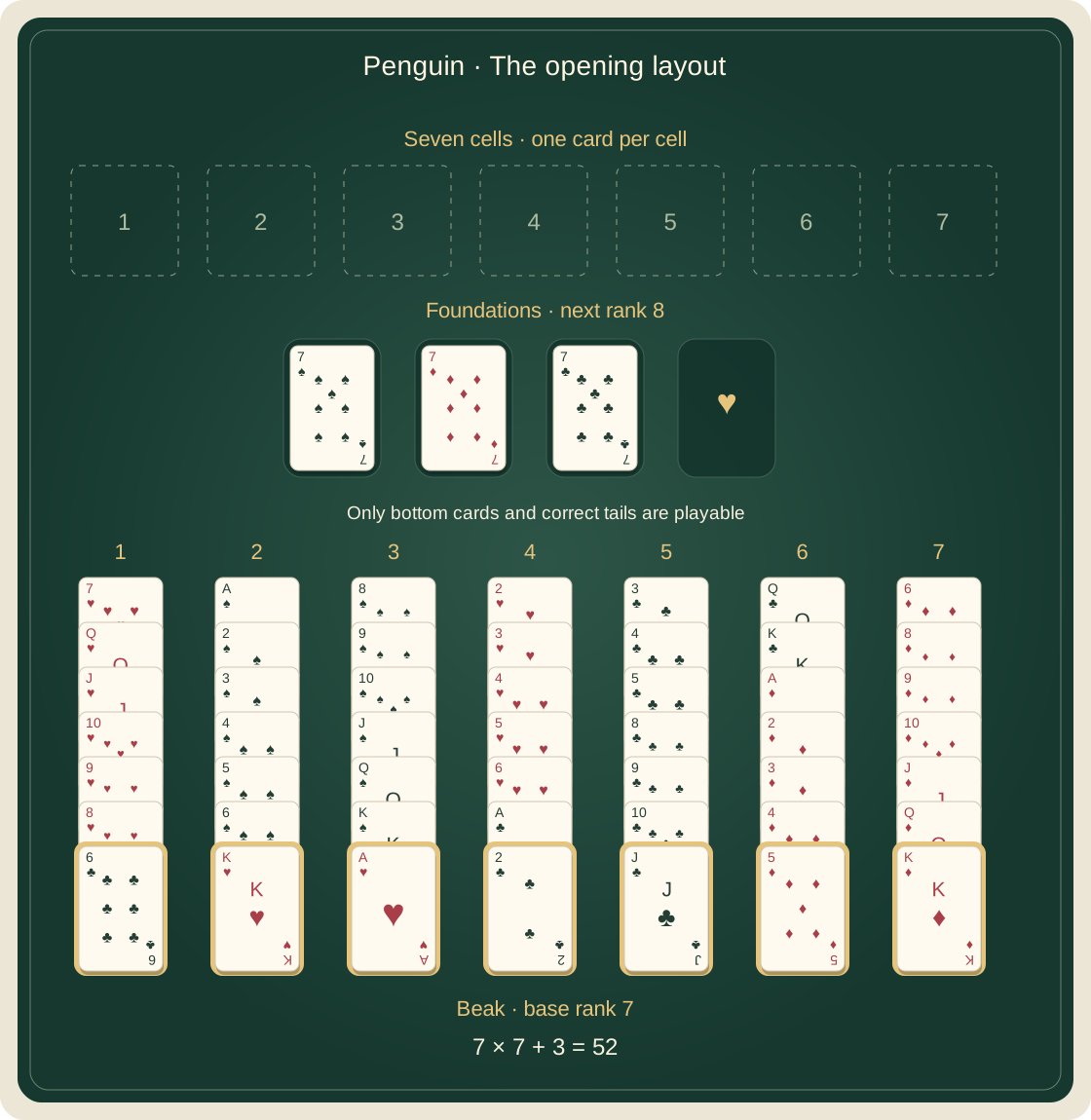
Shuffle an ordinary pack without jokers. Place the first card at the top of the first tableau column: this is the beak. Deal face up across 7 columns, skipping the other 3 cards of the beak’s rank as soon as encountered and putting them directly on their matching foundations. Continue until every column has 7: 49 tableau cards and 3 foundation cards. The beak remains covered by 6 cards. Leave 7 single-card cells empty; the fourth foundation is empty too.
03 /
What happens on your turn
Only the exposed bottom card of a column can move individually. Put it on a foundation if it is the next required card, in an empty cell, or on an exposed card exactly one rank higher in the same suit. A valid descending same-suit tail can move as one unit to a fitting column. Occupied cells hold only 1 card each; their cards may return to a legal column or go to a foundation. A random group containing a break in suit or rank is not a movable run.
04 /
Empty columns and sequence moves
An empty column accepts only a card one rank below the beak, or a legal descending run headed by that rank. Base 7 therefore requires a 6; a king cannot open it. If the beak is an ace, the permitted empty-column rank is king. Moving a valid sequence does not consume empty-cell capacity: the original rule permits the unit move directly. Use the cells for loose blocking cards instead.
05 /
When the round and match end
No points, timed bonus or compulsory foundation move are needed for the basic game. Win by completing every suit; lose a chosen attempt when no useful legal move remains and the foundations are incomplete. Undo is a study aid if agreed, not a new source of cards. Before filling all cells, plan which card will reopen a cell or column. Clearing space without an eligible column starter can leave that space unusable.
06 /
A complete worked example
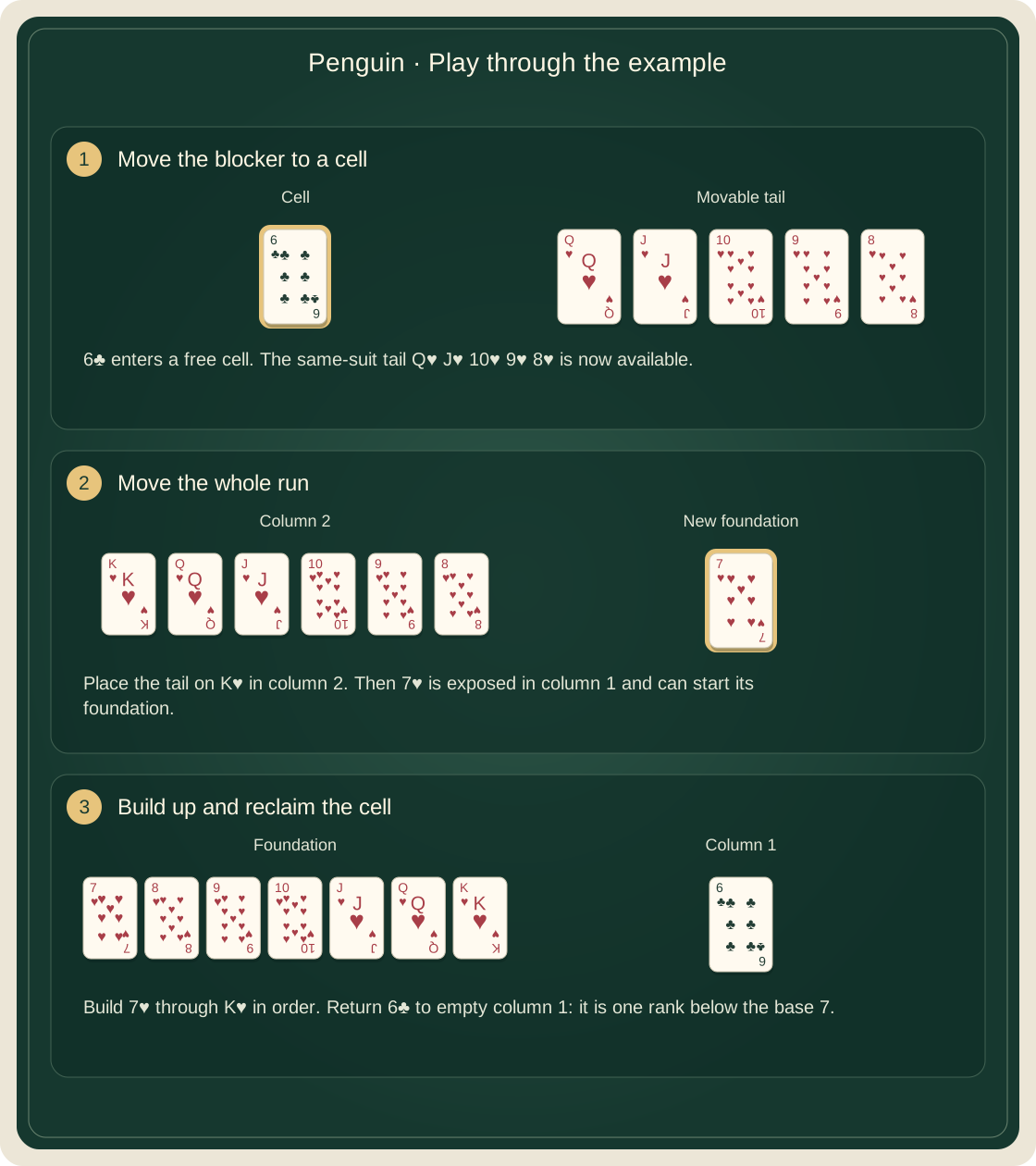
Our initial first column, top to exposed bottom: 7♥ Q♥ J♥ 10♥ 9♥ 8♥ 6♣. Column 2 ends in K♥; the other foundations already hold 7♠ 7♦ 7♣. Move 6♣ into an empty cell. The tail Q♥ J♥ 10♥ 9♥ 8♥ is now exposed and moves as a unit onto K♥ in column 2. This frees 7♥: start the fourth foundation. Transfer 8♥, 9♥, 10♥, J♥, Q♥ and K♥ there in that order. Column 1 is empty; return 6♣ from the cell to it. The cell is free again.
← On a small screen, scroll the diagram horizontally. →
07 /
Check the resulting position
The lesson ends with 10 cards in foundations, 42 in columns and no occupied cells: 10 + 42 = 52. This is an improved opening, not a claimed solution of the entire deal. From the heart king the next foundation card is A♥, then 2♥; 6♥ will finish it. Do not send 6♣ to a foundation still showing 7♣: that foundation next needs 8♣.
08 /
Check your understanding
Base 7: may a king start an empty column?
Reveal the answer
No, only a 6 or a legal run headed by a 6.
Do full cells forbid a legal whole-run move?
Reveal the answer
No. This original Penguin rule has no FreeCell capacity limit.
09 /
History and other versions
David Parlett devised Penguin while working on his book of patience games. The beak and flipper names give the layout its penguin theme. Its exposed information resembles FreeCell, but suit-building, movable whole runs and restricted empty columns create a different puzzle. Do not apply an app’s move counter or automatic rules to another edition without checking. Published win-rate estimates are not a guarantee for a random deal.
10 /
Mistakes to avoid
Extract the other base-rank cards during dealing, not when they later become exposed. Do not alternate colours: columns build in the same suit. A visible but covered card is not available. Do not call every new empty space a free cell: columns have a starting-rank restriction, whereas the seven cells accept any single available card.
Common questions
Is there a stock to draw from?+
No. Every card is already in the tableau or on a foundation.
What follows a foundation king?+
The ace of that suit, unless the foundation has already completed its whole cycle.
Must foundations start with aces?+
No. Their starting rank is the beak’s rank.