← On a small screen, scroll the diagram horizontally. →
01 /
Cards, seats and the deal
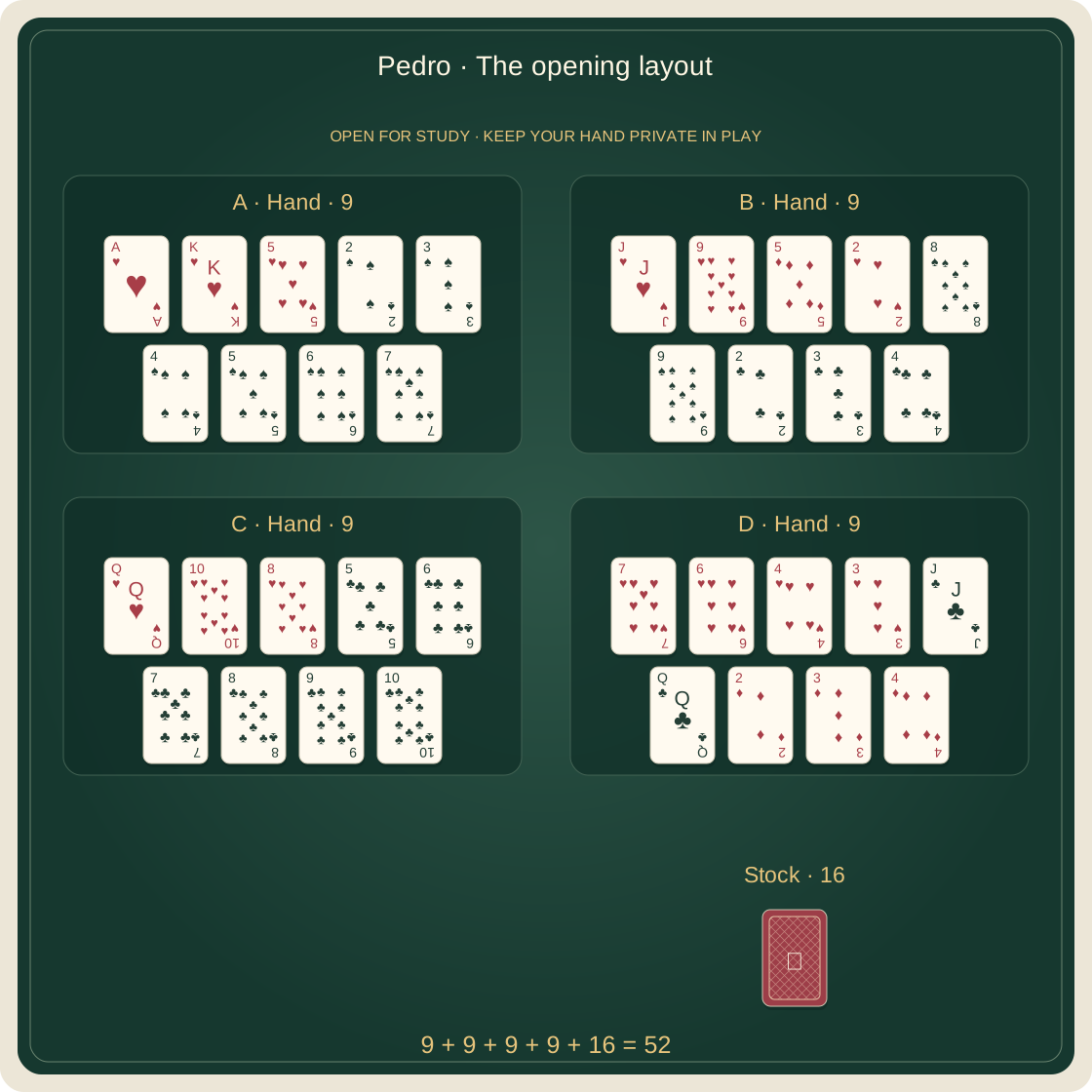
Use 52 cards without jokers. Partners A–C oppose B–D. Dealer gives clockwise in packets of 3 until everyone has 9; 16 remain undealt. Starting left of dealer, each player bids once: pass or a higher bid from 7 to 14. If the first three pass, dealer must bid 7. Highest bidder names trumps. All cards outside the effective trump suit are then discarded face down, not retained as optional fillers.
02 /
Trump order and the left Pedro
The trump five is the right Pedro. The five of the other suit of the same colour is the left Pedro and belongs to trumps throughout. With hearts: A♥ K♥ Q♥ J♥ 10♥ 9♥ 8♥ 7♥ 6♥ 5♥ 5♦ 4♥ 3♥ 2♥. Thus 5♦ must follow hearts and does not follow diamonds. Plain suits otherwise rank A K Q J 10 9 8 7 6 5 4 3 2, with the transferred five absent.
03 /
Replacement and excess trumps
Dealer refills the other three hands from the undealt stock, clockwise, to 6 each; someone already holding more trumps keeps them all. Dealer then examines the remaining stock and takes every remaining trump plus enough plain cards to reach 6. Set aside unused cards. A hand over 6 must shed its extras in the first trick as a face-up stack leaving 5 in hand: only the top card competes, and no scoring trump may be buried. No later drawing occurs.
04 /
What happens on your turn
Bidder leads any card. If a trump is led, follow effective trump when possible. If a plain suit is led, you may follow that suit OR play a trump, even while holding the led suit. Only when you can do neither may you discard any card. There is no obligation to overtrump. Highest trump wins, otherwise highest card in the led suit; winner leads again. Play exactly 6 tricks. Partners combine points, not trick counts.
05 /
Scoring and settlement
There are 14 points: trump A, J, 10 and 2 give 1 each; each Pedro gives 5. Capturers score all except the 2: that point belongs to the team originally receiving it, even if opponents capture it. A successful bidder adds actual points earned; a failed bidder subtracts the bid and adds none of the captured points. Defenders always add their own earned points. Negative totals are allowed.
06 /
When the round and match end
Normally aim for 62. If both teams begin a deal on at least 55, use bidder-goes-out: a made bid wins the match regardless of the defenders’ higher total. A failed bid can let defenders win through normal scoring. If both cross 62 together outside that condition, play an extra deciding deal under bidder-goes-out. Record this agreement before play; regional target and ending rules vary.
07 /
A complete worked example
Player A
A♥ K♥ 5♥ A♠ K♠ Q♠
Player B
J♥ 9♥ 5♦ 2♥ A♣ K♣
Player C
Q♥ 10♥ 8♥ A♦ K♦ Q♦
Player D
7♥ 6♥ 4♥ 3♥ J♠ 10♠
Dealer D; A bids 10, the others pass, hearts are trump. The diagram above shows the initial 9-card hands. All 14 effective trumps happen to be in those hands. Everyone discards plain cards; A draws 3, B 2, C 3, D 2 from the stock, leaving 6 unused. The hands printed here are after replacement. Every row below is a whole trick; columns stay A B C D even when B leads.
| Lead | Player A | Player B | Player C | Player D | Winner |
|---|---|---|---|---|---|
| A | A♥ | 2♥ | Q♥ | 3♥ | A |
| A | K♥ | 5♦ | 8♥ | 4♥ | A |
| A | 5♥ | J♥ | 10♥ | 6♥ | B |
| B | A♠ | 9♥ | A♦ | 7♥ | B |
| B | K♠ | A♣ | K♦ | J♠ | B |
| B | Q♠ | K♣ | Q♦ | 10♠ | B |
← On a small screen, scroll the diagram horizontally. →
08 /
The contract result
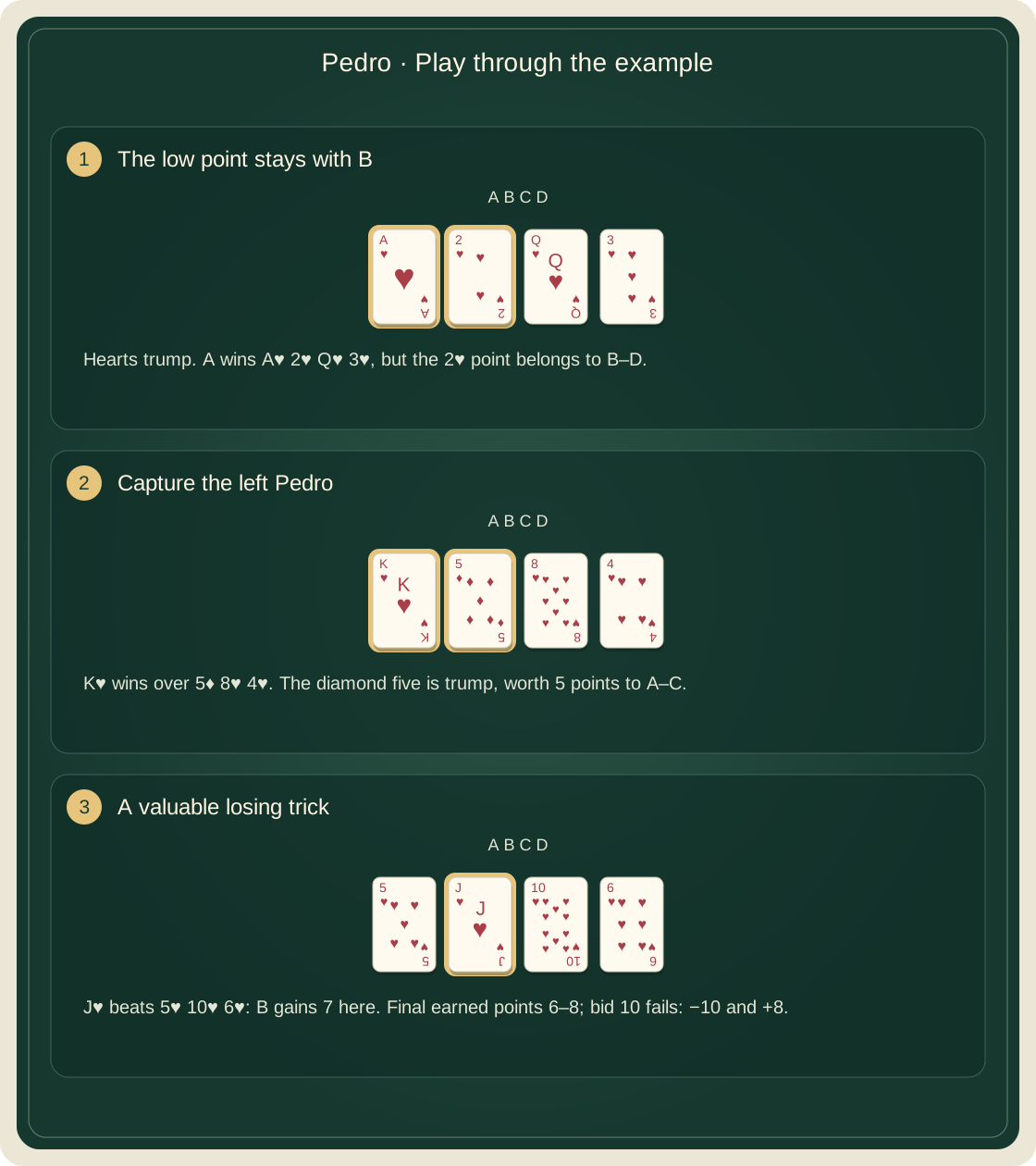
A captures the ace point and left Pedro: 1 + 5 = 6. The captured 2♥ still scores 1 for B–D. B’s trick with J♥ 10♥ 5♥ gives 1 + 1 + 5 = 7, hence defenders earn 8 overall. Check 6 + 8 = 14. A–C miss their bid of 10, recording −10; B–D record +8. Winning the first two tricks did not guarantee the contract.
09 /
Check your understanding
Hearts trump: does 5♦ follow diamonds?
Reveal the answer
No. It is a heart for every trick rule.
May you trump a plain lead while holding its suit?
Reveal the answer
Yes in this Double Pedro profile. On a trump lead, however, you must follow trump if able.
10 /
History and other versions
Pedro grew within the American All Fours and Pitch family. Double Pedro is named for its two valuable fives, while Cinch and High Five identify overlapping traditions. This guide does not present all regional versions as interchangeable. Some groups double the award for a successful 14, change replacement privileges or keep low points by different rules. Agree on those changes before dealing, not after seeing who captured the two.
11 /
Mistakes to avoid
Keep captured-card points separate from the score actually entered for a failed contract. Count the two for its original team, and check whether a five has transferred suit before following. Never discard a trump during replacement or bury a scoring trump under an excess-card stack. A dealer’s stock search is a special privilege, not an option available to every player.
Common questions
Is Pedro played with a special pack?+
Use one ordinary 52-card pack without jokers. No special or proprietary cards are required.
Is the left five higher than the right?+
No. The right five beats the left; both beat the trump four.
Do six tricks mean six points?+
No. The scoring cards distribute 14 points; a trick without them gives none.