← On a small screen, scroll the diagram horizontally. →
01 /
Your first round
Play equal or higher cards to a shared pile, subject to special restrictions. Refill to 5 while stock remains; you cannot go out while a refill is possible. When stock is gone, empty hands leave the game. Everyone else keeps playing until only one player holds cards: that player loses. Suits never affect legality.
02 /
Cards, seats and the deal
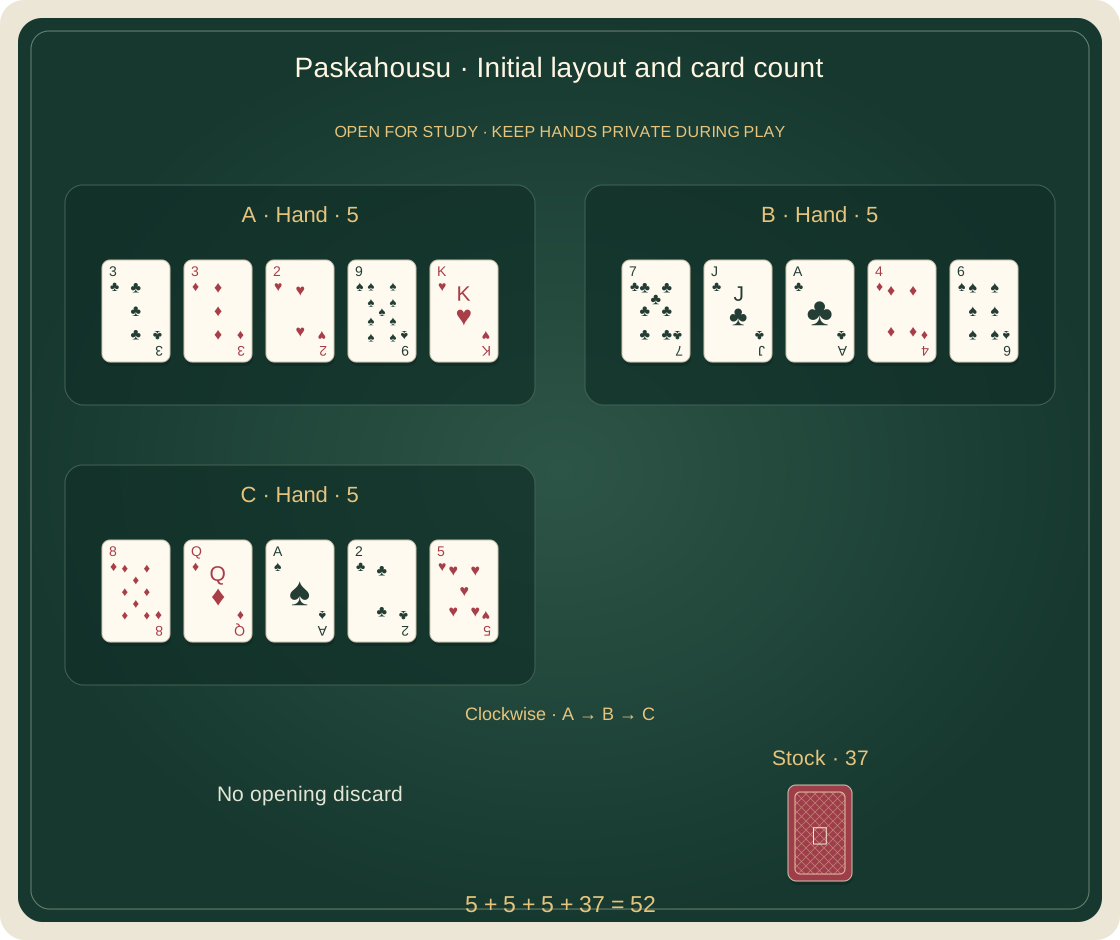
Shuffle 52 cards without jokers. Deal clockwise in packets 2 + 2 + 1 to give 5 each. Stock is the rest; the play pile starts empty. At three players 15 + 37 = 52. Do not deal face-up or face-down personal rows. Highest rank is 2, then A, K, Q, J, 10 down to 3, but special play restrictions override that simple order.
03 /
Who starts and what they must play
The holder of the most threes starts. Resolve a tie by the first such player clockwise from dealer’s left. If no one holds a three, test fours, then fives and onward in ascending ordinary rank order, with twos last. Start by playing the card or equal-rank set that won this selection. Later turns are clockwise, skipping players who have already left.
04 /
Legal cards and the important exceptions
Play one card or several of exactly one rank from your hand; that rank must be legal on the current top. The table includes the empty-pile exception: even a court, ace or ten may open an empty pile. On a standing ten only tens fit, on a standing ace only aces fit. A two does not permit the next person to play a low card.
| Card or position | Rule |
|---|---|
| Empty pile | Any rank or equal-rank set |
| 3–9 | Equal or higher, with the restrictions below |
| J / Q / K | Only on a card above 6; never on a locked 10, A or 2 |
| A | Only on J/Q/K or A; on a court it clears |
| 2 | On anything except 10 or A; only another 2 may follow |
| 10 | Clears on a lower card, but does not clear an empty pile |
05 /
What happens on your turn
Instead of playing from hand, you may pick up the non-empty pile even with a legal card; then the next player opens the empty table. While stock exists you may instead try its single top card. Play it if legal; if not, keep it and pick up the entire pile, ending your turn. Do not draw repeatedly searching for a playable card. On an empty table choose a legal opening or a stock trial, not a pass by picking up nothing.
06 /
Three ways to clear, with limits
Clear and remove the pile permanently when a ten lands on a lower rank, an ace lands on a court, or four equal ranks become consecutive on top. The last case may be built across several turns; it is not restricted to four played together. Refill to 5, then the same player opens a new pile. A ten or ace opened onto empty does not clear itself; later equal cards do not clear merely for being special.
07 /
Refilling without recycling cleared cards
After a successful hand play, draw enough to reach 5, or all remaining stock if fewer. With 5 or more cards, draw no refill. A legal stock trial with fewer than 5 held is followed by the same refill; an unsuccessful trial already ends by pickup. Cleared cards never refill stock. Once stock empties, no more replenishment: hand size finally shrinks towards an exit.
08 /
When the round and match end
After stock is empty, remove a player whose hand empties. If their last card cleared the pile, the next remaining player opens; otherwise that player answers the standing pile. Keep skipping exited seats until just one person has cards. No points or fixed winning target are needed. For a separate endgame example, a last ten on a nine clears and permits its owner to leave; the next remaining player leads, not the departed one.
09 /
A complete worked example
Three players sit clockwise A–B–C, C deals. A has two threes and therefore starts with both. The ordered stock replacements in the table are fixed for this lesson, not choices made after seeing the pile. All hands below are initially private; they are opened here for study.
Player A
3♣ 3♦ 2♥ 9♠ K♥
Player B
7♣ J♣ A♣ 4♦ 6♠
Player C
8♦ Q♦ A♠ 2♣ 5♥
| Step | Player | Action | Refill |
|---|---|---|---|
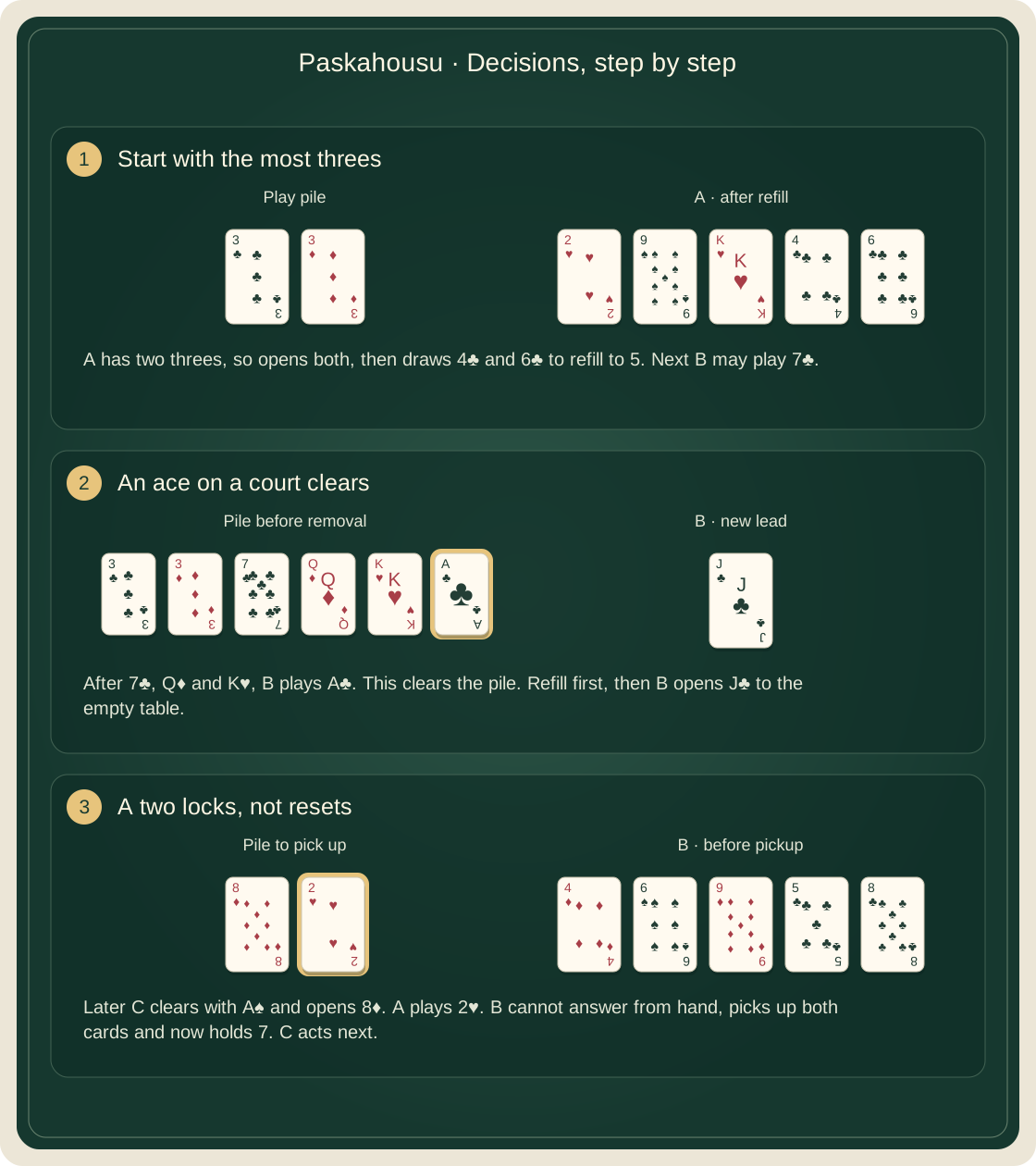
| 1 | A | 3♣ 3♦ | 4♣ 6♣ |
| 2 | B | 7♣ | 9♦ |
| 3 | C | Q♦ | 10♦ |
| 4 | A | K♥ | 7♦ |
| 5 | B | A♣ · Clear; same player again | 5♣ |
| 6 | B | J♣ | 8♣ |
| 7 | C | A♠ · Clear; same player again | Q♠ |
| 8 | C | 8♦ | K♠ |
| 9 | A | 2♥ | A♦ |
| 10 | B | Pick up 8♦ and 2♥ | — |
Q♦ is legal on 7♣, and K♥ on Q♦; both courts meet the above-six rule. A♣ clears K♥, so B refills and opens J♣. A♠ clears that court, so C refills and opens 8♦. A’s 2♥ then locks the pile. B has no two and chooses to pick up both cards, ending the turn; C acts next. Final counts A 5, B 7, C 5; stock 27 and removed cards 8. Thus 5 + 7 + 5 + 27 + 8 = 52. This is an opening sequence, not an endgame: nobody can leave while refills remain.
← On a small screen, scroll the diagram horizontally. →
10 /
Check your understanding
You open a ten onto an empty table. Does it clear?
Reveal the answer
No. It stays and only another ten can be played on it, unless the pile is picked up. Four equal tens would clear by the separate four-card rule.
A two is on top. Can an ace or ten beat it?
Reveal the answer
No. Only a two fits. You may pick up or, while stock exists, try its single top card under the normal trial rule.
11 /
History and other versions
This is a Finnish shedding tradition whose name is a coarse nickname for the final loser. The exact invention date and a sole inventor are not established by the player accounts consulted. Pöytäpaska adds personal table-card stages; Valepaska adds concealed play and bluff challenges. Those related forms explain why online accounts sometimes disagree, but neither should silently replace the base game here.
12 /
A reminder for the table
Find the correct starter, open with that rank and check restrictions before comparing height. Choose a hand play, a single stock trial or a whole-pile pickup. Resolve clear, refill and only then the next turn. Keep removed cards separate. With no stock, skip empty hands and continue to the last loser.
Common questions
Does the first player out end the deal?+
No. After stock empties, remove empty hands and continue. The last person with cards is the loser.
Must four equal cards be played together to clear?+
No. They may accumulate on consecutive turns as long as four equal ranks are consecutive at the top.
Can a court be led to an empty pile?+
Yes. The above-six restriction applies to a non-empty pile. Empty-pile openings allow any rank.