← On a small screen, scroll the diagram horizontally. →
01 /
Your first round
Four players bid individually. The winner takes the table card, discards one and plays the named contract, sometimes with a called partner. There are 8 tricks. Points in captured cards and announcements determine a number contract; trick objectives determine the others. These hand points are separate from the small positive or negative contract score recorded for the match.
02 /
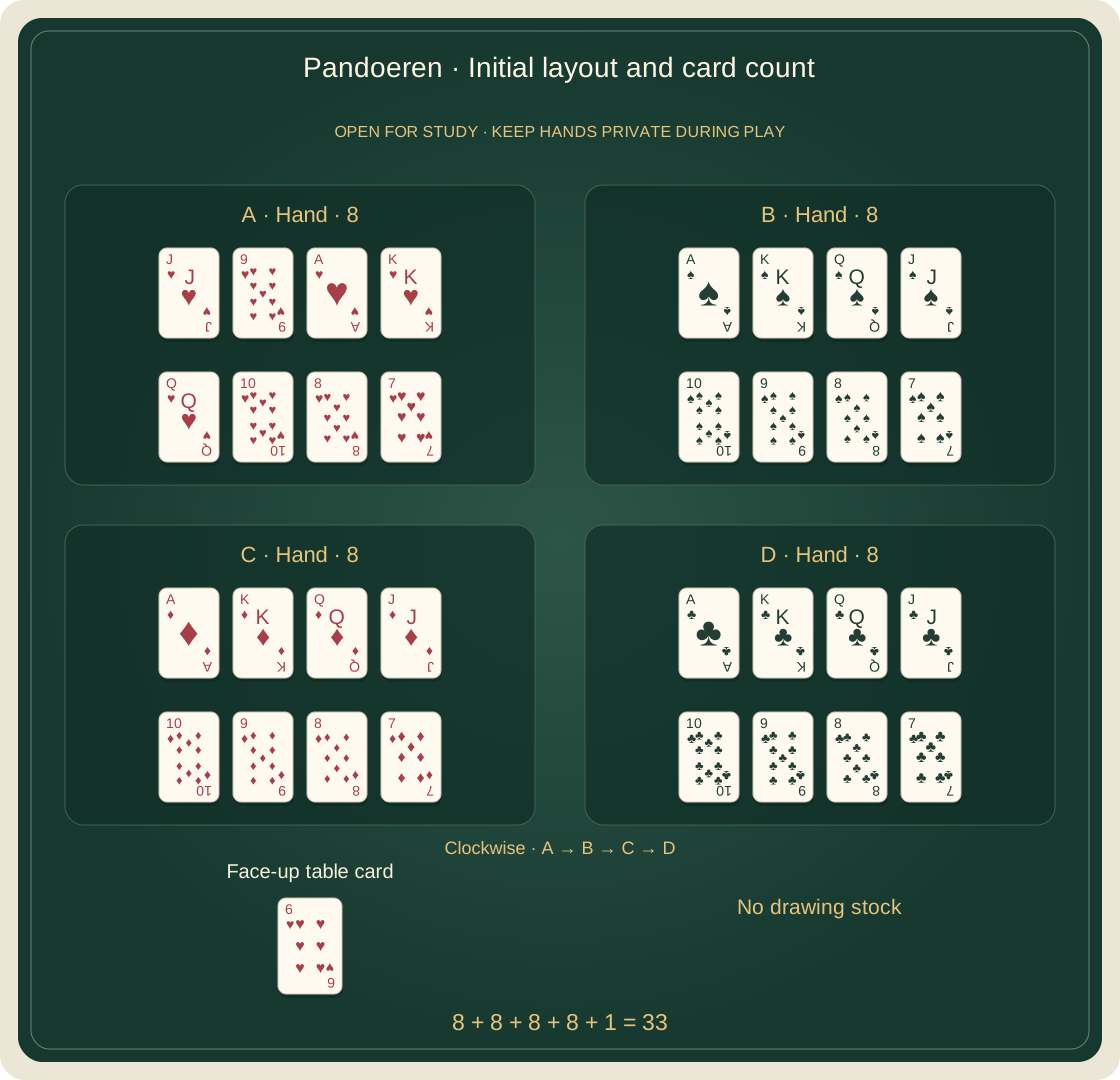
Cards, seats and the deal
Keep A, K, Q, J, 10, 9, 8, 7 of every suit and add only 6♥: 33 cards. Deal clockwise from dealer’s left: 4 each, 1 face up to the table, then 4 each. Each hand has 8; 32 + 1 = 33. There is no stock to draw from during play. First dealer is agreed; later deals rotate left, including an all-pass deal.
03 /
Auction, pickup and discard
Dealer’s left opens. A bid must exceed the current contract in the ordered table; within a number band, the higher number wins. The table is an auction order, not a sort by reward. After a bid, continue until 3 consecutive passes; the last bidder declares. A pass does not permanently remove you while bidding continues. All 4 passing initially means no score and a new deal. Declarer takes the exposed card, discards any 1 face down, then names trumps and a partner where applicable; the discard’s points never count.
04 /
Complete contract ladder
Lowest bids appear first. Numeric contracts and Pandoer call an ace; Kereltje calls trump J. With every ace held, or three held and the fourth discarded, call a king instead of an ace. Choose a called card outside your retained hand. Its holder is your partner, revealed by gathering your side’s tricks or playing the card. Ordinary contracts forbid table talk about hidden cards.
| Contract | Reward | Partner | Trumps | Objective |
|---|---|---|---|---|
| 120 / 130 / 140 | 1 | Yes | Yes | At least the bid points |
| Piccolo | 3 | No | Yes | Declarer wins first trick only |
| Misère | 3 | No | Yes | Declarer wins no trick |
| 150 / 160 | 2 | Yes | Yes | At least the bid points |
| Kereltje | 2 | Yes | Yes | Call trump J; team wins all tricks |
| Zwabber | 2 | Yes | No | Declarer first 4, team all 8 |
| 170 / 180 / 190 | 3 | Yes | Yes | At least the bid points |
| Solo-zwabber | 5 | No | No | Declarer wins all tricks |
| Piccolo Ouvert | 6 | No | Yes | Piccolo; declarer exposed on own second play |
| 200 / 210 / 220 / … | 4 | Yes | Yes | At least the bid points |
| Misère Ouvert | 6 | No | Yes | Misère; declarer exposed on own second play |
| Stil Praatje | 9 | No | Yes | No tricks; all exposed at first lead, no discussion |
| Pandoer | 5 | Yes | Yes | Call ace; team wins all tricks |
| Pandoer + 20 / 40 / … | 5 | Yes | Yes | All tricks plus stated roem/stuk |
| Praatje | 9 | No | Yes | No tricks; expose all after first lead, defenders may discuss |
| Privé | 10 | No | Yes | Declarer wins all tricks |
05 /
Rank order is not point value
For tricks, plain suits rank A–K–Q–J–10–9–8–7; add 6 at the bottom of hearts. Trumps rank J–9–A–K–Q–10–8–7, then 6 if hearts. This is not the A–10 order of many related games. Plain values are A 11, K 3, Q 2, J 1, 10 10, others 0. Trump J is 20 and trump 9 is 14; other values stay. The last trick adds 5. Pack plus last trick totals 146 before removing any point-valued discard.
06 /
What happens on your turn
Declarer leads first; later the trick winner leads. Without trumps, follow suit if possible, otherwise any card. With trumps, you may play trump even while holding the led plain suit. If you neither follow nor trump, you must be void in the led suit. After a plain-suit lead has been trumped, do not undertrump if any alternative exists; you may follow suit, overtrump or discard another suit if void. If trump itself was led, overtrumping is not required. Trump J, the jas, may always be retained as though absent, except when it is your last card.
07 /
Roem: held runs and four of a kind
Roem are held combinations, not cards gathered in tricks. Runs use A–K–Q–J–10–9–8–7–6 even in trumps. Four queens, kings or aces score 100; four jacks 200. Among equal-length runs compare their highest card, then suit: ♠, ♥, ♦, ♣. Overall strength order is run 3, run 4, run 5, four Q, four K, four A, run 6, run 7, run 8, four J. Our table scores disjoint combinations only, never a shorter run inside a longer one.
| Length | Points |
|---|---|
| 3 | 20 |
| 4 | 50 |
| 5 | 100 |
| 6 | 120 |
| 7 | 140 |
| 8 | 160 |
08 /
Announce, challenge and count stuk
In point contracts declarer announces total roem immediately after leading the first card. Only an opponent who actually bid may challenge, by asking for the highest single combination and showing a stronger one; a player who always passed cannot deny it. Partner announces when identified. A partner’s superior unchallenged combination can restore both partners’ roem after an earlier denial. Separately, a team holder of K and Q of trumps may announce stuk for 20 before the second is played; it cannot be denied and may overlap a roem run.
09 /
Scoring and settlement
A number contract succeeds when the team reaches the bid in captured points, valid roem and stuk combined; the discarded card is excluded. Other contracts must meet their exact trick condition. Each member of a successful partnership adds the table reward to their own match score; on failure each subtracts it. Solo contracts change only declarer’s score. Opponents record 0 for that contract, not balancing transfers. Do not enter the much larger hand-point total as the match reward.
10 /
When the round and match end
Complete all tricks needed to verify a contract and record success or failure once. Our teaching session lasts 12 deals, including all-pass deals, so each player deals equally often. Highest final match score wins; equal scores share the place. This session length is an agreement, not an intrinsic target of Pandoeren. Regional games may change contracts, meld comparison and values; use one whole profile rather than mixing a modern score table with these older ranks.
11 /
A complete worked example
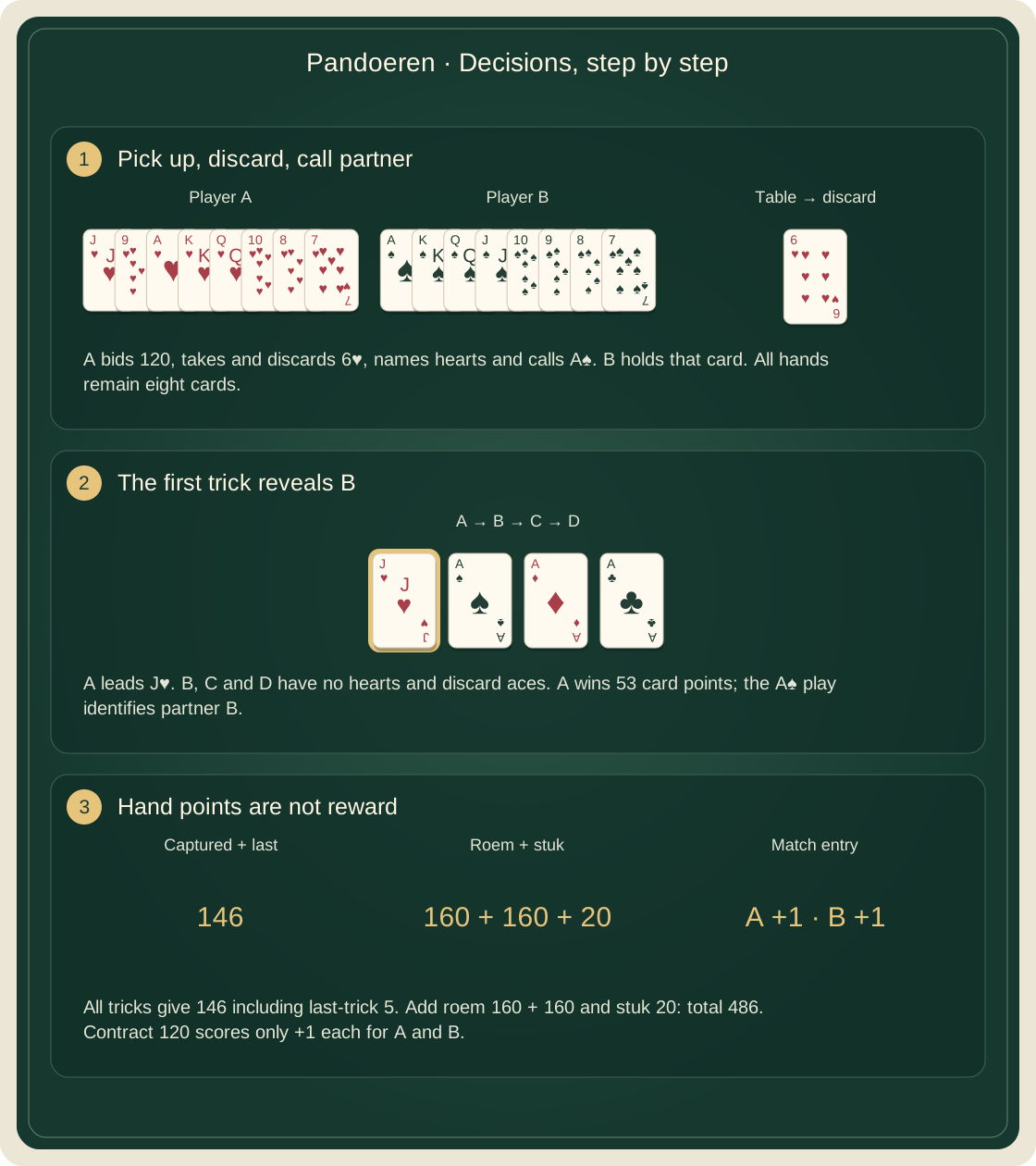
This deliberately constructed four-suit deal makes the accounting easy to audit; it is not a typical random hand or a recommended maximum bid. A bids 120, all others pass. A takes 6♥ and discards that same zero-point card, names hearts and calls A♠. B is partner. Announce A’s eight-card run for 160 after the first lead; B announces the spade run for 160 when A♠ identifies the partnership. A announces stuk before Q♥ is played.
Player A
J♥ 9♥ A♥ K♥ Q♥ 10♥ 8♥ 7♥
Player B
A♠ K♠ Q♠ J♠ 10♠ 9♠ 8♠ 7♠
Player C
A♦ K♦ Q♦ J♦ 10♦ 9♦ 8♦ 7♦
Player D
A♣ K♣ Q♣ J♣ 10♣ 9♣ 8♣ 7♣
| Step | Leader | Player A | Player B | Player C | Player D | Winner |
|---|---|---|---|---|---|---|
| 1 | A | J♥ | A♠ | A♦ | A♣ | A |
| 2 | A | 9♥ | K♠ | K♦ | K♣ | A |
| 3 | A | A♥ | Q♠ | Q♦ | Q♣ | A |
| 4 | A | K♥ | J♠ | J♦ | J♣ | A |
| 5 | A | Q♥ | 10♠ | 10♦ | 10♣ | A |
| 6 | A | 10♥ | 9♠ | 9♦ | 9♣ | A |
| 7 | A | 8♥ | 8♠ | 8♦ | 8♣ | A |
| 8 | A | 7♥ | 7♠ | 7♦ | 7♣ | A |
A wins every trick with the only remaining trumps; the jas need not be led first, but doing so is legal. Opponents cannot deny roem after always passing. Captured cards total 141, last trick adds 5, so 146. Add A’s 160, B’s 160 and stuk 20: 146 + 160 + 160 + 20 = 486. The 120 contract succeeds. Match entries are only A +1, B +1, C 0, D 0. A different contract such as Zwabber would also require A personally to win the first 4; a partner’s early win would not satisfy that condition.
← On a small screen, scroll the diagram horizontally. →
12 /
Check your understanding
Hearts trump, K♠ led; you hold 7♠ and Q♥. May you play Q♥?
Reveal the answer
Yes. This profile permits trumping even while holding the led plain suit. Do not import Ombre’s ordinary follow-suit restriction.
Piccolo: declarer loses the first, wins only the second. Success?
Reveal the answer
No. Here Piccolo requires the first trick specifically and no others. Exactly one arbitrary trick is a different, easier variant.
13 /
History and other versions
Pandoeren belongs to the Dutch Jass-related contract tradition. The older description used here and accounts from West Friesland and Amsterdam do not share one universal contract list. The available evidence does not justify naming an exact inventor or first year. Its distinctive features are the extra heart six, flexible trumping and contracts where the first tricks matter separately from the final team total.
14 /
A reminder for the table
Use the exact short pack; keep the table card in the deal. Finish the auction before picking up and discarding. Name trumps, call the correct partner and let declarer lead. Announce roem at its proper time and stuk before its second card leaves. Check the exact contract, then record only its small reward.
Common questions
Is the table card left untouched?+
No. The declarer picks it up and discards one card before naming trumps and the partner. That discarded card never scores.
Can someone who always passed deny roem?+
No in this older profile. An opponent must have made an actual bid to challenge. Stuk cannot be denied at all.
Are captured points paid directly as match points?+
No. They test the number contract. Match entries use only the contract reward, added or subtracted for each involved player.