← On a small screen, scroll the diagram horizontally. →
01 /
Your first round
Move all 52 cards onto four foundations, one suit per row, with 13 in each. There is no ascending or descending rank sequence. The top row accepts any exposed card of its own suit. Each lower row accepts a rank only after that rank is already in the row directly above.
02 /
Cards, seats and the deal
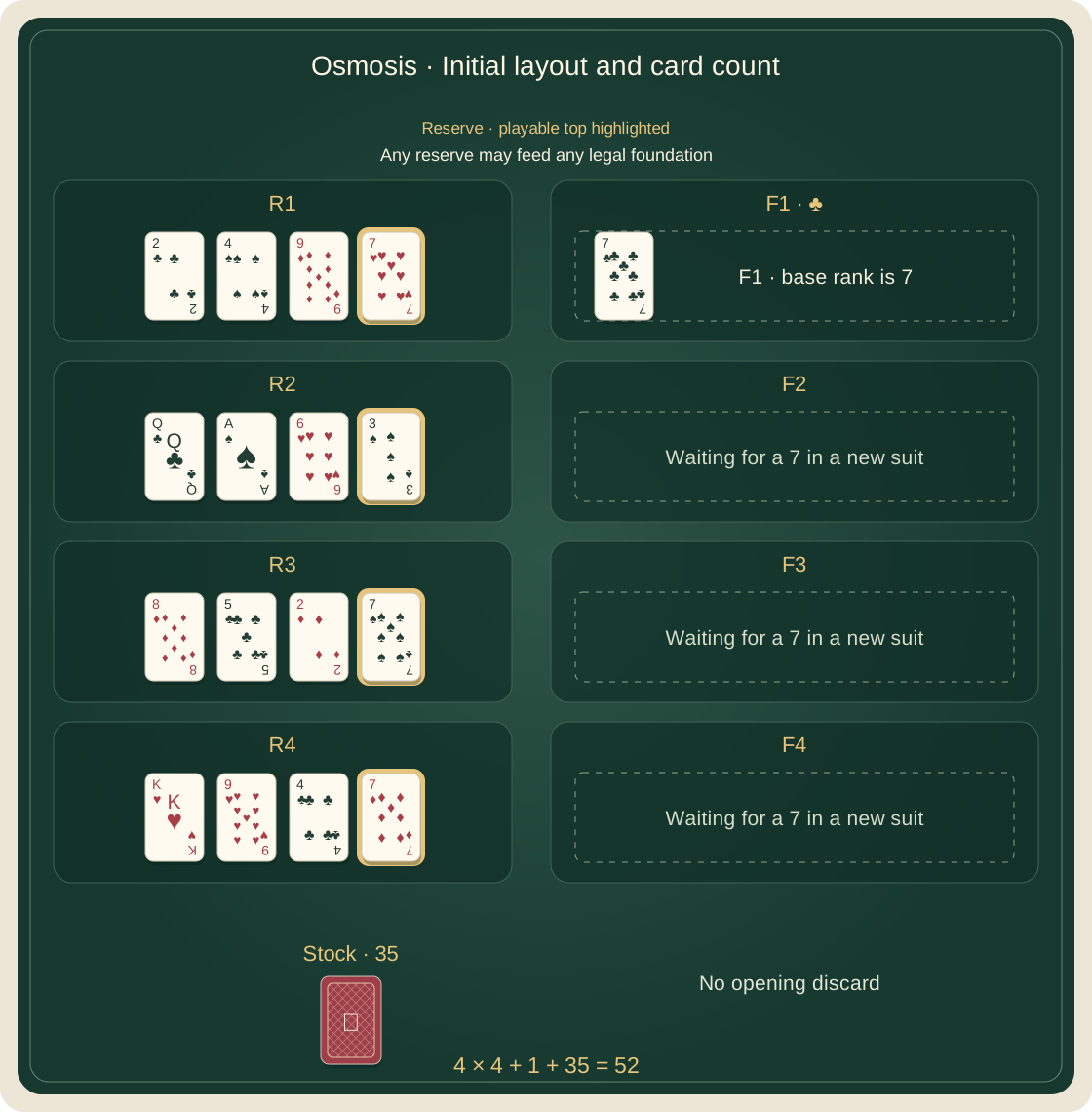
Shuffle one ordinary pack without jokers. Deal four reserves of 4 cards, with only the top card of each face up. Place the next card as the first foundation; it fixes both that row’s suit and the base rank for all rows. Leave space for three lower rows. The remaining 35 form stock; waste starts empty: 16 + 1 + 35 = 52.
03 /
How ranks filter down the foundations
Open the next empty row with an accessible card of the base rank in an unused suit; all higher rows must already be open. That suit then belongs to the row permanently. Later ranks need only match the row’s suit and exist immediately above. Because the same restriction applies above in turn, the rank necessarily exists in every higher row. Never require adjacency in rank or alternate colours.
04 /
What happens on your turn
Play only a reserve top or the waste top to a legal foundation. Remove one card at a time; expose the next reserve card as soon as it becomes top. Empty reserves remain empty. No transfer between reserves, no filling empty spaces, no packet movement and no return from a foundation. Keep foundation ranks readable by spreading cards instead of hiding the permissions under a stack.
05 /
Draw three and recycle without shuffling
Turn up to 3 stock cards onto waste in their original order; the last turned is on top and is the only immediately available one. If it moves, the card below becomes available. With fewer than 3 left, turn all that remain. You may deal another packet without playing. When stock empties, turn the entire waste over without shuffling to restore stock. Repeat as often as needed; removing cards may change later packet boundaries.
06 /
When the round and match end
Win when every row has all 13 cards of its suit. A partial suit is not a win, even if every reserve is empty. Stop as blocked when a complete stock cycle with no move returns exactly the same reserves, foundations and stock order: repeating that state cannot help. For a personal record count cards already on foundations out of 52, but this is a progress measure, not a traditional competitive score.
07 /
A complete worked example
The first foundation is 7♣. F1–F4 mean foundations from top to bottom; R1–R4 are reserves. The reserve lists below run from bottom to top, so the rightmost card is initially playable. Buried cards are shown only to explain this fixed deal.
R1
2♣ 4♠ 9♦ 7♥
R2
Q♣ A♠ 6♥ 3♠
R3
8♦ 5♣ 2♦ 7♠
R4
K♥ 9♥ 4♣ 7♦
| Step | Source and destination | Card | Why |
|---|---|---|---|
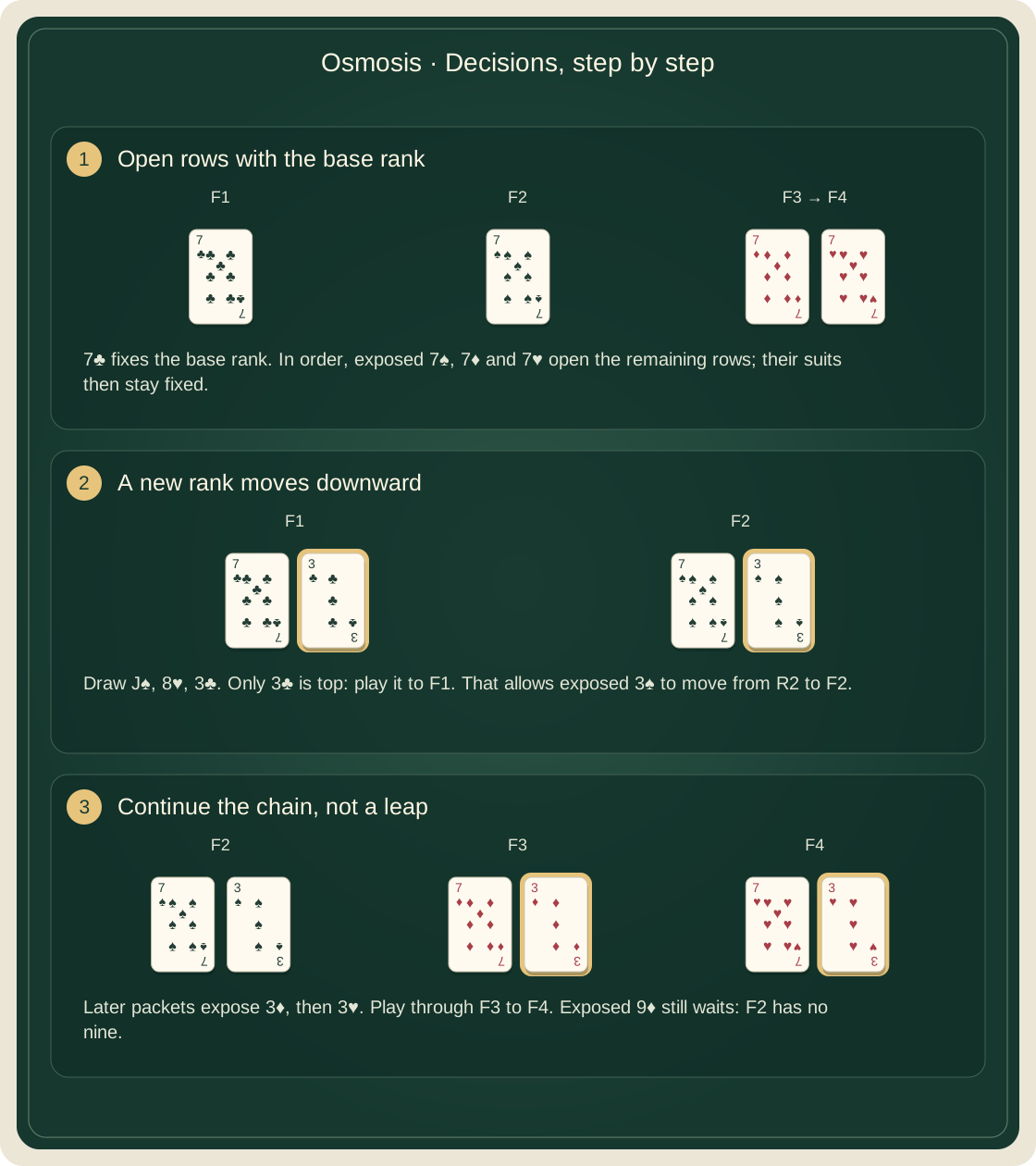
| 1 | R3 → F2 | 7♠ | Opens spades; reveals 2♦ |
| 2 | R4 → F3 | 7♦ | Opens diamonds; reveals 4♣ |
| 3 | R1 → F4 | 7♥ | Opens hearts; reveals 9♦ |
| 4 | JS · 8H · 3C | 3♣ | Draw packet; only last card can enter F1 |
| 5 | R2 → F2 | 3♠ | Allowed by 3♣ above; reveals 6♥ |
| 6 | JD · TS · 3D | 3♦ | Last card enters F3 because F2 has 3♠ |
| 7 | 6C · QH · 3H | 3♥ | Last card enters F4 because F3 has 3♦ |
F1 now contains 7♣ and 3♣; the lower rows contain their sevens and threes too. Yet the exposed 9♦ still cannot enter F3: F2 has no nine. The waste’s 8♥ is covered by later cards; visibility does not make it playable. After these moves, 8 foundation cards + 12 reserve cards + 6 waste cards + 26 stock cards = 52. This is a legal opening, not a claimed complete solution.
← On a small screen, scroll the diagram horizontally. →
08 /
Check your understanding
F1 has a nine, F2 does not. May 9♦ go to F3?
Reveal the answer
No. F3 needs the rank immediately above, in F2. A rank in F1 alone is insufficient.
After drawing J♠, 8♥, 3♣, can you take the middle card first?
Reveal the answer
No. Only 3♣ is on top. Once it leaves, 8♥ becomes accessible, but still needs a legal foundation.
09 /
History and other versions
Osmosis is a published patience name, also used as Treasure Trove. Its defining idea is the dependency between suit rows rather than an ordinary rank sequence. The implementation rules consulted do not establish a secure inventor or precise first publication, so no invention date is asserted here. Draw-one editions expose different waste cards and should not be used to judge a draw-three solution.
10 /
Mistakes to avoid
A rank in the first row alone cannot jump straight to the fourth. A visible card buried in waste is not its playable top. Do not refill an empty reserve or reorder foundation suits to bypass a blockage. When a top reserve card leaves, reveal the next immediately; otherwise you may overlook the base card that opens a new row.
11 /
A reminder for the table
Read the base rank, keep row suits fixed and inspect only playable tops. Open rows in order. Advance a rank down through the immediately preceding row. Draw packets in order and flip waste without shuffling. Check the entire repeated state before declaring the layout blocked.
Common questions
Can an empty reserve be filled?+
No. It remains empty; there is no reserve-to-reserve building.
Does every foundation begin with an ace?+
Only if the first foundation was dealt an ace. Its actual base rank opens every later row.
Why not keep redealing a frozen position?+
With no moves and no shuffle, an identical full state exposes exactly the same cards again. A changed state may help; an identical one cannot.